Your Parent Is Probably Paying Medicare Costs That Rhode Island Will Cover
Every month, $202.90 comes out of your parent's Social Security check for the Part B premium. On a fixed income of $1,500 a month, that is over 13% of their disposable income — money that could go to groceries, utilities, or prescriptions. And there is a strong chance Rhode Island will pay that premium for them.
Rhode Island's Medicare Savings Programs cover more people than most families realize. Since February 2026, the state folded its SLMB tier into QMB, which means applicants who previously qualified only for Part B premium help now receive full Medicare cost-sharing protection — including deductibles, coinsurance, and copays. If your parent's gross monthly income is under $2,255 as an individual, there is a program that can help.
The problem is that the process is scattered across DHS field offices, the HealthyRhode web portal, and the Office of Healthy Aging. The forms are dense, the phone queues are long, and most online resources publish federal baseline numbers instead of Rhode Island's actual limits.
The Rhode Island Medicare Cost-Help Navigator
This guide consolidates every layer of Rhode Island's Medicare cost-assistance system — MSP, Extra Help, and RIPAE — into a single, step-by-step workflow. Instead of bouncing between state websites, federal portals, and outdated brochures that still reference the "donut hole," you follow one document from eligibility check through application, approval, and annual renewal.
It is built specifically for the way Rhode Island administers these programs — including the SLMB-to-QMB consolidation, the state's asset limits, the Part A buy-in mechanics, and the RIPAE pharmacy assistance tiers — not the way the federal government describes them in general terms.
What the Guide Covers
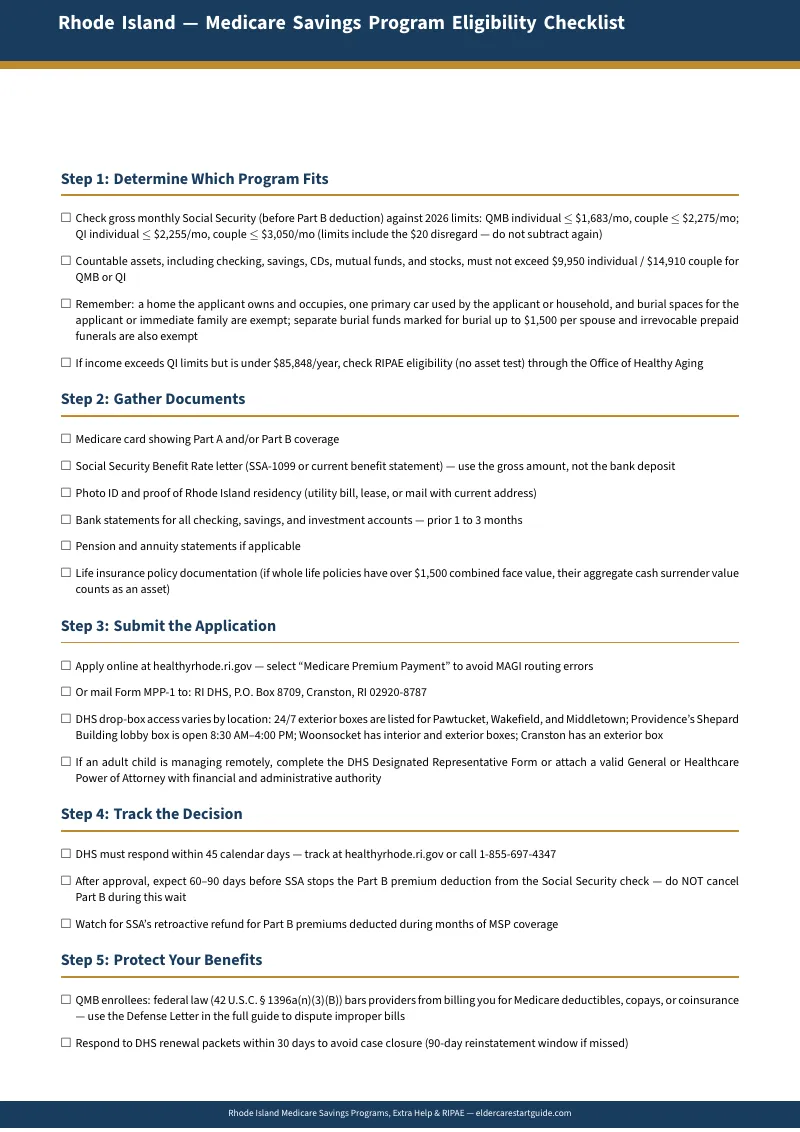
- 2026 income and asset limits with disregards explained — the actual Rhode Island thresholds (QMB up to $1,683/month, QI up to $2,255/month, assets up to $9,950 individual), not the generic federal numbers that Medicare.gov publishes
- The February 2026 SLMB consolidation — what changed, who was upgraded automatically, and why former SLMB recipients now qualify for full QMB cost-sharing protection with zero out-of-pocket at the doctor
- Form MPP-1 and DHS-2 walkthrough — line-by-line guidance through both application forms, including the authorized representative section for adult children filing from out of state
- HealthyRhode portal vs. paper route — when to use the online portal, when to use paper, and how to handle the upload glitches that trip up many applicants
- Part A buy-in procedure — how QMB covers the Part A premium year-round for people who lack 40 work credits, without waiting for the General Enrollment Period
- Post-approval premium refund tracking — what happens to the Social Security check after DHS approval, how long the 60–90 day SSA BENDEX processing window takes, and how to verify the retroactive lump-sum reimbursement
- QMB billing protections — the federal law that prohibits providers from balance-billing QMB beneficiaries for deductibles, coinsurance, and copays, and a pre-drafted dispute letter for when a provider sends a bill anyway
- Extra Help auto-enrollment — how MSP approval automatically triggers the federal Part D Low-Income Subsidy, and what it covers
- RIPAE coordination — Rhode Island's own pharmacy assistance program, which covers a share of generic drug costs during the Part D deductible stage, who qualifies at each income level, and why it cannot be combined with Extra Help
- Renewal and recertification management — the annual Form MPP-1 renewal timeline and the separate RIPAE renewal through the Office of Healthy Aging, so neither lapses
- Fair hearing procedures — how to request an EOHHS administrative hearing if the application is denied, including the aid-pending-appeal rule
- Social Security Fairness Act impact — how retroactive lump sums and higher monthly benefits after the WEP/GPO repeal affect income and asset calculations for MSP eligibility
Who This Guide Is For
- Adult children helping a parent in Rhode Island apply for Medicare cost assistance — whether you are in-state or managing the process from across the country
- Seniors managing the application process on their own and looking for clear, step-by-step instructions
- Long-distance caregivers who need to file on behalf of a parent without being physically present at a DHS field office
- Families who were told their parent earns too much or has too many assets — and want to check whether that was based on the correct Rhode Island thresholds and disregards
- Anyone who has already been approved and needs to understand what happens next — premium refunds, billing protections, RIPAE enrollment, and renewals
Why Free Resources Are Not Enough
Rhode Island does have free help available. SHIP counselors at the Office of Healthy Aging give excellent advice, and POINT serves as a central intake line for state aging services. But SHIP appointments fill up during peak enrollment, and the state's own published brochures still describe RIPAE using obsolete "donut hole" language from before the 2026 Part D redesign.
The HealthyRhode portal accepts applications online, but it does not explain how to calculate gross versus net Social Security income, how to handle a lump-sum deposit from the Social Security Fairness Act without breaching the $9,950 asset limit, or what to do when the Part B premium keeps coming out of your parent's check for two months after DHS says they are approved.
This guide is not an insurance company. It does not sell plans, collect health data, or earn carrier commissions. It is a self-paced reference that prepares your family to file a complete application, avoid the most common processing mistakes, and manage the ongoing paperwork so the help does not lapse.
What You Get
The download includes the full guide, a printable eligibility checklist, and six standalone planning tools:
- The full guide — 53 pages covering eligibility, application, Part A buy-in, post-approval procedures, QMB billing protections, Extra Help, RIPAE coordination, renewals, fair hearings, and worked income-calculation examples
- The eligibility checklist — a printable action list you can work through in one sitting to determine eligibility, gather documents, and submit the application
- MSP eligibility worksheet — a fill-in calculator for countable income and resources using Rhode Island's disregards, with the 2026 QMB and QI thresholds built in
- 30-day document collection checklist — every document DHS needs for the MPPP application, with where to get each one and a date-obtained column to track progress
- Family task split and remote authorization planner — divides each application step between the parent in Rhode Island and the adult child managing remotely, with authorization status tracking
- Premium refund tracker — a timeline worksheet for recording the approval date, monthly deductions, and the expected retroactive refund during the 60–90 day SSA processing window
- QMB billing dispute letter — a ready-to-customize letter citing 42 U.S.C. § 1396a(n)(3)(B) for any provider who improperly bills a QMB beneficiary for Medicare cost-sharing
- RIPAE and Extra Help decision flowchart — a step-by-step decision tree that maps income against program limits and shows the mutual exclusion rule between Extra Help and RIPAE
Satisfaction Guarantee
If the guide does not help your family navigate the process, email [email protected] for a full refund — no time limit, no questions asked.
Your parent may be eligible for help that covers far more than the Part B premium. The checklist shows you whether they qualify. The full guide shows you exactly how to get it.
Download the free checklist to check eligibility, or get the complete guide with the application walkthrough, six printable planning tools, the billing dispute letter, RIPAE coordination, and renewal management.
Frequently Asked Questions
What if the rules change after I buy?
We update the guide when the rules change. Email us any time, even years later, and we'll send you the current edition free.