
Your parent has Parkinson's. The disease has a plan. You need one too.
Parkinson's doesn't hand you a schedule. It hands you a medication alarm that goes off every 90 minutes, a parent whose feet freeze to the floor in doorways, siblings who think you're making a bigger deal than necessary, and a neurologist appointment next Tuesday where you'll have four minutes to describe three months of changes you didn't write down.
You've bookmarked articles on the Parkinson's Foundation website. You've Googled "freezing of gait" at 2 a.m. You've scrolled through Reddit threads from other caregivers who sound exactly as exhausted as you feel. And none of it has given you a system — a single place where the medication schedule, the safety modifications, the legal deadlines, and the daily care routine are organized so you can stop holding everything in your head.
The Stage-by-Stage Operational System
This is not a book about Parkinson's disease. It is an operational guide organized by the Hoehn and Yahr clinical staging system — the same framework your neurologist uses to track disease progression. Each chapter addresses a specific domain of care in the order your family will need it, with concrete tools, specific thresholds, and actionable checklists at every stage.
When your parent's care needs change — and in Parkinson's, they will change — you don't start from scratch. You turn to the next chapter.
What's Inside the Full Guide
- 24-Hour Medication Timing Protocol — because carbidopa-levodopa isn't a "take with breakfast" medication. A 15-minute delay can trigger a rapid return of rigidity that lasts hours. The dosing tracker uses hourly windows (not vague morning/afternoon categories) and flags the protein-absorption conflict that most families discover through a bad day instead of a warning.
- Room-by-Room Home Safety Audit — specific modifications with dimensions: contrasting-color grab bars (not just "install grab bars"), ADA toilet heights of 17–19 inches, 60-inch turn clearances, colored tape on step edges for diminished depth perception, and the seating rule that prevents the transfer falls occupational therapists see every week.
- Freezing of Gait Cue Sheets — print-ready visual and auditory cueing guides to place in doorways, narrow hallways, and bathroom entries where gait freezing is most likely. Includes the Stop-Sigh-Shift-Step technique and laser-line walker recommendations, based on the sensory cueing evidence that bypasses damaged basal ganglia circuitry.
- Swallowing Safety and Aspiration Prevention — the warning signs of silent aspiration that don't look like choking (throat clearing after drinking, a wet-sounding voice, meals that take twice as long), texture modification guidelines, mealtime positioning specs, and the criteria for requesting an instrumental swallowing evaluation before aspiration pneumonia becomes the wake-up call.
- Legal and Financial Protection Workflow — the three documents your family must execute while your parent retains cognitive capacity (Durable POA for Finances, Healthcare Proxy, Advance Directive), Medicaid's five-year look-back planning sequence, and the HCBS waiver application that unlocks Medicaid-funded home care in your state.
- Sibling Delegation Matrix — a neutral, task-focused sheet that converts emotional arguments about who's doing enough into a written division of care responsibilities, bookkeeping, and funding. When care tasks are documented, the conversation shifts from blame to logistics.
- Neurologist Prep Sheet — a structured template that organizes your parent's symptom observations, on/off motor patterns, and medication responses into the format a movement disorder specialist actually needs. Four minutes of appointment time goes further when you hand over organized data instead of trying to narrate three months from memory.
- Caregiver Strain Audit and Respite Plan — a clinical self-screening tool based on standard caregiver burden indexes, plus a structured weekly schedule for respite breaks. Nearly half of Parkinson's caregivers meet clinical criteria for major depression. This section treats caregiver health as an operational necessity, not a reward for surviving.
- Advanced Care Transition Matrix — objective clinical indicators (Hoehn and Yahr Stage 4 threshold, injurious fall frequency, dysphagia severity, neuropsychiatric complexity) mapped to care decisions: when to add professional home care, when to evaluate facility placement, when to request palliative care, and when to discuss hospice. Your family makes these decisions proactively, not in an ER waiting room.
Who This Is For
You're the adult child who became the care coordinator — probably not by choice. You're managing your parent's medical team, tracking medication schedules, arguing with insurance, modifying the house, keeping siblings informed, and trying to hold your own life together while a progressive disease rearranges all the rules every few months.
You don't need another article explaining what dopamine does. You need a system that tells you what to do today, what's coming next, and exactly when the decisions that feel distant become urgent.
Why Not Free Online Resources?
The Parkinson's Foundation, Michael J. Fox Foundation, and AARP all publish excellent clinical education. They explain the disease, describe the medications, and outline the stages. What they don't provide are the operational tools families use at the kitchen table: a daily dosing tracker built for levodopa's hourly precision, a safety audit with actual product specs and measurements, a sibling delegation matrix that removes personal friction from task division, or a medication-protein timing chart that prevents the absorption conflict most families learn about through a sudden, frightening crash in motor function.
Clinical education tells you what Parkinson's is. This guide gives you a system to manage it.
Etsy care planners are clean, affordable, and generic. They work for any chronic condition, which means they work deeply for none. They won't tell you to space iron supplements two hours from levodopa, or why a chin-tuck posture isn't the universal swallowing fix the internet claims, or that your Medicare therapy denial can be overturned under the Jimmo v. Sebelius maintenance standard.
The Free Checklist Gets You Started Tonight
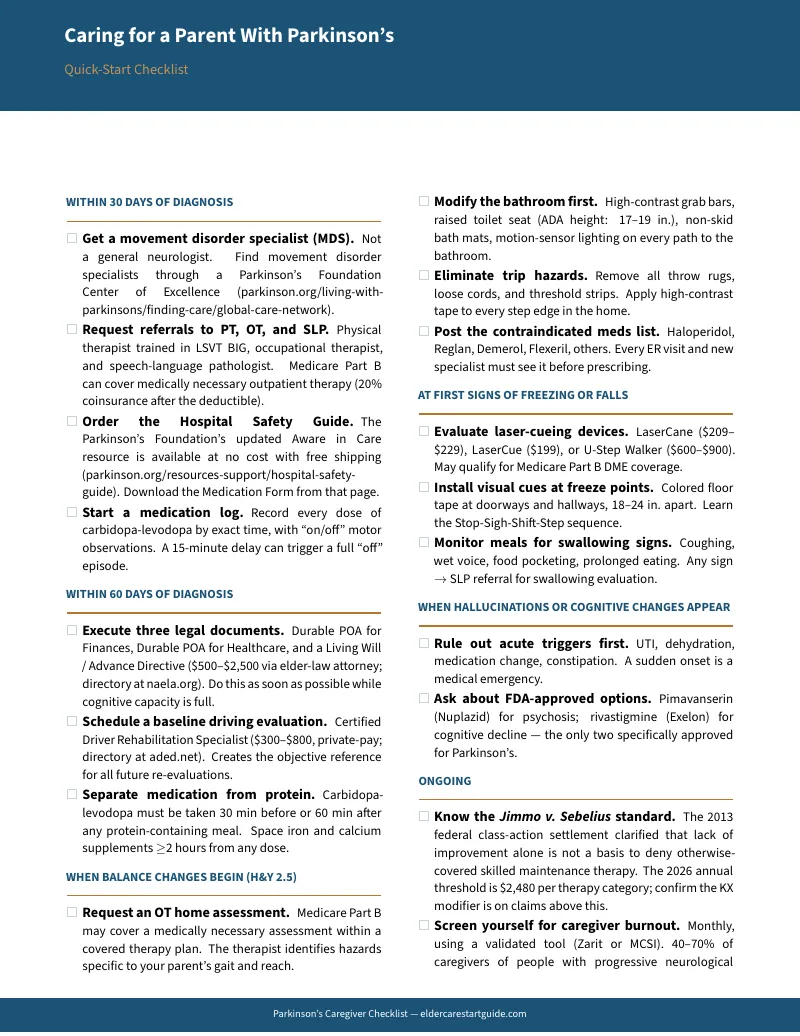
Not ready for the full guide? Download the free Quick-Start Checklist — 19 items covering the most urgent first-two-weeks actions after a Parkinson's diagnosis. It takes 15 minutes and catches the early mistakes that compound into crises later.
If you need the complete stage-by-stage system — medication protocols, safety audits, legal workflows, care transition triggers, and caregiver health tools — the full guide picks up where the checklist points and keeps going through every stage of the disease.
Get the Full Parkinson's Caregiver Guide →
Your Purchase Is Protected
Full refund, no time limit. If the guide doesn't help, email [email protected] and you'll get your money back. No forms, no questions, no expiration.
You didn't choose to become your parent's care coordinator. But now that you are, the difference between managing Parkinson's with a system and managing it from memory is the difference between controlled decisions and preventable crises. The disease progresses on its schedule. Your preparation doesn't have to wait.