
You Haven't Had a Full Day Off in Months. Your Backup Plan Is "Hope Nothing Goes Wrong."
You know you need a break. Everyone tells you to "take care of yourself." But nobody tells you how — how to find someone your parent will actually accept, how to pay for it when you are already stretched thin, how to hand off daily care without a crisis, and how to stop feeling guilty long enough to actually rest.
Meanwhile, the strain is compounding. Missed sleep becomes chronic fatigue. Chronic fatigue becomes missed medication doses, snapped conversations, and doctor appointments you keep canceling for yourself. Sixty percent of family caregivers report clinical symptoms of depression. One in three die before the person they are caring for.
The information exists — scattered across AARP fact sheets, Medicaid waiver manuals, VA benefits portals, and Etsy planner templates. But exhausted caregivers do not have twenty hours to stitch together a respite plan from a dozen bureaucratic websites and Pinterest boards.
The Respite Blueprint — A Complete System for Taking a Break Without Guilt or Guesswork
The Caregiver Self-Care and Respite Planning Guide is not a motivational booklet about the importance of self-care. It is a fill-in-the-blank system that takes you from "I can't leave" to a concrete, funded, scheduled break — with backup caregivers vetted, handoff binders prepared, and emergency protocols in place.
The guide starts where most resources skip: measuring your actual strain level with the same clinical tools hospital social workers use. Then it walks you through every respite option available, the public funding programs that can pay for them, the job protections that let you step away without losing your career, and the family coordination templates that get siblings to actually share the load.
What's Inside
- Caregiver Strain Assessment — the Zarit Burden Interview and Modified Caregiver Strain Index, with scoring guides and interpretation thresholds. Know exactly how burned out you are in clinical terms, not feelings. A score you can show your doctor and your family.
- Complete Respite Options Map — five categories of respite compared side by side: informal networks (family, friends, faith communities), in-home professional care, adult day programs (social vs. medical), short-term residential stays, and emergency backup systems. Cost benchmarks, screening checklists, and decision-tree worksheets for each.
- Public Funding Walkthrough — Medicaid HCBS 1915(c) waivers, the VA Program of Comprehensive Assistance for Family Caregivers (with Form 10-10CG instructions), the National Family Caregiver Support Program, state respite vouchers, and tax deductions. Step-by-step eligibility checks, not policy overviews.
- Job Protection Navigator — FMLA qualifying criteria, state paid family leave programs, intermittent leave strategies, and employer accommodation requests. Know exactly what your employer is legally required to provide, and how to request it without jeopardizing your position.
- Backup Caregiver Roster Builder — a tiered roster system (primary, secondary, local contacts, remote support) with vetting checklists, background check guidance, and pre-written handoff binders so any backup person can walk in and provide safe care.
- Emergency Respite Protocol — what happens if you are suddenly hospitalized, injured, or unavailable. Go-bag checklists, refrigerator emergency poster, pre-certified overnight facility contacts, and a step-by-step plan your family can execute without you.
- Sibling Coordination Toolkit — task-division matrices, family meeting templates, "I" statement scripts, and role assignment worksheets. Long-distance siblings get concrete remote tasks (insurance paperwork, appointment scheduling, financial oversight) instead of the default "thoughts and prayers from across the country."
- Sustainable Scheduling System — weekly and monthly respite schedule templates with gradual introduction timelines. Start with a two-hour break and build to regular half-day and full-day respite without overwhelming your parent or triggering guilt spirals.
- Self-Care Action Plan — not generic "take a bubble bath" advice. Concrete health monitoring checklists, sleep hygiene protocols, physical activity plans sized for exhausted caregivers, and boundary-setting scripts for when family members push back on your recovery time.
- Professional Referral Decision Tree — when to hire a geriatric care manager, when to consult an elder-law attorney, when to call Adult Protective Services, and when a situation has moved beyond what any guide can handle. Clear criteria so you do not over-spend or under-react.
Who This Guide Is For
- The solo caregiver who handles everything alone and has not had a real break in months — or years
- The long-distance coordinator managing a parent's care from another state and worrying about what happens between visits
- The sandwich generation parent raising children while caring for an aging parent, with no margin left for their own health
- The recently diagnosed family adjusting to a new dementia, Parkinson's, or chronic illness diagnosis and trying to build a sustainable care plan before the crisis hits
- The post-crisis planner who just survived a fall, a hospitalization, or a near-miss medication error and realized there is no backup system in place
Why This Exists When AARP and Government Sites Are Free
AARP, the National Institute on Aging, and ARCH National Respite Network produce excellent policy overviews. They explain what respite care is, why it matters, and which programs exist. What they do not give you is the operational infrastructure: the daily handoff binders, the backup caregiver vetting checklists, the sibling task-division worksheets, the emergency protocols, the funding application walkthroughs, or the scheduling templates.
Free resources tell you to "explore respite options." This guide gives you the forms, the scripts, the checklists, and the step-by-step system to actually build and run a respite plan — in the same sitting you download it.
And unlike Etsy caregiver planners that offer pretty daily logs without any guidance on legal boundaries, Medicaid eligibility, VA benefits, or family coordination, this guide covers the operational, financial, and interpersonal dimensions that actually determine whether a respite plan survives contact with reality.
The Math Is Simple
A geriatric care manager charges $150–$800 for an initial assessment. An elder-law attorney bills $200–$500 per hour. A single day of skilled nursing facility respite costs $255–$290. For less than the cost of one professional consultation hour, you get the complete planning system — strain assessment, funding walkthroughs, care team templates, emergency protocols, and scheduling tools — that lets you show up to those professional meetings prepared, saving hours of billable time and hundreds in fees.
Satisfaction Guarantee
If the guide does not give you a clear, actionable respite plan, email us and we will refund your purchase. No forms, no hassle.
Start With the Free Checklist — Or Get the Full System Now
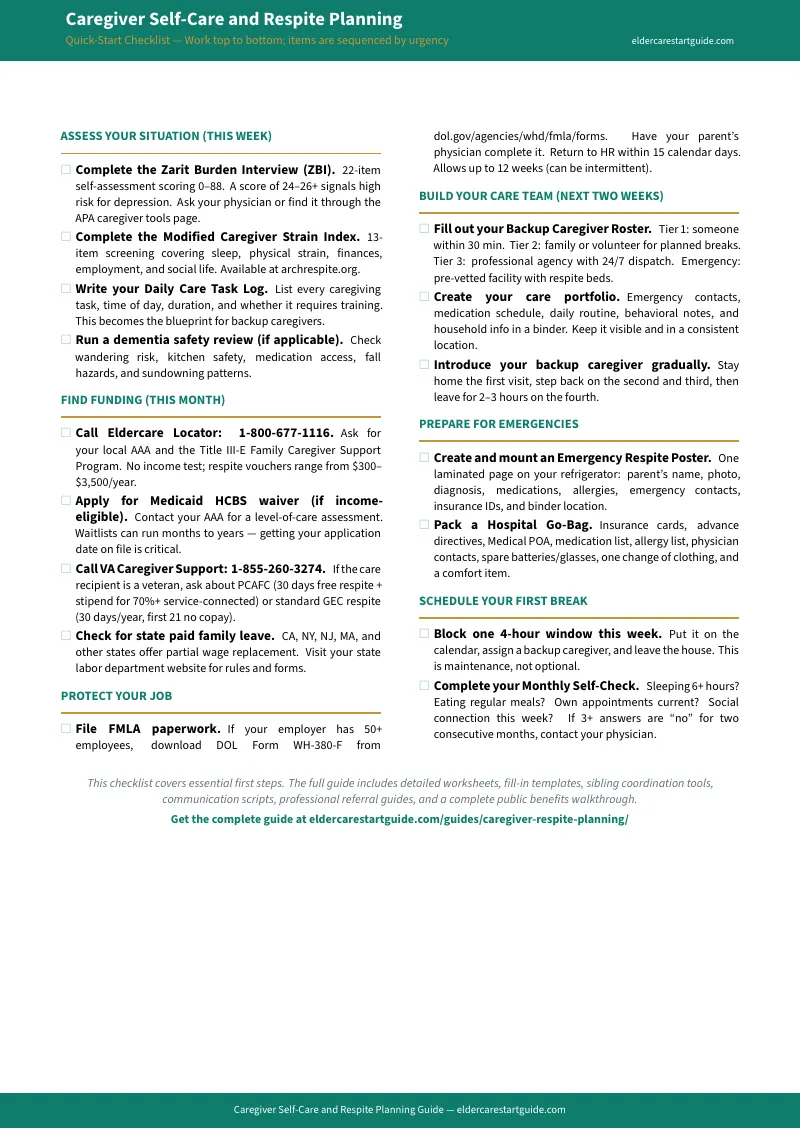
Download the Quick-Start Checklist for free — it covers the essential first steps: assess your strain, identify your nearest funding program, and schedule your first two-hour break. When you are ready for the complete system — all ten chapters plus 13 standalone printable worksheets (strain assessment, daily care task log, respite options comparison, funding eligibility checklist, job protection worksheet, backup caregiver roster, emergency poster, hospital go-bag checklist, weekly schedule, family task division, monthly self-check, professional referral decision guide, and emergency scenario planning) — the full guide is waiting.