
The School Called. The Hospital Called. Your Boss Just Scheduled a Late Meeting.
You are running two households on one person's energy. Your parent's medication refill is overdue, your kid's science project is due tomorrow, and you spent your lunch break on hold with Medicare. By the time you collapse into bed, you've solved everyone's problems except yours.
This is the sandwich generation: caught between aging parents who need more help every month and children who still need you for everything. There's no training for it. There's no playbook. There's no moment when someone sits you down and says, "Here's how to do both without losing your health, your marriage, and your career."
Until now.
The Dual-Care Operating System
The Sandwich Generation Survival Kit is the working system that replaces the chaos of dual caregiving with a structured, fill-in framework. Not a book to read — a system to use. Clinical assessment tools, legal checklists, care cost calculators, family communication scripts, and an emergency binder builder — all designed for someone who has fifteen minutes between crises, not fifteen hours to browse AARP articles.
Every chapter ends with a printable worksheet, template, or checklist you act on immediately. The kit includes 10 standalone printable PDFs — each one works independently so you can bring the right tool to the right situation: the assessment tracker to the doctor, the legal tracker to the attorney, the emergency binder to the hospital.
What You Get
- Validated Clinical Assessments — the Mini-Cog (3-minute cognitive screen), Timed Up and Go (fall risk), Katz ADL scale (daily function), and the Zarit Burden Interview (your own burnout score). These are the same tools geriatric care managers use — you'll have objective baselines instead of guesses.
- Room-by-Room Home Safety Audit — grab bar specifications, lighting standards, medication storage rules, kitchen reorganization, and bathroom fall prevention. One weekend converts your parent's home from a hazard zone to a safe living space.
- Legal Authority Roadmap — durable POA vs. springing POA comparison, healthcare proxy, HIPAA authorization, and advance directive guidance. Organized so you walk into the elder-law attorney's office with everything they'll ask for — saving hours of billable time at $195–$500 per hour.
- The Family Operating System — shared calendar templates with color-coding for parent medical, child activities, and work deadlines. Sibling Partnership Agreements that convert vague promises into written commitments with specific tasks and deadlines. Communication scripts for the family meeting that actually produces results instead of accusations.
- Care Cost Breakdown by Country — US, UK, Canadian, and Australian cost ranges for in-home care, adult day programs, assisted living, and memory care. Medicaid spend-down rules, VA benefits overview, NHS continuing healthcare, and My Aged Care pathways — with links to eligibility calculators for each system.
- Hospital Discharge Playbook — the 72-hour action plan for when your parent is sent home (or to rehab) with two days' notice. Questions to ask before discharge, rehab facility comparison worksheet, medication reconciliation checklist, and home modification priorities for the first 48 hours.
- Career Protection Templates — FMLA eligibility checklist, manager conversation scripts for requesting flexible scheduling, EAP access guide, and a written accommodation request template. Because losing your income to caregiving creates a second financial crisis on top of the first.
- Self-Care Triage Plan — not spa days and yoga retreats. Micro-interventions calibrated for someone who has ten minutes: when to call your own doctor, how to recognize the physical symptoms of burnout before they become chronic conditions, and a respite care planning template.
- Emergency Binder Builder — one master template that compiles medical records, insurance details, legal documents, medication lists, physician contacts, and emergency protocols into a single binder you grab on the way to the hospital.
Who This Is For
- Adults raising children under 18 while managing an aging parent's care — the classic sandwich position
- Caregivers who have been improvising for months (or years) and need a system before they burn out
- Families blindsided by a parent's hospitalization, fall, or cognitive decline who need to get organized fast
- Long-distance adult children trying to coordinate parent care while running their own household
- Anyone who scored 24 or higher on the Zarit Burden Interview and knows the current approach is unsustainable
Why Not Just Google It?
The information exists — on AARP, on government portals, in 400-page textbooks written for social workers. But when you're dealing with a parent's 11pm ER visit while your kid has a math test tomorrow, you don't need another article. You need a filled-in template that organizes everything in one place.
Free resources tell you what caregiving involves. This kit gives you the how: fill-in worksheets, specific scripts for difficult conversations, and decision frameworks that cut through the overwhelm. Area Agencies on Aging provide referrals, but they can't sit with you at midnight and help you build a medication list. AARP articles cover the landscape, but they don't give you a printable binder you hand to the ER nurse.
A geriatric care manager charges $90–$250 per hour. An elder-law attorney charges $195–$500 per hour. This kit is the preparation layer that lets you use those expensive professionals for strategy — not for gathering basic information you could have organized yourself.
Satisfaction Guarantee
If the Survival Kit doesn't help you get organized and reduce the daily chaos of dual caregiving, email us and we'll refund your purchase. No time limit, no hoops.
— Less Than One Hour of Home Care
The average home care aide costs $30–$45 per hour. This kit costs less than one visit — and it gives you a system that works for the entire caregiving journey.
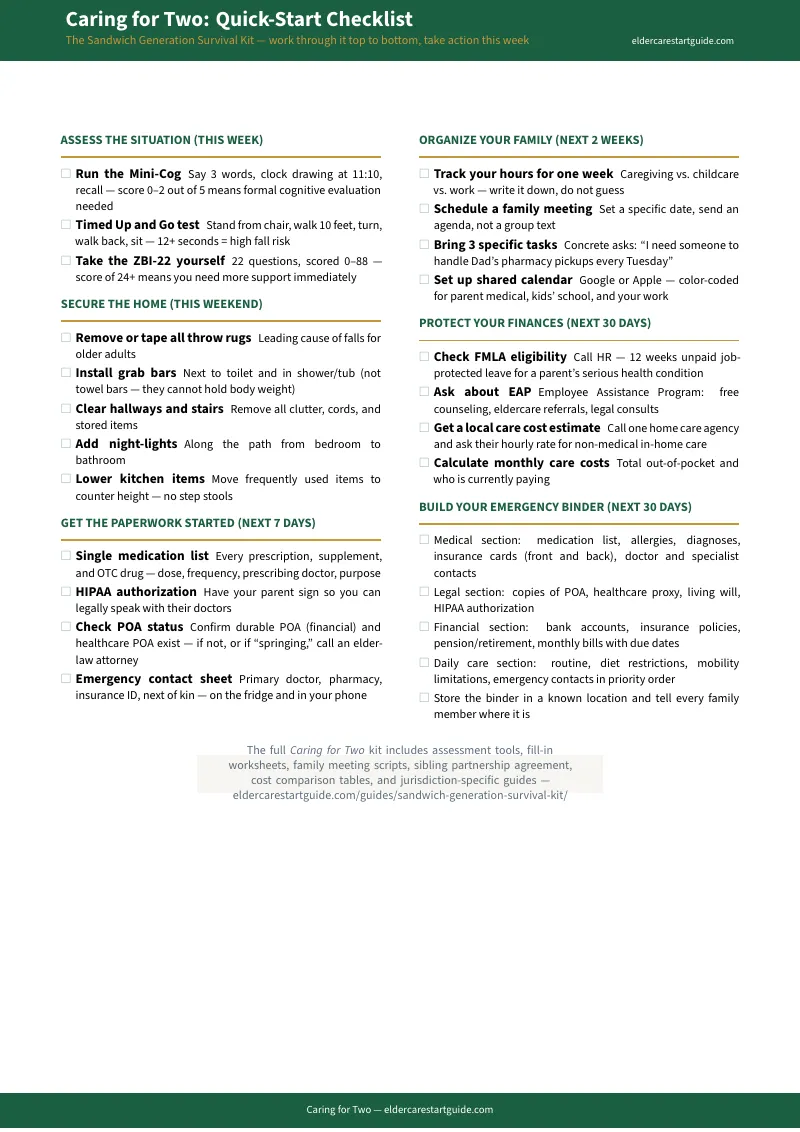
Start with the free Quick-Start Checklist — 20 concrete actions you can take this week. If you want the full system with every template, worksheet, and script, the complete kit is waiting.