Your Parent Isn't Being Stubborn or "Going Senile" — They Can't See the Step or Hear the Question, and Every Free Guide Treats Vision and Hearing as Two Separate Problems
You noticed it on the last visit. Mom asks you to repeat things, then snaps that you're mumbling. Dad grips the handrail a beat too long at the top of the stairs, sets the thermostat to the wrong number, squints at his pill bottles under a dim kitchen light. The daily phone calls turn into arguments because half of what you say doesn't land. And somewhere in the back of your mind sits the fear you haven't said out loud: is this the start of dementia?
Here's what almost no one tells you. Roughly a third of people aged 65–74 and nearly half of those over 75 have real hearing loss, and close to one in ten older adults has dual sensory loss — vision and hearing declining together, each one amplifying the other. When the brain has to work overtime just to decode a garbled sentence, it steals resources from memory and thinking. That's why untreated hearing loss is one of the biggest reversible risk factors for dementia — and why doctors so often mistake a sensory-impaired parent for a cognitively declining one. What looks like "selective listening" or "getting forgetful" is frequently a hearing you can fix and a lighting change you can make this weekend.
But when you go looking for help, you find the internet has been carved into silos. Audiology sites talk about hearing aids. Low-vision blogs talk about magnifiers. Fall-prevention pages talk about rugs. Legal sites talk about power of attorney. Nobody hands you the one thing you actually need: a single plan that treats your parent as a whole person whose eyes, ears, balance, safety, and independence are all connected.
The Dual-Sense Care System
This is the missing plan. Managing Vision and Hearing Loss in Aging Parents is built around one idea the free resources miss entirely: vision and hearing loss compound each other, and so must your response. Instead of fourteen scattered browser tabs, you get one connected system that moves you from "something's wrong" to a safe home, calmer conversations, the right devices, and the legal groundwork — in the order that actually protects your parent.
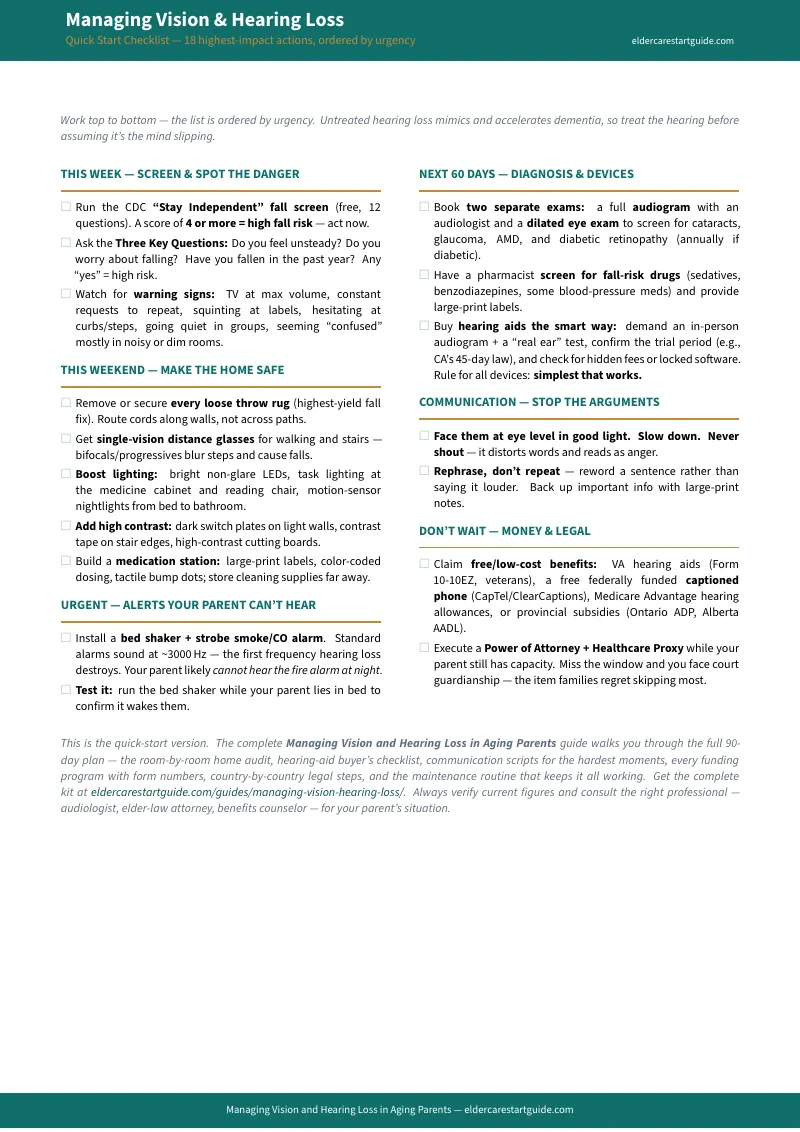
At its core is the Do Now / Do Soon triage: every action sorted into what keeps your parent safe tonight (secure the loose rugs, fix the bed height, swap the stairway lens, review the pill labels) versus what to schedule this month (separate audiology and ophthalmology exams, the free captioned phone, the power-of-attorney paperwork). No overwhelm. No guessing what matters most. Just the next right step, every time.
What's Inside
- The Room-by-Room Sensory-Safe Home Audit — walk through the house with a checklist built for failing eyes and a declining sense of balance: high-contrast switch plates and toilet seats, glare-killing lighting, contrast tape on stair edges, secured rugs, correct bed height, and the multifocal-lens trap that blurs every step on the stairs (and the single-vision fix). This is the "immediate safety" pain point solved on page one.
- The "Stop Shouting" Communication Scripts — exactly what to say, and how, so conversations stop ending in frustration. Why raising your voice distorts words and reads as anger, why you rephrase instead of repeat, how to get attention before you speak, and the face-to-face, good-lighting rules that make you understood the first time — including the special techniques for when hearing loss and memory changes overlap.
- The Free Captioned Phone Qualifying Map — how your parent can get a captioned phone worth hundreds of dollars at zero cost under Title IV of the ADA, which certification form their doctor or audiologist signs, and how to choose between internet and standard-line models. Immediate financial value before you've spent a dollar on hardware.
- The Hearing Aid Buyer's Checklist — the exact list to take to the audiologist so you don't overpay or get locked into hidden fees: how to match the style and technology tier to your parent's real needs and dexterity, why to demand an in-person audiogram and a "real ear" test, and how to check trial periods, warranties, and follow-up costs before you sign.
- The Low-Vision Device Directory — organized low-tech to high-tech (bump dots and large-print labels up through electric magnifiers and voice-activated home devices) with the one buying rule that saves money and frustration: choose the simplest device that actually solves the problem.
- The Medication-Safety Station Setup — how to prevent the dangerous dosing errors that come with low vision: large-print labels, color-coded and talking pill organizers, tactile markers, and a consistent, well-lit medication station kept safely away from cleaning supplies.
- The "Take the Emotion Out of It" Sibling Toolkit — fill-in-the-blank task-delegation lists and family-meeting frameworks that turn a vague "someone should help" into a clear, fair division of labor. Use your parent's documented needs to pierce a faraway sibling's denial without another shouting match.
- The Legal Authority Starter — a plain-language walkthrough of why a valid Durable Power of Attorney and Healthcare Proxy must be signed before capacity slips, so your family never gets forced into court-supervised guardianship (which routinely runs $5,000–$12,000 in attorney's fees), plus a document-organizer to walk into any attorney's office already prepared.
- The Driving & Independence Conversation Guide — compassionate scripts for the "it's time to stop driving" talk, the concrete warning signs to watch for, and transport alternatives — framed to protect your parent's dignity, not just take the keys.
- The Isolation & Connection Plan — because sensory loss quietly slides into withdrawal and depression. Non-verbal ways to stay close when talking is hard: captioned shows, card games, puzzles, and shared routines that keep your parent connected.
Who This Is For
- Long-distance children who noticed something's off during a short visit and need a plan they can execute from 500 miles away
- The in-town sibling worn down by daily arguments over a parent who "refuses" hearing aids and won't admit anything's wrong
- Families scared that Mom or Dad is developing dementia — who need to rule out (and treat) the sensory causes first
- Anyone staring at a dim, cluttered, fall-prone house and not knowing which fix comes first
- Preemptive planners whose parent is early in sensory decline and who want the safety, device, and legal groundwork done before a crisis forces it
Why the Free Resources Leave You Stuck
AARP and the NCOA publish excellent, trustworthy overviews — but they're broad and policy-focused. They rarely hand you a room-by-room checklist, a word-for-word communication script, or a fill-in-the-blank sibling task list you can use tonight. Clinical advocacy sites like the Hearing Loss Association and Lighthouse Guild are authoritative but medicalized and fragmented across dozens of pages — no unified path for an exhausted adult child working against the clock.
Then there are the "free" lead-referral portals — A Place for Mom, Caring.com — that feel helpful until you realize their business model runs on commissions from the senior-living facilities they steer you toward. Their incentive is to move your parent out of the home, not to help you make the low-cost changes that let them safely stay in it. Hand over your phone number and you'll spend weeks fielding sales calls.
And the professionals who would connect all these dots charge accordingly. Geriatric care managers run $90–$250 an hour, with initial assessments of $800–$2,000 — none of it covered by Medicare or Medicaid. Elder law attorneys bill $195–$500+ an hour. This guide is designed to do the organizing work before you ever pay one of them: walk in with your home audited, documents sorted, and questions sharp, and you cut billable hours from five to one — or handle most of it yourself for the cost of a couple of takeout coffees.
Satisfaction Guarantee
If this guide doesn't show you at least one safety fix, communication technique, free benefit, or legal step you didn't already know, email us for a full refund. No forms, no waiting period. The only risk is leaving things exactly as they are.
Start Making Your Parent's Home Safer Tonight
Download the free Quick-Start Checklist for the one-page room-by-room safety and communication overview — or get the complete Managing Vision and Hearing Loss in Aging Parents for and have every checklist, script, buyer's list, and template you need to protect your parent's safety, sanity, and independence — all in one connected system.