Every "Best Medical Alert" List Is Paid For. This Guide Isn't.
Your parent fell. Or had a close call. Or the doctor said the words "living alone" with a tone that made your stomach drop. Now you need a medical alert system — and every company in the industry is racing to get your phone number before you've had time to think.
The review sites rank Life Alert #1 because Life Alert pays the highest commissions. The "comparison charts" conveniently omit whichever features their sponsor doesn't offer. The sales rep who called 90 seconds after your inquiry is trained to close on the first call — before you realize the $29/month plan becomes $49/month after the cellular surcharge, activation fee, and equipment deposit.
You don't need another sales pitch disguised as a review. You need a structured way to evaluate these companies on your terms.
The Conflict-Free Evaluation System
The Medical Alert Systems Buying Guide replaces the industry's rigged comparison game with a structured evaluation toolkit built for families, not commissions. No affiliate links. No sponsor deals. No company rankings. Instead: worksheets, checklists, negotiation scripts, and a 12-point provider scoring system that helps you make a decision based on your parent's actual medical needs, living situation, and budget — not on whoever answers the phone first.
It's built for the adult child who became a care coordinator overnight — whether you're choosing a system for the first time after a hospital discharge, or auditing a contract your parent signed three years ago under pressure.
What's Inside
Provider Evaluation Scorecard
A structured scorecard covering the criteria that actually matter: monitoring center staffing certifications (EMT/EMD trained operators vs. minimum-wage dispatchers), average response times, false alarm policies, contract flexibility, cancellation terms, and caregiver companion app quality. Print one per provider. Fill it in during sales calls. Compare scores, not marketing claims.
Total Cost of Ownership Worksheet
The advertised price is never the real price. This line-by-line breakdown captures monthly monitoring ($20–$40), cellular surcharges ($10/month), activation fees ($25–$100), equipment deposits, restocking penalties ($35–$50), and the unreturned-device charge ($350–$400) that most families discover only after they try to cancel. Two providers quoting "$29/month" can have annual costs $300 apart once the fine print is included.
Contract Negotiation Scripts
Pre-written scripts for the specific objections medical alert sales reps are trained to use. Covers waiving activation fees, securing month-to-month billing instead of annual lock-in, locking in pricing against annual increases, and negotiating free equipment upgrades. Written for the awkward reality of negotiating with someone whose commission depends on you not negotiating.
Fall Detection Technology Breakdown
How triaxial accelerometers and barometric pressure sensors detect falls — and why some devices trigger false alarms when you sit down fast while missing actual falls on soft carpet. Covers the real-world accuracy differences between pendant-style devices (center-of-gravity advantage, higher physical accuracy) and wrist-worn devices (higher daily compliance, more false triggers). Includes the scenarios where automatic fall detection is worth the $5–$15/month premium and where it isn't.
Cardiac Device Safety Checklist
The American Heart Association recommends keeping cellular and RF transmitters at least 6 inches from pacemakers and implantable defibrillators. No sales rep will volunteer that their product requires placement restrictions for cardiac patients. This checklist maps safe wearing positions for pendants, wristbands, and mobile GPS units — because choosing a medical alert system that interferes with a pacemaker defeats the entire purpose.
Dementia Wandering Prevention Protocol
Sixty percent of people with dementia will wander at least once. Standard medical alert pendants don't track location — they're designed for falls, not for a parent who walks out the front door at 3 AM. This section covers GPS-enabled tracking options: secure wristbands with locking clasps, shoe-insert trackers, geofence configuration, and the specific alert routing that notifies family before triggering a 911 dispatch — because a police search is not always the first response a wandering parent needs.
First-Responder Home Access Plan
When EMS responds to a medical alert and the door is locked, they force entry. That means a broken door, a damaged frame, and $500–$2,000 in repair costs. This plan covers secure exterior lockbox setup, code registration with the monitoring center, first-responder information sheet placement, and alert routing configuration — so emergency crews get inside without destroying property.
The Parental Resistance Conversation Framework
The most common barrier to medical alert adoption isn't the technology — it's the conversation. Parents hear "you need monitoring" and hear "you can't take care of yourself." This framework reframes the pitch from surveillance to independence: scripts that connect the device to staying in their own home longer, not to being watched. Plus form factor options that reduce stigma — watches that look like smartwatches, pendants that tuck under clothing, wall buttons that don't announce themselves.
30-Day Setup and Testing Protocol
Step-by-step installation, base station placement (not on top of the microwave), wall button positioning (bathroom floor level — where a person on the ground can reach it, not eye level), pendant wearing habits, and a weekly test call schedule that catches equipment failures before an emergency does. Includes the first-week compliance log to identify resistance patterns early.
Contract Termination Checklist
How to exit a medical alert contract without getting hit with penalties you didn't know existed. Covers return-by-date requirements, trackable shipping documentation, written cancellation procedures, and the specific restocking and unreturned-equipment traps that penalize families who cancel without following the provider's exact process.
Who This Is For
- Families making a post-hospital decision under pressure — your parent is being discharged and the social worker says they need a safety plan by Friday. The Provider Evaluation Worksheet cuts through the noise so you choose based on evidence, not whoever called you first.
- Long-distance caregivers managing from another state — you need remote monitoring you can trust. The guide covers companion app features, battery-level alerts, daily wear verification, and multi-caregiver alert routing so you know the system is working when you can't check in person.
- Families caring for a parent with dementia — wandering risk changes everything about device selection. Standard medical alerts don't track location. The Dementia Protocol covers GPS-enabled devices, tamper-resistant wearables, and geofence alerting designed for cognitive decline.
- Adult children who suspect their parent is being oversold — your parent already has a system, but the monthly bill is high, the contract is three years, and nobody can explain what the premium tier adds. The Contract Audit Worksheet shows exactly what they're paying for and how to renegotiate.
Why "Best Medical Alert" Lists Won't Help You
The major review sites ranking medical alert companies — the ones that show up first in Google — operate on referral commissions. A Place for Mom, Caring.com, and the dedicated medical alert review sites earn per-lead fees from the companies they rank. Their comparison charts are built to sell, not to inform.
AARP and NCOA publish genuinely useful editorial reviews. But they tell you which products exist and how they rate on general criteria. They don't give you a worksheet to score providers against your parent's specific medical conditions, living situation, and budget. And they don't give you a script to negotiate away the activation fee before you sign.
This guide gives you the evaluation structure, not the answer — because the right medical alert system depends on your parent's actual life, and no affiliate-funded ranking can account for that.
Satisfaction Guarantee
If the guide doesn't give you the clarity and structure to make a confident, informed decision about your parent's medical alert system, email us for a full refund. No forms, no hoops, no time limit.
— Less Than One Month of the Cheapest Monitoring Plan
A geriatric care manager charges $90–$250/hour to help evaluate care options. A single activation fee from a medical alert company runs $25–$100. And the real cost of choosing the wrong system — a three-year contract on a device your parent won't wear, a plan missing the cardiac safety checks, a provider whose "fall detection" misses real falls — is measured in months of wasted premiums and the emergency that happens while you're still trying to cancel.
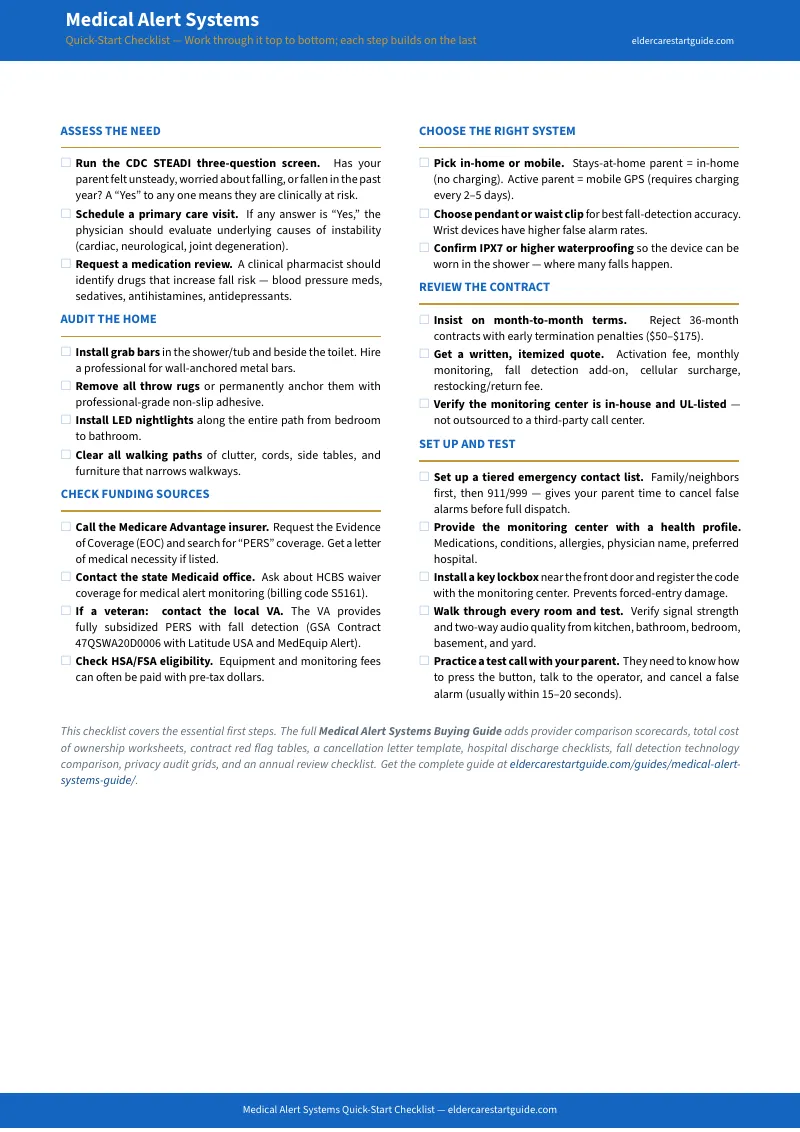
Download the free Medical Alert Systems Quick-Start Checklist to start, or get the complete Buying Guide with the full evaluation worksheets, negotiation scripts, safety checklists, and setup protocol.