
Your Parent Can't Live Alone Anymore. You Have a Spare Bedroom. Nobody Told You What Happens Between "Move In" and "This Is Working."
The fall happened. Or the diagnosis. Or the phone call from a neighbor who found your mother wandering in the driveway at 2 AM. Something shifted, and now the question you've been circling for months has an answer: your parent is moving in with you.
You've already done the emotional math. You love them. You have the space. Assisted living costs $5,000 to $7,000 a month. This seems like the obvious choice.
What nobody prepared you for is everything that comes after. The Medicare plan that doesn't transfer across state lines. The Power of Attorney you thought was valid — until the bank rejected it. The sibling who hasn't lifted a finger but has opinions about every decision you make. The morning you realize you haven't slept through the night in three weeks, your marriage is strained, and you can't remember the last time you did something for yourself.
The Co-Living Transition Blueprint
This isn't a list of caregiving tips you could find on a government website. The Co-Living Transition Blueprint maps the exact sequence of legal, financial, medical, and household decisions your family needs to make — starting from wherever you are right now — so you don't discover a $15,000 Medicaid penalty, a rejected POA, or a dangerous bathroom at 3 AM.
The critical mistake most families make: they move their parent in first and figure out the paperwork later. They skip the clinical assessment that establishes the baseline for VA benefits. They don't set up a Personal Care Agreement, so when their parent eventually applies for Medicaid, every dollar they've exchanged during the previous five years gets flagged as an uncompensated gift. They don't install grab bars until after the first fall. They don't discuss boundaries until the first argument.
The guide puts you in the right order: assess before you commit, secure legal authority before the bank freezes access, modify the home before anyone gets hurt, formalize the financial arrangement before it becomes a Medicaid problem, and build a burnout prevention plan before you hit the wall.
What You Get
Your download includes 11 PDFs — the complete 12-chapter guide plus 9 standalone printable worksheets you can use immediately:
- The Complete Guide (guide.pdf) — 12 chapters covering the full arc from pre-move assessment through exit planning: legal authority, home modifications, care agreements, tax credits, medication management, burnout prevention, dementia considerations, and when to transition to professional care.
- Pre-Move Financial Inventory (financial-inventory.pdf) — Fillable worksheet for documenting your parent's income sources, assets, and insurance coverage. Bring this to your elder law attorney — it saves billable hours and is required for Medicaid planning, VA benefit applications, and the IRS dependent claim Support Test.
- Home Safety Audit Checklist (home-safety-audit.pdf) — Room-by-room walkthrough covering staircases, living areas, kitchen, bedroom, and bathroom. Each hazard rated by priority (Urgent/High/Medium) with specific fixes. Print it, walk through your home, and check off each item before move-in day.
- Emergency Contact Card (emergency-contacts.pdf) — Fillable one-page reference with spaces for every critical contact (PCP, pharmacy, hospital, elder law attorney, insurance) and document locations (POA, HIPAA, advance directive). Post copies in the kitchen, your parent's room, and your wallet.
- Personal Care Agreement Checklist (care-agreement-checklist.pdf) — The 8 required elements every Medicaid-compliant PCA must include, with the fair-market-value formula. Verify every box before signing — Medicaid auditors will check each one during the 60-month lookback review.
- Daily Care Log (daily-care-log.pdf) — Print multiple copies. Complete one for each caregiving day — documenting ADLs, IADLs, medical coordination, and clinical notes. This is your audit evidence if your parent applies for Medicaid.
- Respite Caregiver Handoff Sheet (respite-handoff.pdf) — Complete before handing care to any substitute caregiver. Covers medical contacts, daily medication schedule, emergency triggers, sundowning protocol, and ADL routines. The difference between a safe handoff and a preventable crisis.
- Medication Schedule & Physician Visit Prep (medication-schedule.pdf) — Two-page worksheet: the complete medication list (post in the kitchen) and the "Brown Bag" physician visit preparation checklist with pre-written questions and a symptom log to bring to every appointment.
- Caregiver Burnout Self-Assessment (burnout-self-assessment.pdf) — The clinically validated Zarit Burden Interview (ZBI-12) adapted as a quarterly self-check. Score yourself, read the clinical thresholds, and write an action plan. A score of 13+ means you need immediate intervention.
- Who to Call When (who-to-call.pdf) — Quick reference matching 12 common caregiving situations to the right professional (elder law attorney, Medicaid planner, geriatric care manager, Area Agency on Aging, consulting pharmacist). Post on your fridge or keep with your care binder.
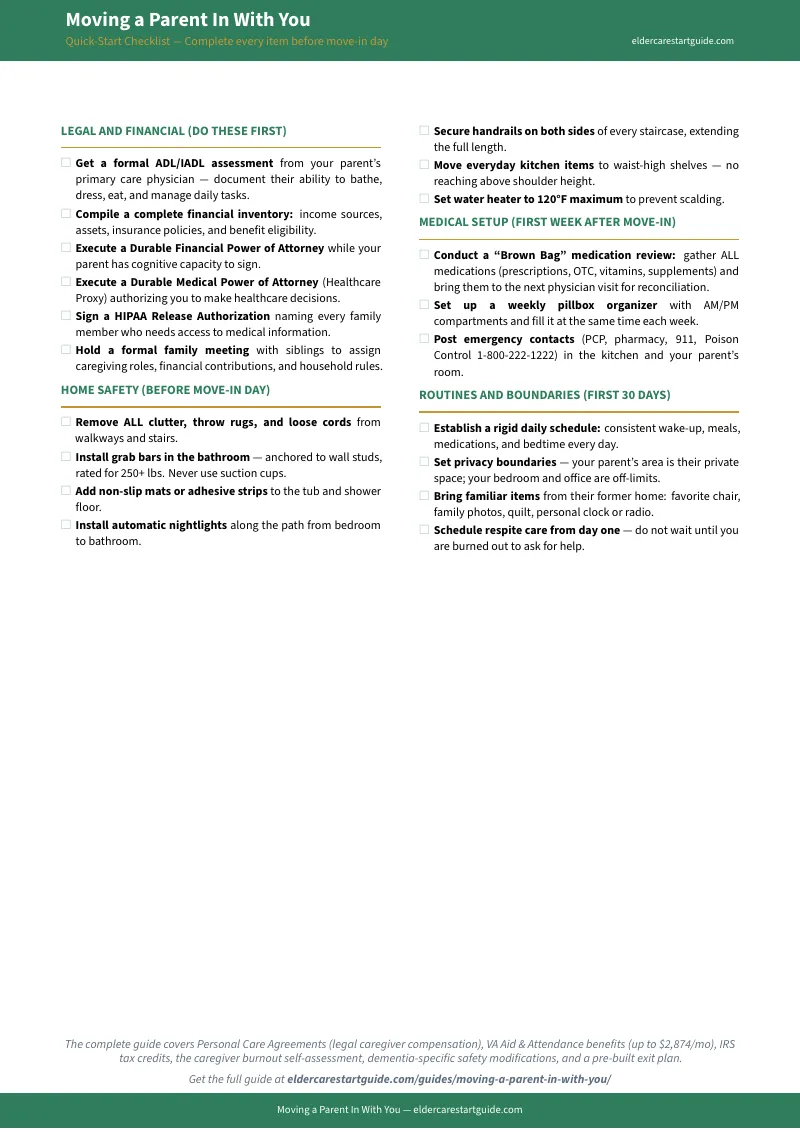
- Quick-Start Checklist (checklist.pdf — Free Download) — 20 actionable items organized by priority: clinical assessment, legal authority, home safety, financial triage, and family alignment. Know exactly what to do tonight, this week, and this month.
Who This Guide Is For
- Adult children who have decided (or are deciding) to move an aging parent into their home and want to get the legal, financial, and safety groundwork right before the move-in day
- Families dealing with a sudden health crisis — a fall, a stroke, a hospitalization — who need to set up a safe home environment and establish care authority fast
- Caregivers already living with a parent who skipped the planning phase and need to backfill the legal documents, care agreements, and financial structures they should have set up from the start
- Primary caregivers who want to get paid for the care they're providing — legally, through a Medicaid-compliant Personal Care Agreement or a state HCBS waiver program
- Families navigating sibling conflict over caregiving responsibilities, financial contributions, or the parent's estate — and needing a transparent, documented framework to defuse it
- Caregivers approaching burnout who need a structured respite plan and clear clinical criteria for when home care is no longer the right answer
Why Free Information Isn't Getting You Anywhere
The caregiving forums — AgingCare, Reddit's r/CaregiverSupport — are full of people sharing hard-won experience. But every thread is one family's specific situation, and the advice contradicts itself from post to post. One person says you don't need a care agreement. Another says Medicaid denied their parent because they didn't have one.
A Place for Mom and Caring.com rank well on Google, but their revenue comes from referral commissions — typically 50% to 100% of the first month's rent at the facility they place your parent in. They're structurally incentivized to move your parent into a facility, not to help you make co-living work at home.
Elder law attorneys provide the gold standard in legal guidance. They also bill $195 to $500 per hour, with comprehensive Medicaid planning packages running $2,000 to $10,000. For many families, the attorney comes into the picture after a crisis — which is exactly when you can least afford the time and money.
This guide fills the gap between the forum thread that tells you what happened to one family, the referral site that steers you toward a placement, and the attorney who bills by the hour. It gives you the complete sequence — from pre-move assessment through exit planning — so you walk into every conversation knowing what questions to ask and what documents to bring.
Satisfaction Guarantee
If this guide doesn't give you a clear, actionable path to setting up a safe, legally sound, financially protected co-living arrangement with your parent, email [email protected]. We read every message.
— Less Than One Hour With an Elder Law Attorney
Elder law attorneys charge $195 to $500 per hour. A single mistake — a Personal Care Agreement drafted without prospective-only payment terms, a POA missing the gifting authority your parent's bank requires, a home modification installed after the first fall instead of before it — can cost thousands in legal fees, medical bills, or Medicaid penalties calculated at the average private nursing home rate per month of ineligibility.
This guide won't replace an attorney when you need one (and it tells you exactly when that is). But it will save you weeks of research, prevent the most expensive mistakes, and ensure you're organized before the first consultation — so you pay for an attorney's legal judgment, not their time explaining the basics.
Download the free Quick-Start Checklist to see the 20 most urgent action items. When you're ready for the complete system, the full guide is waiting.