
Your Parent Had a Stroke. Now You're Running a Medical Operation You Never Trained For.
The hospital is pushing for a discharge decision. A social worker just handed you a list of rehab facilities you've never heard of. Your siblings are calling with opinions but nobody's stepping up. You're googling "IRF vs SNF" at midnight, terrified that picking the wrong option will cost your family thousands — or worse, set your parent's recovery back months.
Meanwhile, the stroke team is moving fast. They need answers about insurance, discharge destinations, and home modifications — and nobody explains how all the pieces connect.
The Stroke Recovery Coordination System
This is the complete action framework for families managing a parent's stroke recovery — from the acute hospital stay through rehabilitation, home transition, and long-term secondary prevention. It replaces the patchwork of Googled articles, generic AARP handouts, and frantic sibling group texts with a single structured system that tells you exactly what to do, in what order, at every stage.
Where free resources explain what stroke recovery involves, this guide gives you the how — fillable tracking templates, decision-tree worksheets, daily care schedules, and step-by-step protocols that turn an overwhelming medical situation into a manageable, organized operation.
What's Inside — 11 Printable PDFs
- Complete 16-Chapter Guide (guide.pdf) — the full action framework covering hospital advocacy, discharge decisions, home setup, daily care protocols, medication management, secondary prevention, and family coordination
- Hospital Advocacy Playbook (hospital-advocacy-playbook.pdf) — the exact questions to ask the neurologist, case manager, and discharge planner so you understand your parent's prognosis, therapy needs, and coverage options before signing anything
- IRF vs. SNF Decision Worksheet (irf-vs-snf-worksheet.pdf) — a structured comparison of inpatient rehab (3+ hours/day intensive therapy) versus skilled nursing (1-2 hours/day subacute care), including Medicare coverage rules, the 3-day hospital stay requirement, and daily coinsurance rates that can exceed $200/day after day 20
- Discharge Transition Checklist (discharge-transition-checklist.pdf) — medication reconciliation, equipment delivery, home safety modifications, follow-up scheduling, and emergency contact protocols — every item that must happen before your parent leaves the hospital
- Room-by-Room Home Setup Guide (home-setup-guide.pdf) — grab bars, transfer benches, hallway clearance, adaptive utensils, lighting adjustments, and fall-prevention modifications you can complete in a weekend without a contractor
- Daily Care Schedule Templates (daily-care-schedule.pdf) — hour-by-hour caregiving structure: morning hygiene, medication administration, guided exercises, cognitive stimulation, vitals checks, and mealtime safety protocols for dysphagia management
- Secondary Stroke Prevention Tracker (stroke-prevention-tracker.pdf) — blood pressure targets (<130/80), cholesterol goals (LDL <70), medication adherence logs, and the B.E. F.A.S.T. emergency response protocol — so you catch warning signs before they become a second stroke
- Family Coordination Binder (family-coordination-binder.pdf) — role assignment worksheets, shared communication templates, shift-handoff logs, and a structured daily record that keeps all siblings informed with objective data instead of secondhand phone updates
- When to Call 911 vs. the Doctor (emergency-reference-chart.pdf) — a color-coded reference chart distinguishing emergency red flags (new stroke symptoms, signs of aspiration pneumonia) from yellow-flag concerns (new pressure sores, UTI symptoms) that warrant a same-day physician call
- Insurance Benefit Tracker (insurance-benefit-tracker.pdf) — track Medicare Part A/B limits, therapy thresholds, and out-of-pocket costs so you aren't blindsided by coverage gaps
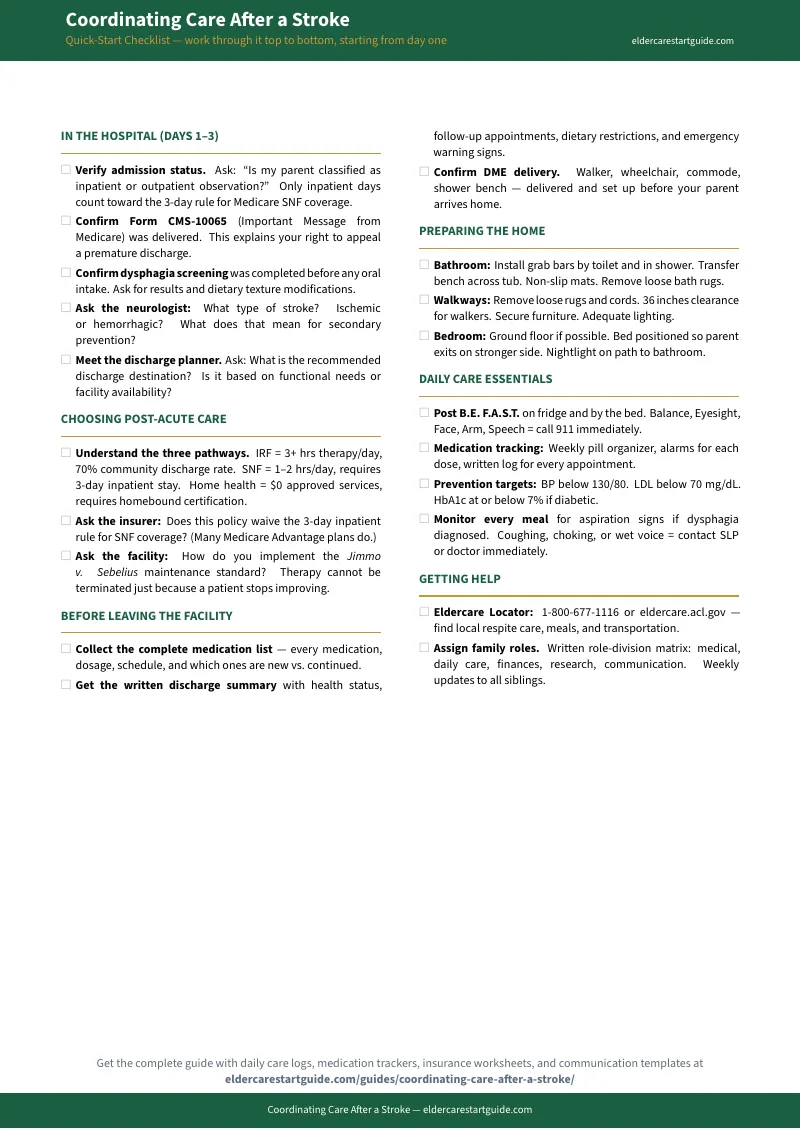
- Quick-Start Checklist (checklist.pdf) — the 20 critical action items organized by recovery stage — print it, check items off, track your progress
Who This Is For
- Adult children whose parent is currently hospitalized after a stroke and facing discharge decisions
- Primary caregivers managing a parent's home recovery — daily medications, therapy exercises, mealtime safety, and fall prevention
- Families splitting care responsibilities across multiple siblings (including long-distance family members)
- Anyone hiring or managing private home care aides who need a standardized handoff system
- Caregivers trying to prevent a second stroke while managing the daily grind of physical recovery
Why Free Resources Don't Work Here
The American Stroke Association explains stroke types and general recovery stages. The NIA covers aging topics at a high level. Medicare.gov lists coverage rules in regulatory language. None of them hand you the operational tools — the daily schedules, the discharge checklists, the medication logs, the family communication templates — that you need to actually run this.
Etsy templates look clean, but they're generic medical logs. They don't include dysphagia safety protocols, stroke-specific secondary prevention targets, or the IRF vs. SNF decision framework. A geriatric care manager would build this system for you — at $40-60 per hour, ongoing.
This toolkit gives you the complete coordination system for less than a single hour of professional consulting.
Satisfaction Guarantee
If the guide doesn't help you feel more organized and confident managing your parent's stroke recovery, email us within 30 days for a full refund. No questions, no hassle.
Get Started Now
Download the free Quick-Start Checklist to see the format and approach. When you're ready for the complete system — decision worksheets, daily schedules, medication trackers, home setup guides, and the family coordination binder — get the full toolkit for .