Your Parent's Home Isn't Safe Anymore. You Just Haven't Found All the Hazards Yet.
The stove knobs face outward. The bathroom mirror triggers panic episodes. The dark hallway between the bedroom and toilet is a fall waiting to happen at 2 a.m. And the front door — the one your parent has opened ten thousand times — is now the most dangerous exit in the house.
You know something needs to change. But every time you search for help, you get the same thing: a 50-item checklist from a nonprofit that tells you to "remove tripping hazards" and "improve lighting" without ever explaining which hazards matter most, what order to tackle them in, or how to actually install the fixes. Meanwhile, a geriatric care manager charges $150–$250 an hour for a home assessment, an occupational therapist requires a physician's order you don't know how to get, and your siblings think you're overreacting.
You don't need another tip list. You need a system.
The Invisible Safety Blueprint
This guide replaces scattered internet research with a clinically grounded, stage-matched action plan that tells you exactly what to do, in what order, for every room in your parent's home — without turning it into a sterile, institutional-looking facility.
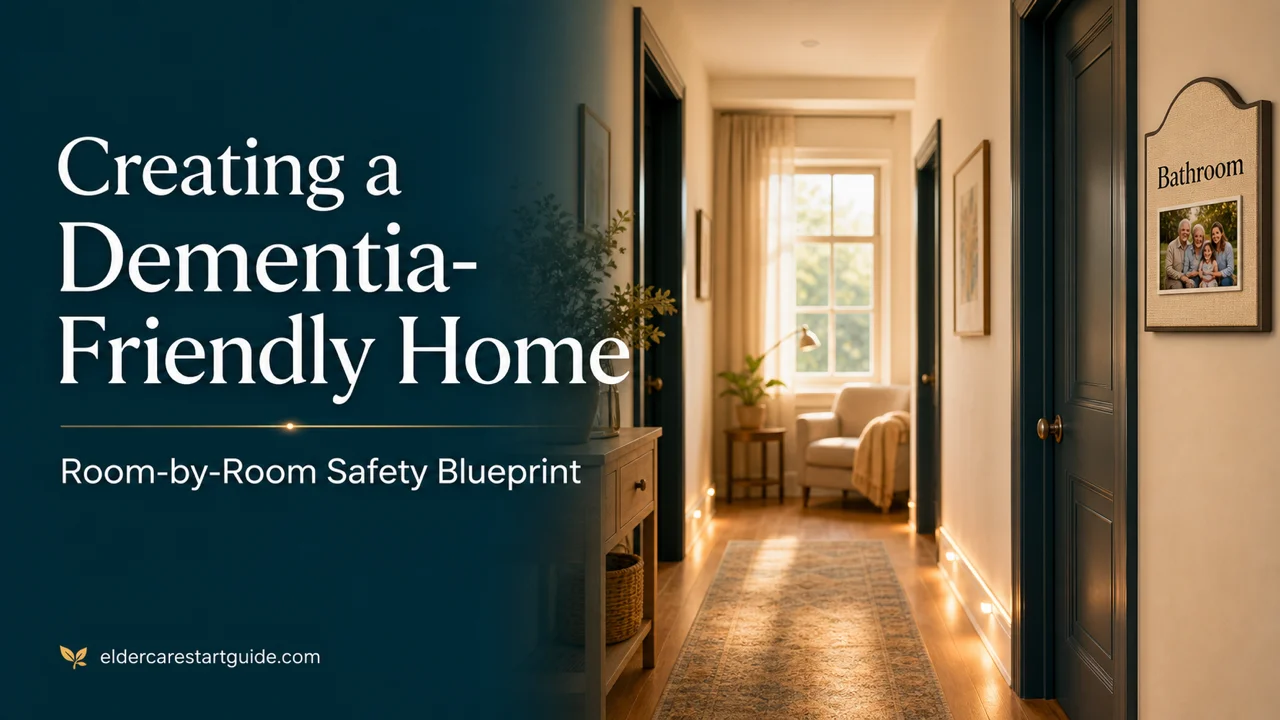
It's built on a principle called invisible environmental support: every modification protects your parent while preserving the warmth, dignity, and familiar character of their home. High-contrast toilet seats instead of medical handrails bolted to every wall. Camouflaged exit doors instead of padlocked deadbolts. Motion-activated path lighting instead of fluorescent overhead strips. Your parent sees their home. You see a fortress.
What's Inside
Stage-Matched Modification Sequences
Dementia changes what's dangerous in the home at every stage. Removing car keys matters in the early stage; covering mirrors matters in the middle stage; transfer equipment matters in the late stage. This guide maps every modification to the correct clinical stage so you're not installing protections too early (which restricts independence and accelerates anxiety) or too late (which leaves gaps until an injury forces the issue).
Room-by-Room Safety Overhauls
The kitchen, bathroom, bedroom, hallways, stairways, and outdoor areas each get a dedicated chapter with specific product recommendations, installation instructions, and the clinical reasoning behind every change. Not "install grab bars" — where to mount them, what load rating to specify, which wall anchors work on drywall versus studs, and why the placement height matters for someone with impaired depth perception.
Wandering Prevention System
Exit-boundary camouflage techniques, lock placement above and below the natural line of sight, door-sensor alarm comparisons, GPS tracking bracelet options, and a neighbor notification template for coordinating with your local community and emergency services programs like Project Lifesaver.
Lighting and Sensory Environment Guide
Shadows trigger the amygdala's fear response in a person with dementia — dark patches can cause agitation, paranoid reactions, and refusal to enter rooms. This chapter covers uniform lighting strategies, circadian rhythm alignment (bright daylight in the morning, warm dim light in the evening), acoustic management for hearing-aid wearers, and the calming sensory environment research behind reducing sundowning episodes.
Wayfinding and Signage Standards
Clinical rules for sign placement (centered on doors at 4–5 feet to match the natural downward gaze), photo-based labels instead of abstract icons, high-contrast color principles for door frames and stair edges, and memory shadow boxes that help your parent identify their bedroom by familiar personal objects.
Family Coordination Worksheets
Structured behavior logs with clinical tracking scales that replace subjective observations ("Mom seems worse") with documented data ("3 wandering attempts this week, 2 medication errors, 1 fall"). When you hand a sibling a log sheet instead of an emotional plea, the "you're overreacting" conversation ends. Includes task delegation grids, daily routine templates, and a medication handoff logbook to prevent double-dosing.
Clinical Assessment and Funding Path
The exact steps to get a physician's order for a Medicare-covered occupational therapy home evaluation — including the CPT billing codes your doctor needs, what "medical necessity" documentation looks like, and how to check whether your parent's Medicare Advantage plan covers supplemental benefits for grab bars, ramps, and safety installations.
Emergency Preparedness Kit
A dementia evacuation go-bag list, extreme weather power-outage checklists, verbal scripts for explaining emergencies in simple reassuring language, and a waterproof document binder template for legal papers, insurance cards, and medication lists.
8 Standalone Printable Tools
Every worksheet and quick-reference sheet prints as its own standalone PDF — no flipping through the main guide to find what you need. Includes the room-by-room safety audit, medication handoff log, daily observation log, emergency contact sheet, sibling task division matrix, professional care assessment prep form, a wandering prevention fridge-post reference, and an emergency preparedness checklist with go-bag contents and communication scripts.
Who This Is For
- The adult child who just got the diagnosis and needs to know what to change before the first serious incident — not after
- The primary caregiver running on fumes who can't spend twelve hours researching every modification and needs someone to tell them what matters most, right now
- The long-distance sibling who wants to help but doesn't know what to do beyond sending money — this gives them specific tasks they can own
- The family navigating the middle stage where wandering, sundowning, and mirror anxiety have turned the home into an obstacle course
- Anyone preparing for a hospital-to-home transition who needs the house ready before discharge day
Why Free Tools Don't Cover This
The Alzheimer's Association and AARP publish excellent safety tip lists — but tips aren't a system. They tell you to "improve lighting" without specifying color temperature, lux levels, or circadian timing. They tell you to "remove tripping hazards" without sequencing which rooms to tackle first based on your parent's current stage. And they offer zero tools for the hardest part of caregiving: coordinating with siblings, tracking behavioral changes, and knowing when it's time to stop modifying the home and start planning for facility care.
Etsy sells printable care planners — color-coded, nicely designed — but they're made by graphic designers, not clinicians. A beautiful daily schedule template means nothing if the time blocks don't account for sundowning patterns, if the medication tracker doesn't flag interaction risks, or if the "safety checklist" is a generic bullet list that applies equally to a child-proofed kitchen and a dementia-adapted one.
Professional assessments are the gold standard — and this guide tells you exactly how to get one covered by Medicare. But a care manager's hourly rate means most families get one evaluation, not an ongoing system. This toolkit fills the gap between that single professional visit and the daily reality of keeping someone safe at home for months or years.
Satisfaction Guarantee
If the guide doesn't give you a clearer, more confident plan for your parent's home safety, email us for a full refund. No forms, no hoops, no time limit.
— Less Than a Single Hour of Professional Help
A geriatric care manager charges $150–$250 per hour. An elder law attorney runs $300–$500 per hour. An occupational therapy evaluation, even when Medicare covers it, requires a physician's order and a 20% coinsurance after the deductible. This toolkit costs less than a single professional consultation — and it stays on your shelf for every stage of the journey.
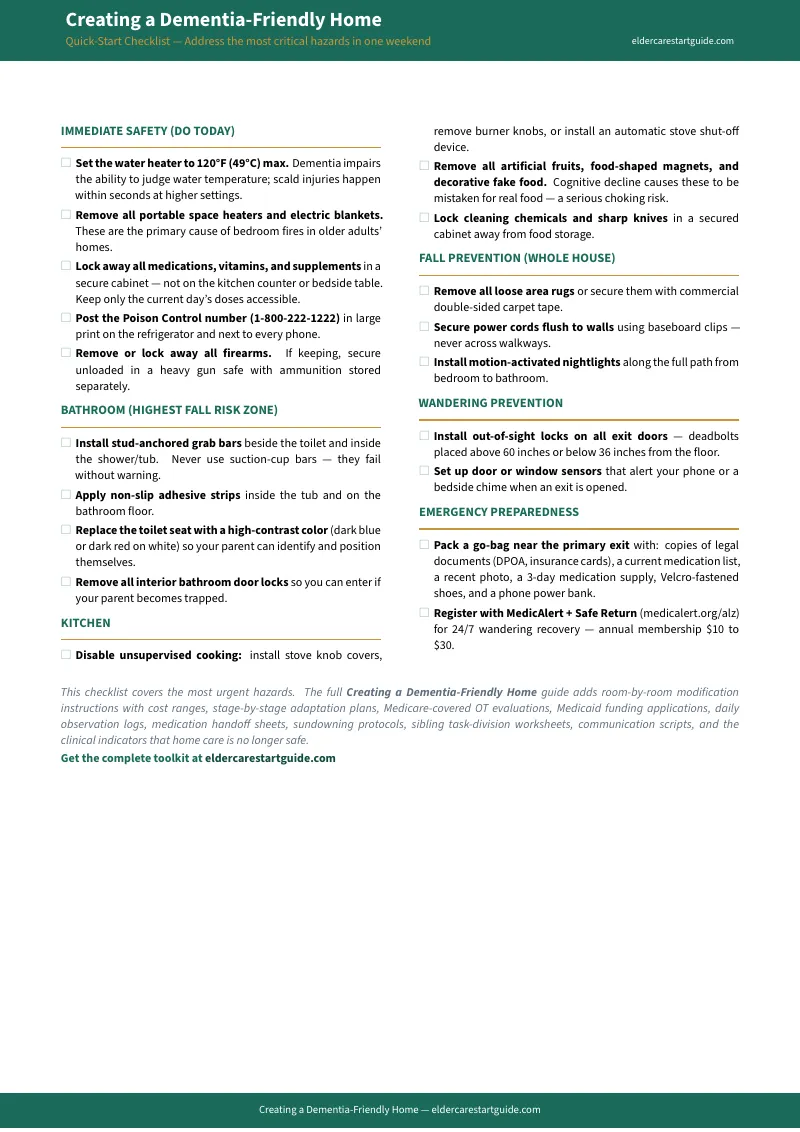
Download the free Dementia-Friendly Home Quick-Start Checklist to begin, or get the complete guide with the full room-by-room blueprint, worksheets, wandering prevention system, and family coordination tools.