Your Parent Deserves an Advocate Who Knows the System's Pressure Points
A discharge planner hands you a form and says your parent is ready to go home. The doctor used clinical shorthand you cannot decode. The nurse mentions a "transition plan" that does not actually exist yet. And somewhere in the background, the hospital's bed-management system is counting the hours until your parent's room gets reassigned.
This is where most families lose ground. Not because they do not care — because they do not know the institutional language that forces compliance. They do not know that writing "unsafe discharge" on the medical record triggers a mandatory risk-management review. They do not know that the case manager works for the hospital, not the patient. They do not know the difference between a medical release and a healthcare proxy — and they sign forms that limit their own access to information.
The Bedside Advocacy System
The Healthcare Advocacy Toolkit is not a collection of generic health tips. It is a structured operational system — observation logs, dispute scripts, reconciliation worksheets, and escalation contacts — designed around the specific administrative pressure points that determine whether your parent gets safe care or gets pushed through the system.
It works because healthcare institutions respond to documentation, not emotion. When you present a completed bedside observation log during physician rounds, you are treated as a clinical partner, not a worried family member. When you file a formal discharge appeal with the correct regulatory body, the hospital is legally required to review. When you hand a pharmacist a structured medication reconciliation worksheet, dangerous interactions get caught before your parent takes the wrong pill at home.
What's Inside the Toolkit
Bedside Observation Log and Daily Tracking Sheets
Structured templates for recording vitals, fluid intake, mobility changes, and cognitive shifts — the concrete clinical data that transforms you from a passive visitor into an essential source of information during physician rounds.
Discharge Dispute Scripts and Escalation Protocols
The exact language to formally challenge an unsafe discharge, with jurisdiction-specific contacts: BFCC-QIO fast-track appeals in the United States, Patient Ombudsman escalation in Canada, PALS referral in the United Kingdom, Aged Care Quality and Safety Commission complaints in Australia, HDC complaints in New Zealand, and HSE patient advocacy in Ireland. These are not polite suggestions — they are the administrative triggers that create legal obligations for the hospital.
Medication Reconciliation Worksheets
Before-and-after comparison templates to cross-reference pre-admission prescriptions against the hospital discharge summary. Medication errors during care transitions are one of the leading causes of emergency readmission — these worksheets catch duplicate therapies, dropped medications, and dangerous interactions before your parent leaves the building.
Medical Records Request System
Step-by-step instructions for accessing patient portals across jurisdictions — MyChart, My Health Record, provincial systems — with form templates and the statutory response deadlines hospitals are legally required to meet. Because information you cannot access is information you cannot act on.
Care Conference Preparation Sheets
Fifteen critical questions organized by discipline — nursing, pharmacy, physical therapy, social work — so you walk into every interdisciplinary meeting with a structured agenda instead of hoping someone tells you what you need to know.
Facility Evaluation Scorecards
Weighted comparison checklists for assisted living, skilled nursing, and memory care facilities. Covers staffing ratios, inspection deficiencies, complaint histories, and the contractual fine print that families overlook until the first invoice arrives.
Distance Caregiving Coordination Templates
Care-circle task assignments, local contact rosters, and digital health-binder protocols for families managing care across state lines or international borders — because being far away does not have to mean being uninformed.
Legal Authority Quick-Reference Index
A cross-jurisdiction comparison of Medical POA, HIPAA release, Substitute Decision-Maker designation, Lasting Power of Attorney, and Enduring Power of Attorney requirements — what each one authorizes, how to execute it, and where to file it so the hospital actually honors it.
Who This Toolkit Is For
- Families in a hospital crisis right now — your parent was admitted and you need to understand your rights before the next shift change
- Long-distance caregivers — you are being excluded from medical updates and need a system for remote coordination
- Families facing an unsafe discharge — you believe the hospital is releasing your parent too early and you need the formal appeal process
- Siblings dividing caregiving responsibilities — you need neutral, structured tools to assign tasks and document agreements
- Proactive planners — you want to set up legal authority and organize medical records while your parent can still participate
Why Free Resources Fall Short
AARP, government portals, and hospital websites publish thousands of pages about caregiving. They explain what a discharge plan is. They define medical terminology. They list phone numbers for agencies.
What they do not do is give you the operational tools to act. They do not include the script to formally dispute a discharge. They do not provide the worksheet to reconcile medications across care transitions. They do not walk you through the specific regulatory language that triggers a mandatory hospital review. They describe the system — they do not give you the tools to navigate it under pressure.
The Healthcare Advocacy Toolkit fills the gap between knowing what should happen and having the documents to make it happen.
Satisfaction Guarantee
If the toolkit does not give you the tools to advocate more effectively for your parent's care, contact us and we will make it right. No conditions, no time limit.
Start Advocating with Confidence
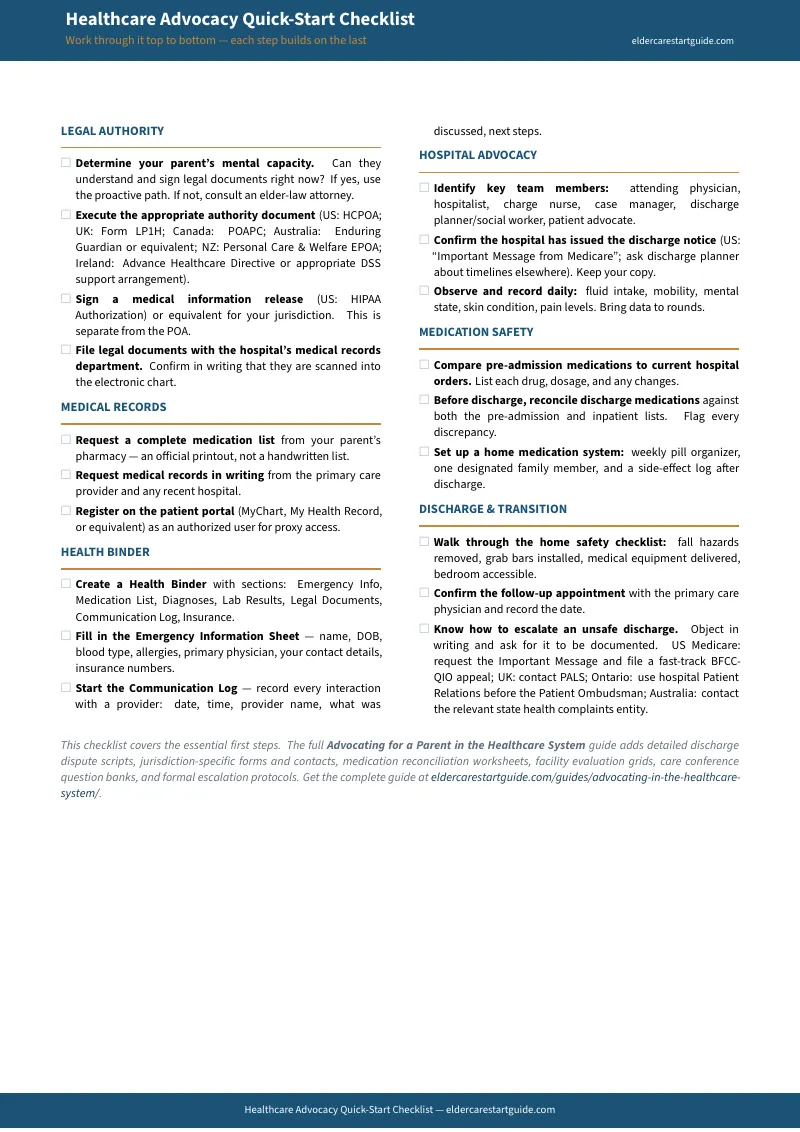
Download the free quick-start checklist to see the advocacy framework in action — or get the full Healthcare Advocacy Toolkit with every template, script, worksheet, and escalation contact you need to protect your parent in any healthcare system.