
The Conversation You Keep Putting Off Is Getting More Urgent
You know you need to talk to your parent about what they want at the end of their life. You also know how it will go: they will get defensive, change the subject, or tell you to stop being morbid.
So you keep waiting — for the right moment, the right opening, the right words. Meanwhile, your parent's cognitive window is narrowing. Once they lose decision-making capacity — through advanced dementia, a major stroke, or sudden illness — they can no longer legally sign an advance directive or appoint a healthcare proxy. Every medical decision then falls to whoever happens to be standing in the emergency room, with no written guidance, under enormous pressure, while your siblings text conflicting opinions from different time zones.
The Advance Care Planning Command Center replaces that crisis with a structured process — one that starts with your parent's values and life story (not medical jargon), moves through the legal documents in the right order, aligns your family before a disagreement becomes a courtroom fight, and gives you a bedside reference for when the medical decisions actually arrive.
What's Inside the Toolkit
- Values-First Conversation Scripts — open-ended prompts that start with your parent's memories, beliefs, and priorities instead of medical scenarios. These bypass the defensiveness that shuts down the typical "we need to talk about death" conversation, because you are asking about their life, not their funeral
- Advance Directive Walkthrough — plain-language explanation of every section, with side-by-side examples of how to translate vague statements like "I don't want to be kept alive on machines" into specific instructions a doctor can follow. Covers the difference between a living will, healthcare proxy, and durable power of attorney for healthcare — and why most families need all three
- Healthcare Proxy Appointment Guide — how to choose the right person, formally appoint them, and have the conversation most families skip: what should the proxy do when your parent's written wishes conflict with the medical team's real-time recommendation?
- POLST/MOLST vs DNR Comparison — which document does what, who signs it, where it needs to be posted, and the critical difference between an in-hospital DNR order (which only applies inside the hospital) and an out-of-hospital POLST that EMS is actually required to follow during a 911 call
- Dementia Planning Timeline — stage-by-stage framework for families navigating cognitive decline. Covers when documents must be signed (before capacity narrows), how to adapt conversations as comprehension changes, when to involve a capacity evaluator, and how surrogate decision-making works after capacity is lost
- Sibling Alignment System — a structured family meeting agenda, a care-sharing task menu organized by each person's availability and location, and a perception-gap worksheet that surfaces the core disconnect: the local caregiver witnesses daily decline while the visiting sibling sees Mom on a "good day" and thinks the situation is being exaggerated
- Palliative Care vs Hospice Decision Tree — when each applies, what Medicare covers under each, how to request a palliative care consult without "giving up," and the eligibility, enrollment, and revocation rules for hospice that most families learn about too late
- Comfort Care Emergency Kit — a bedside reference covering pain management protocols, symptom escalation contacts, medication schedules, who to call when symptoms change, and when to call 911 versus when calling 911 will override your parent's documented wishes
- 50-State Jurisdictional Form Finder — quick-reference table mapping the correct advance directive, healthcare proxy, and POLST form names across all US states, Canadian provinces, UK nations, and Australian states, so you know exactly which forms to download for your location
Who This Is For
This toolkit is built for adult children navigating the advance care planning process for an aging parent.
- Families who have not started the conversation — and need a way in that does not trigger defensiveness or family conflict
- Sandwich generation caregivers — juggling work, children, and a parent who needs help, with no time to research legal forms, Medicare rules, and hospice eligibility separately
- Long-distance family members — who need a shared framework to coordinate care planning with siblings and local caregivers across state lines
- Families facing early-stage dementia — who know the documentation window is closing and need to act before a capacity evaluation changes the legal landscape
- Primary caregivers carrying the full load — who need an objective framework to distribute responsibility instead of absorbing it all alone
Why Not Free Resources?
You can find advance directive forms on government websites, conversation starters from The Conversation Project, and Five Wishes pamphlets for a few dollars. Each one covers a narrow slice of the process without connecting it to what comes before or after.
Government sites give you blank statutory forms but no guidance on how to introduce them to a parent who gets defensive at the mention of end-of-life planning. The Conversation Project helps you start the talk but does not cover the legal documents, Medicare rules, or family coordination that follows. Five Wishes addresses personal and spiritual preferences but does not include daily caregiving logistics, sibling mediation, or the POLST that EMS actually follows during a 911 call.
The gap is not information — it is sequence. Free resources tell you what the pieces are. This toolkit tells you what to do first, what to do next, and how to handle the family dynamics, legal requirements, and medical decisions in the right order.
What You Get
Your download includes 12 PDFs — the complete guide, a quick-start checklist, and 10 standalone worksheets you can print and use immediately:
- guide.pdf — The complete guide (14 chapters plus appendices)
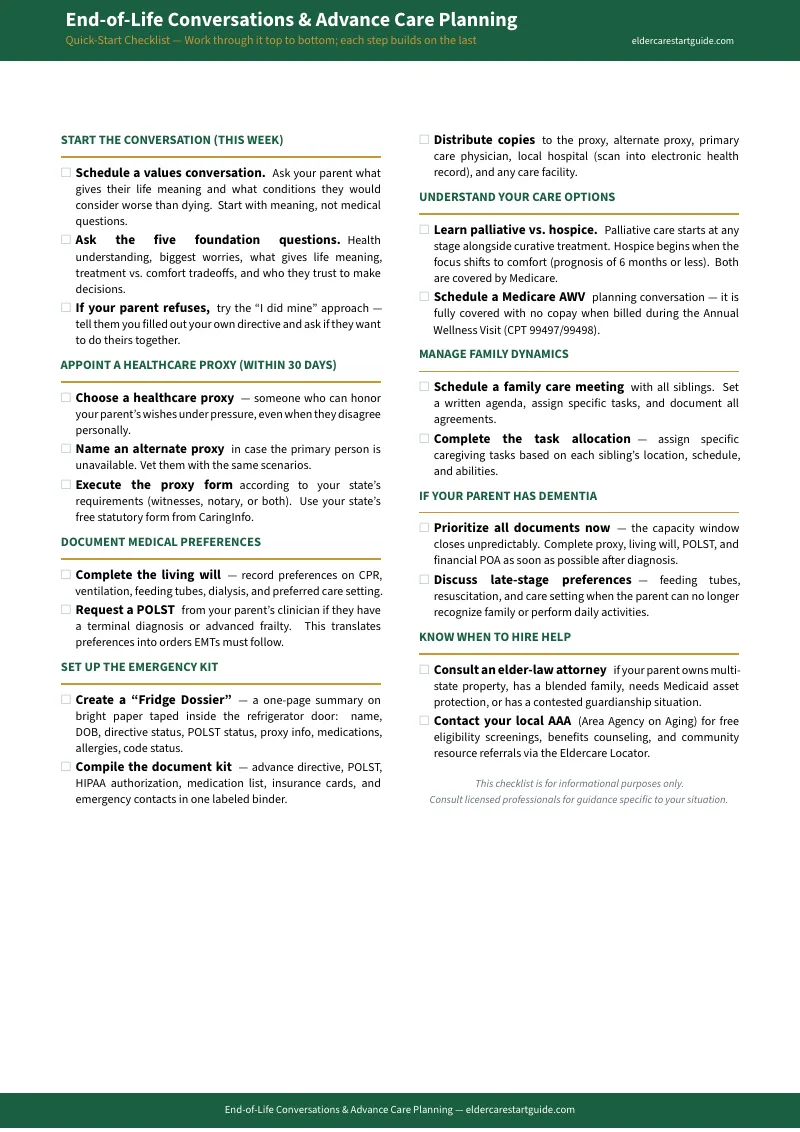
- checklist.pdf — Quick-start checklist with the 20 most critical action items
- values-conversation-worksheet.pdf — Fill-in worksheet for the values conversation
- proxy-designation-worksheet.pdf — Record your parent's chosen healthcare proxy
- living-will-preferences-worksheet.pdf — Document specific medical treatment preferences
- polst-readiness-checklist.pdf — Pre-appointment checklist for the POLST conversation
- palliative-hospice-decision-worksheet.pdf — Side-by-side comparison and decision questions
- dementia-planning-worksheet.pdf — Track critical planning steps as capacity narrows
- sibling-task-allocation-worksheet.pdf — Distribute caregiving tasks by availability
- emergency-document-kit-checklist.pdf — Assemble everything the hospital needs in one binder
- jurisdictional-form-finder.pdf — Find the correct forms for your state or country
- document-tracking-checklist.pdf — Master tracker for every document in the care plan
Free version: Download the Quick-Start Checklist — 20 action items covering the essential advance care planning steps, from the first conversation through document completion and emergency kit setup.
Full toolkit: The complete guide with conversation scripts, document walkthroughs, decision trees, and all 10 standalone worksheets — everything you need to move from "we should talk about this" to "it's done."
— Less Than 10 Minutes of an Elder-Law Attorney's Time
An elder-law attorney charges $195 to $500 per hour. A Geriatric Care Manager charges $100 to $250 per hour for initial assessments. Families who walk into those appointments disorganized spend thousands in billable hours sorting through basics that could have been prepared at home.
This toolkit costs a fraction of one professional hour — and it ensures that when you do hire an attorney, you arrive with your parent's wishes documented, your family aligned, and your questions organized. That preparation alone can save you more than the cost of the toolkit in the first fifteen minutes of a consultation.
Every purchase is a one-time payment. No subscriptions. No recurring fees. If the toolkit does not give you a clear, actionable process for planning your parent's care wishes, reach out and we will make it right.