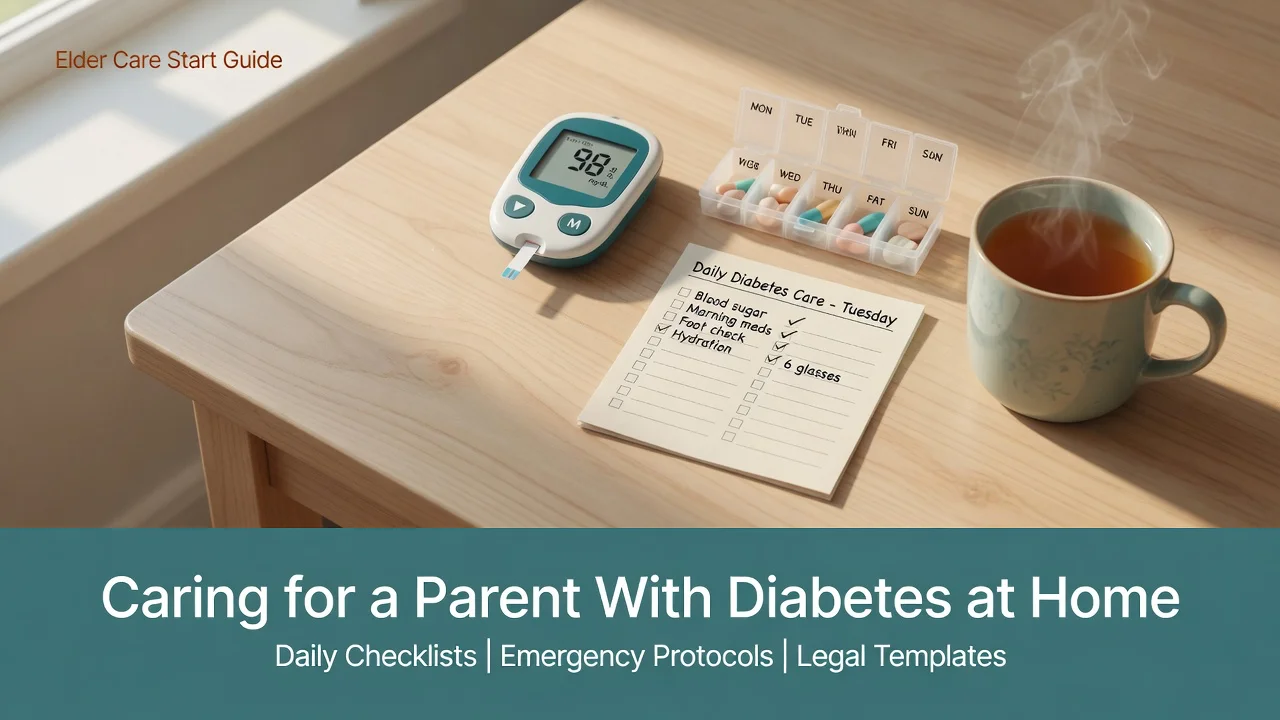
Your Parent Has Diabetes. The Hospital Sent Them Home. Now What?
You are standing in the pharmacy trying to figure out which test strips go with the glucometer the discharge nurse handed you, while your phone buzzes with a text from your sister asking if Dad ate lunch. Nobody taught you how to check for foot ulcers or what to do when a blood sugar reading of 52 mg/dL shows up on the screen at 2 AM. Every article you find online is either a medical textbook written for endocrinologists or a generic "tips for caregivers" listicle that says "monitor blood sugar regularly" without explaining what the numbers actually mean.
Meanwhile, the stakes are concrete: one severe hypoglycemic episode doubles an older adult's risk of dementia. A small cut on a neuropathic foot can progress to bone infection within days. And if you are paying yourself out of your parent's savings for the care you provide without a formal contract, Medicaid will classify every dollar as a disqualifying gift when the look-back audit comes.
The Diabetes Home Operations System
The Caring for a Parent With Diabetes at Home toolkit bridges the gap between what the medical system assumes you know and what you actually need to execute every day. It is a 60-page operational manual and template suite that replicates the structural framework of a private geriatric care assessment — the same assessment that costs $1,500 to $2,000 when ordered through an Aging Life Care professional — translated into printable daily checklists, emergency protocols, legal templates, and care coordination tools that work for family caregivers managing diabetes without clinical training.
This is not another collection of medical definitions. It is a day-by-day operating system: what to check at 7 AM, what to log after each meal, when to call the doctor, when to call 911, and how to keep your parent safe between appointments.
What Is Inside
- Tiered Daily Care Checklists (3 versions) — because a healthy 72-year-old and a frail 86-year-old with dementia need completely different monitoring. Each version tracks blood glucose, medications, meals, hydration, and physical activity on a morning-afternoon-evening schedule you can hand to a home health aide on day one.
- Hypoglycemia & Hyperglycemia Emergency Protocols — the Rule of 15, clinical thresholds for when to treat at home versus when to call emergency services, and a critical warning about stroke mimics. Severe hypoglycemia in older adults can present as sudden one-sided weakness or aphasia — if a caregiver does not know this, they delay glucose treatment while assuming it is a stroke.
- Consolidated Medication Schedule Template — designed for the reality of polypharmacy, where your parent takes medications from three prescribers and nobody has reconciled the list. Includes a Beers Criteria reference so you can flag high-risk drugs (like glyburide) with the physician at the next appointment.
- Weekly Diabetic Foot & Skin Inspection Checklist — goes beyond "look for cuts" to cover peripheral circulation assessment using the back-of-hand temperature test, safe moisturizing protocol (never between the toes), proper nail trimming, and the specific warning signs that require an immediate podiatric referral.
- Dementia-Friendly Behavioral Logs — for parents with coexisting cognitive decline where standard verbal instructions do not work. Built around sensory routines, environmental cues, and passive monitoring with CGM family-sharing rather than daily finger sticks that trigger agitation.
- Medicaid-Compliant Personal Care Agreement — a contract template for family caregivers receiving payment from a parent's savings. Structured with prospective payment language, local market rate documentation fields, and dated task logs — the three elements Medicaid caseworkers look for during the five-year look-back audit. Without this documentation, family payments are classified as uncompensated asset transfers and trigger eligibility penalties.
- HIPAA Right of Access Request Scripts — pre-written letters for securing medical records and establishing formal proxy access to patient portals. Sharing your parent's MyChart login is a compliance vulnerability; proxy access creates an auditable, attributed record of every message and medication renewal.
- Home Safety Audit & Shift-Handoff Log — a weekly environmental safety checklist for fall-prone diabetic seniors with neuropathy, plus a structured handoff log for coordinating care notes between family members and paid aides without anything falling through the cracks.
- Sibling Care-Needs Assessment Worksheet — an ADL/IADL scoring tool that turns "I think Mom is fine" versus "Mom cannot live alone" into a quantitative evaluation. Takes the emotion out of sibling disagreements about care level by putting objective numbers on the table.
Who This Is For
This toolkit is for adult children and family caregivers managing an elderly parent's type 2 diabetes at home — whether you are the primary hands-on caregiver, coordinating care from another state, juggling caregiving with your own job and family, or trying to get uninvolved siblings to help share the workload.
It is especially useful if your parent was recently discharged from the hospital with diabetes management instructions you do not fully understand, if your parent also has dementia or cognitive decline, or if you are paying yourself from your parent's funds and need Medicaid-defensible documentation.
Why Free Online Resources Are Not Enough
The ADA publishes rigorous clinical guidelines — but they are written for physicians, not for the daughter who just learned what "polypharmacy" means last Tuesday. AARP and the NIH offer excellent educational content, but they do not provide printable daily checklists, fillable medication schedules, or legally structured caregiver contracts. Etsy sells caregiver binder templates for a few dollars, but they are designed by graphic designers with no clinical background — they track "daily mood" but miss diabetic foot temperature checks, hypoglycemia emergency protocols, and Beers Criteria medication flags.
This toolkit fills the structural gap between authoritative clinical information and the daily operational tools a family caregiver actually needs to use at 8 AM.
Start With the Free Checklist
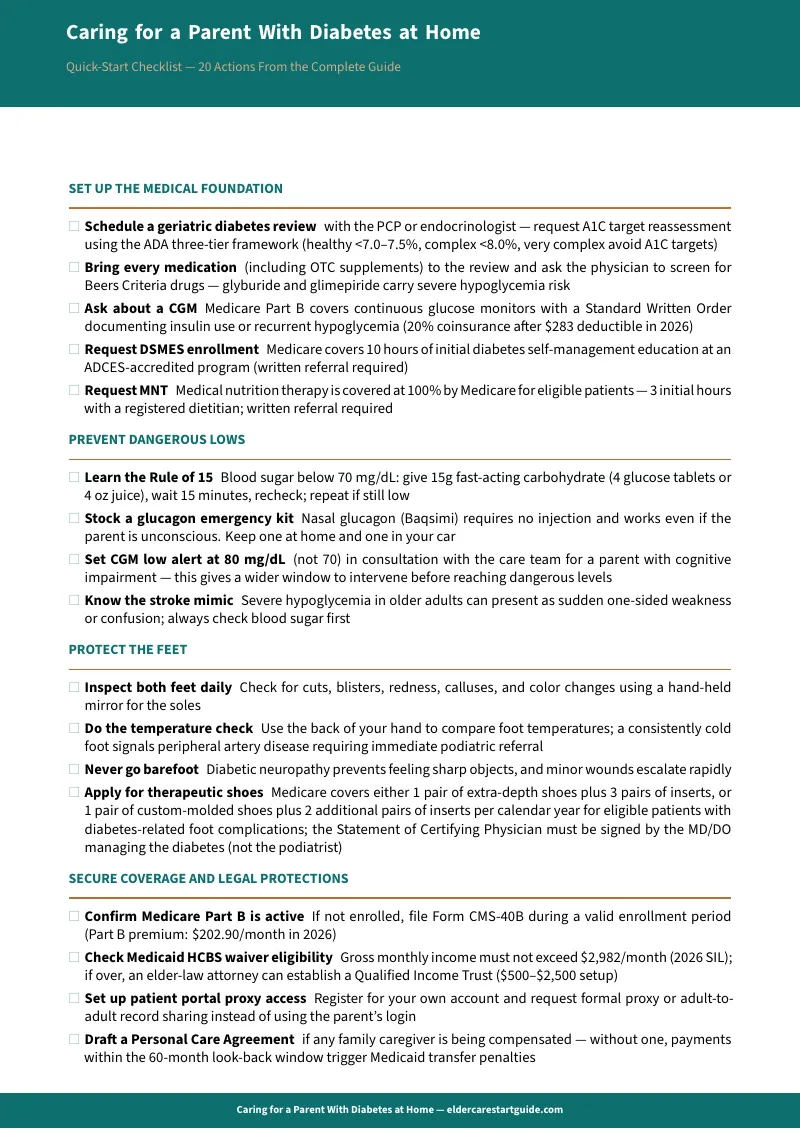
Download the free Quick-Start Checklist — a single-page emergency reference and daily care summary you can print and post on the refrigerator tonight. It covers the immediate essentials: blood sugar thresholds, the Rule of 15 for hypoglycemia, and a post-discharge home safety sweep.
When you are ready for the complete system — the tiered daily checklists, the medication schedule, the foot care protocol, the legal templates, the care coordination tools — the full toolkit has everything organized in one place so you can stop rebuilding it from scratch every morning.
Get the Caring for a Parent With Diabetes Toolkit →
Covered by our satisfaction guarantee. If the toolkit does not help you organize your parent's care, email us and we will refund your purchase — no forms, no justification needed.