
The Move Can't Wait. Your Parent Can't Do It Alone. And Google Isn't Going to Sequence It for You.
Your parent's house has become too much — the stairs, the maintenance, the isolation. A fall, a diagnosis, or a quiet conversation you've been putting off has made it clear: the move needs to happen.
But "needs to happen" and "knowing what to do first" are very different things. You're staring at a house packed with forty years of belongings, a sibling group chat that's going in circles, and a set of financial rules you've never encountered before. Medicaid lookback penalties. Capital gains exclusions. Power of attorney types you didn't know existed until a hospital social worker mentioned them.
Free articles cover pieces of this. AARP gives you a three-paragraph overview of the emotional side. A Place for Mom gives you a facility directory disguised as advice. Etsy gives you a pastel checklist designed by someone who's never navigated a dementia transition or a Medicaid application.
None of them sequence the steps. None of them tell you what to do before the sort, before the sale, before the move — in the order that protects your parent's finances and your family's relationships.
The Elder Transition Blueprint
The Downsizing a Parent's Home toolkit is a complete, sequenced transition system — not a moving checklist with a compassionate font. It covers the legal and financial decisions that must happen before you touch a single box, the sorting methodology that prevents sibling blowups over heirlooms, and the move-day logistics that reduce the clinical risk of Relocation Stress Syndrome.
Every chapter is ordered by when it matters: legal audit before the sort, sort before the sale, sale before the move. Skip a step or do them out of order, and you're looking at Medicaid penalty periods, taxable capital gains you could have avoided, or a parent whose health deteriorates because the transition was rushed.
What's Inside
A 13-chapter guide plus 10 standalone printable worksheets you can take to the attorney, the sibling meeting, or move day:
- Conversation Scripts for Resistant Parents — because telling a parent "we need to talk about the house" triggers the defensive shutdown that stalls most families for months. These validation-based frameworks acknowledge your parent's attachment to their home before introducing the logistics. Print the script card and write the words you will actually say.
- The Medicaid Lookback Audit — the 60-month lookback rule explained in language a non-lawyer can act on. Which transfers trigger penalty periods, how the penalty math actually works, and the legally recognized exceptions (caregiver child, disabled child, sole-benefit trust) that let you protect assets without running afoul of Medicaid eligibility. Includes a printable transfer ledger.
- Room-by-Room Sorting System — start with low-emotion spaces (garage, guest room, basement), build momentum, and save the sentimental items for last. The Keep / Sell / Donate / Toss / Ask Family framework with a strict no-maybe rule that breaks decision paralysis. Includes an heirloom rotation protocol for when multiple siblings want the same piece.
- Home Sale Timing Matrix — a printable worksheet to coordinate the sale with the Section 121 capital gains exclusion, Medicaid planning windows, and your parent's living situation. Pre-listing repairs that affect the sale price versus cosmetic upgrades that waste time and money.
- Professional Team Evaluation — when to hire a Senior Move Manager, an elder law attorney, a Seniors Real Estate Specialist, or a geriatric care manager — and when you're paying for services you don't need. Interview questions, credential checks, and cost benchmarks for each professional.
- Benefit Transition Checklist — a printable tracker for transferring Medicare, supplemental insurance, prescriptions, and VA benefits to the new address and provider network. Mail forwarding, utility disconnection schedules, and the subscription cancellations everyone forgets.
- Sibling Coordination Worksheets — task delegation based on each person's actual capacity, not guilt or proximity. Communication templates for the out-of-town sibling, the disengaged sibling, and the sibling who disagrees with the plan entirely.
- Move Day Protocol — a day-one essentials bag, packing timelines calibrated for seniors, and room setup at the destination to replicate familiar spatial layouts and reduce Relocation Stress Syndrome risk. Plus 30-day, 90-day, and 6-month settling checklists.
- Special Situations — downsizing a parent with dementia (timing around sundowning, consistent family scripts, memory anchoring objects), hoarding scenarios, and long-distance moves across state lines.
Who This Is For
- The adult child running point on the transition — you live nearby and you're managing the physical move around your job, your own family, and a parent who isn't making this easy. You need a plan that fits your actual schedule, not a motivational article.
- Distance caregivers — you're hundreds of miles away and your next visit is a long weekend. You need an operational blueprint that lets you accomplish in four days what local families spread across four months.
- Families in crisis mode — a hospital discharge, a fall, a dementia diagnosis that means your parent can no longer live alone. The 6-month timeline compresses when the clinical timeline demands it, and the guide shows you which steps to prioritize when you don't have the luxury of planning ahead.
- Sibling groups who need a shared playbook — everyone gets the same information, the same timeline, and assigned tasks. It replaces circular group-chat debates with a written structure.
Why Not the Free Stuff?
Free resources exist. You've probably already spent hours reading them. Here's what they don't do:
- They don't sequence the steps. AARP publishes an article on the emotional side. A real estate blog covers staging for a senior home sale. A legal site explains Medicaid lookback. None of them tell you which comes first, which triggers which, or what happens when you do them out of order.
- They don't cover the financial traps. A gifted asset during the lookback period can create months of Medicaid ineligibility — after your parent has already spent down their savings. A poorly timed home sale can generate a taxable capital gain that a few months of planning would have avoided.
- They don't handle the family dynamics. The sorting process breaks down when siblings disagree about heirlooms, workload distribution, or whether the move should happen at all. Generic checklists assume a cooperative family. This guide plans for the one you actually have.
Satisfaction Guarantee
If the toolkit doesn't give you a clearer path forward within 48 hours of opening it, email us and we'll refund your purchase. No questionnaires, no hoops.
Get Started
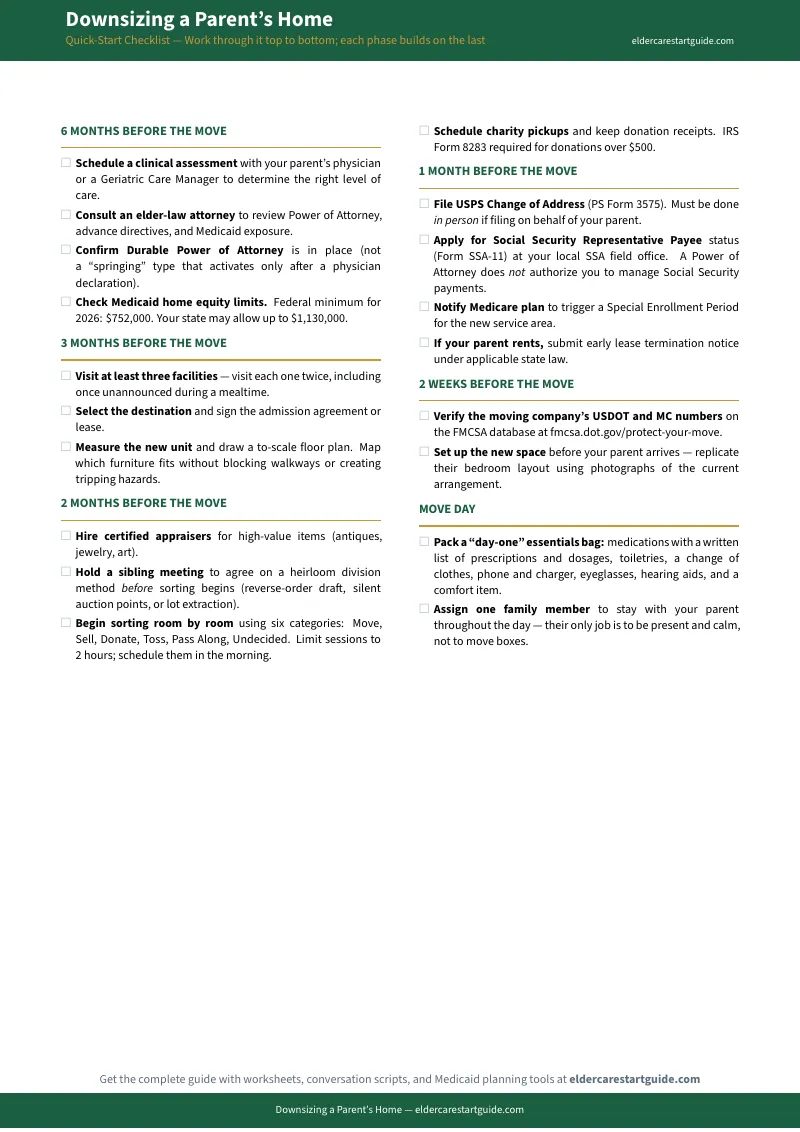
The free checklist gives you the 19 most critical action items — enough to stop the feeling of paralysis and start making progress tonight.
The full Downsizing a Parent's Home toolkit gives you the complete system: 13 chapters plus 10 printable worksheets — conversation scripts, the Medicaid lookback audit, sorting logs, professional team evaluation, sibling coordination, and a 6-month timeline with every step in the right order.
For less than a single hour with a Senior Move Manager, you get the plan that makes every professional hour you do spend count.