Your parent is losing $202.90 every month — and DC funds a programme that can stop it
That $202.90 Part B premium leaves your parent's Social Security check before a dollar hits the bank. On a fixed income of $1,800 or $2,400 a month, it's a devastating monthly cut — before rent, utilities, groceries, or prescriptions enter the picture. Add Original Medicare's deductibles and coinsurance, and the out-of-pocket total can push past $6,600 a year.
You've searched for help. Every result for "help paying Medicare in DC" lands on a site that wants your parent's phone number so a licensed agent can call back to sell a Medicare Advantage plan. The District Direct portal is a redirect labyrinth — DC Health Link sends you to District Direct, District Direct sends you back to DC Health Link, and neither one tells you what to do next. National websites list federal income limits around $1,300 a month and a $9,950 asset test. In the District of Columbia, neither of those figures applies. DC expanded QMB income eligibility to $4,010 a month for a single person and eliminated the asset test entirely. The families who need the most help are the ones most likely to give up before they find that out.
Meanwhile, the Part B premium keeps hitting the Social Security check. The drug copays keep stacking. And your parent keeps paying for benefits they may already qualify to have covered.
The DC Medicare Cost-Relief System
This is a step-by-step operating manual for cutting your parent's Medicare costs through every layer of help available in the District of Columbia — without surrendering contact information to a broker, without waiting weeks for a DC SHIP counsellor appointment, and without navigating the District Direct portal blind.
It covers the Medicare Savings Programs — principally QMB, because DC's 300% FPL expansion makes separate SLMB and QI categories operationally irrelevant in the District — that eliminate the Part B premium and all deductibles and coinsurance. It covers Extra Help, the federal Part D subsidy that MSP approval automatically triggers, slashing drug copays to a few dollars per prescription. The District eliminated the asset test entirely: a home, savings, retirement accounts, vehicles — none of it counts. Each layer stacks. Most eligible families are enrolled in zero.
What's Inside
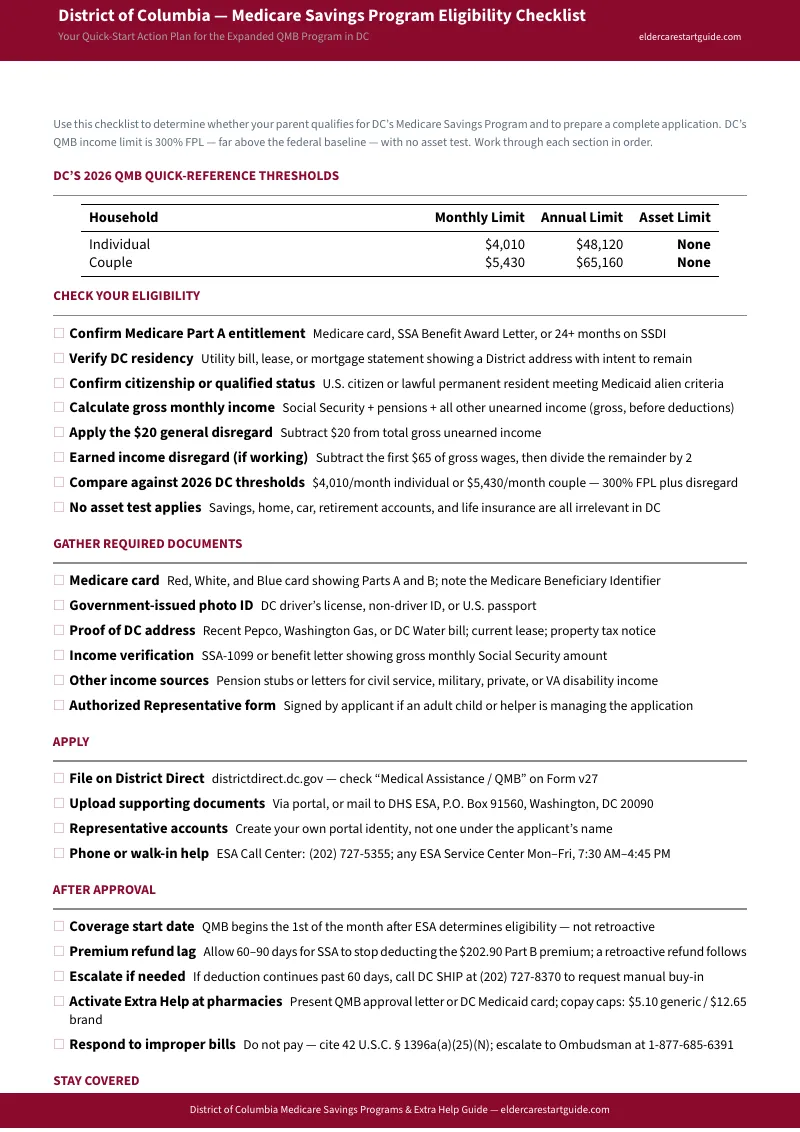
- The 2026 DC eligibility breakdown — QMB income limits of $4,010/month (individual) and $5,430/month (couple) as the District applies them, plus the complete elimination of the asset test. Worked examples showing how the $20 unearned income disregard, the earned-income exclusion ($65 + 50% of the remainder), and VA pension disregards reduce a parent's countable income below the published ceiling.
- The District Direct application walkthrough — Step-by-step filing through the District Direct online portal, by paper at an ESA service centre (Taylor Street NW, H Street NE, MLK Jr. Avenue SE, and others), or by certified mail to the DHS ESA Case Record Management Unit (P.O. Box 91560). How to avoid the DC Health Link redirect loop, how to establish Authorized Representative status for out-of-state caregivers, and what documents to gather before starting.
- Why SLMB and QI don't exist here — In most states, Medicare Savings Programs run on three tiers with progressively less help. Because DC's QMB ceiling is 300% FPL — far above all three federal tier thresholds — everyone who would qualify for SLMB or QI elsewhere receives full QMB benefits in DC: Part A premiums, Part B premiums, all deductibles, all coinsurance, and all copayments. The guide explains why this matters and what it means for your parent's application.
- Extra Help coordination — Why MSP approval automatically deems a beneficiary eligible for the federal Extra Help subsidy (no separate application needed), how Extra Help eliminates the Part D deductible and caps drug copays at $5.10 for generics and $12.65 for brand-name drugs, and how the SSA-to-DHCF data exchange works in practice — including the multi-month lag that leaves families in limbo unless they know where to check.
- Part A buy-in for seniors without 40 work quarters — DC is a Part A buy-in jurisdiction. If your parent lacks premium-free Part A, QMB approval triggers Part A enrolment at any time of year — no General Enrollment Period wait, no late-enrolment penalties. The guide walks through the conditional Part A process and what it costs without QMB ($311–$565/month).
- QMB billing protection steps — Federal law prohibits Medicare providers from billing QMB enrollees for deductibles, coinsurance, or copayments. Automated billing systems send those bills anyway — DC families report it constantly. The guide gives you the statutory citation (42 U.S.C. § 1396a(n)(3)(B)), the steps to challenge the bill, and the escalation contacts including the DC Health Care Ombudsman and Bill of Rights Program.
- Post-approval timeline — After ESA approves the MSP, Social Security keeps deducting $202.90 while the DHCF-to-CMS-to-SSA data exchange processes — typically one to three months. The guide maps when the deduction stops, how retroactive reimbursement works, and what to do if the timeline stalls.
- Income disregard calculations — DC uses Non-MAGI counting rules that most families don't know about. The $20 general disregard, the earned-income exclusion, and special disregards for VA pensions and certain Social Security adjustments — with worked dollar examples showing how a parent with gross income above the published limit can still qualify after disregards are applied.
- The zero-asset rule — DC completely eliminated the asset and resource test for its Medicare Savings Programs. Property, savings accounts, retirement funds, vehicles, and any other assets are entirely excluded. National websites that list the federal $9,950 individual resource limit do not apply in the District of Columbia.
- Renewal system — ESA passive versus active redetermination, the 30-day response window, change-reporting rules, the 90-day grace period for late or missing renewals, and how to avoid gaps in coverage between renewal cycles.
- Denial and appeal roadmap — How to request a fair hearing through the DC Office of Administrative Hearings (OAH) at 441 4th Street NW Suite 450N, the 90-day filing window, how to request continuation of benefits (aid continuing) by filing within the 30-day advance notice window, and what evidence to prepare.
The Complete Toolkit
- 49-page guide — 15 chapters covering every programme, every step, and every edge case a District of Columbia family faces
- Eligibility checklist — Confirm qualification for QMB and Extra Help in minutes
- MSP eligibility worksheet — Record income sources, apply all DC-specific disregards, and determine whether your parent qualifies
- Application document checklist — Check off every required document before filing through District Direct or at an ESA service centre
- Premium refund tracker — Track the 1–3 month refund window after MSP approval and calculate the expected lump sum
- QMB billing dispute log — Record every improper bill by provider, date, and amount through resolution
- Balance billing dispute letter — Ready-to-send letter citing the federal prohibition and requesting a zero-balance statement
- Renewal calendar — 12-month timeline with change-reporting log and the 90-day grace period deadlines
- Agency communication log — Record every call to ESA, DHCF, SSA, DC SHIP, and providers with dates, names, and reference numbers
- Quick-reference fridge sheet — 2026 income limits, key contacts (ESA (202) 727-5355, OAH 441 4th St NW Suite 450N), and critical deadlines on one page
- QMB billing protection steps — Step-by-step dispute resolution card with the statutory citation and escalation contacts
Who This Is For
- Adult children managing a parent's Medicare costs in the District of Columbia — whether you live in DC, suburban Maryland, Northern Virginia, or across the country
- Seniors on fixed income paying the full $202.90 Part B premium and wondering if there's help
- Families who read the federal eligibility limits online and assumed their parent earns too much — without knowing that DC's QMB limit is $4,010 a month and that the District has no asset test at all
- Anyone who tried the District Direct portal, got caught in the DC Health Link redirect loop, and gave up
- Out-of-state adult children who need to manage a parent's ESA case remotely and don't know how to establish Authorized Representative status
- Caregivers who received a DHS notice — a verification request, a denial, or a renewal packet — and need to know what it means before the deadline passes
- Families helping a parent without 40 work quarters navigate Part A enrolment through QMB
- Retired DC government employees or their spouses who were affected by the now-repealed GPO and WEP provisions and need to recalculate their income for MSP eligibility after the Social Security Fairness Act
- Anyone searching for a DC prescription drug assistance programme and finding outdated references — the District does not operate a standalone SPAP; the pathway is MSP to automatic Extra Help
Why Not Just Use the Free Resources?
The free resources are real. DC SHIP counsellors (the State Health Insurance Assistance Program, hosted within the Department of Aging and Community Living) are excellent, unbiased, and entirely free. ESA accepts applications through District Direct. Medicare.gov lists the federal rules.
But here's what the free path looks like in practice:
- DC SHIP call volumes spike dramatically during the Medicare Open Enrollment period (October 15 to December 7), and counsellor expertise on complex topics — income disregards, billing disputes, OAH appeals — varies by appointment
- District Direct is a shared intake portal for all DC public assistance programmes, and the DC Health Link redirect loop is a documented source of frustration — families trying to file an MSP application regularly bounce between two portals without reaching the right form
- ESA service centres on Taylor Street NW, H Street NE, and MLK Jr. Avenue SE involve long queues, and caseworker familiarity with Non-MAGI eligibility rules varies — staff primarily handle MAGI Medicaid, SNAP, and TANF
- National websites list the federal $9,950 resource limit and income ceilings around $1,300 a month — neither applies in DC, but families self-disqualify without ever applying
- Legal Aid DC and Legal Counsel for the Elderly provide free representation, but their staff capacity forces them to prioritise acute legal crises — active evictions, debt collection, termination of home care waivers — over routine application guidance
The guide does not replace these free services. It prepares you to use them effectively — with the right forms, the right documents, the right eligibility calculation, and the right questions — so you don't waste the appointment, the queue time, or the 30-day deadline on a fixable mistake.
Satisfaction Guarantee
Full refund, no time limit. If the guide doesn't help, email [email protected] and we'll refund it — no questions, no hassle.
Get the complete DC Medicare Savings toolkit and start the application that could save your parent over $2,400 a year in premiums alone — plus every deductible, coinsurance charge, and drug copay that QMB and Extra Help eliminate.
Already downloaded the free checklist? Upgrade to the full guide →
Frequently Asked Questions
What if the rules change after I buy?
We update the guide when the rules change. Email us any time, even years later, and we'll send you the current edition free.