Your Parent Is Paying Medicare Costs Delaware Would Cover — If You Knew How to Apply
Every month, Delaware seniors on fixed incomes watch $202.90 disappear from their Social Security check before it reaches the bank. That is the standard Medicare Part B premium. Over a year, it is $2,434.80 — money that was supposed to pay for groceries, utilities, and the gap between getting by and not.
Delaware runs programs that eliminate that premium entirely. The Medicare Savings Programs (QMB, SLMB, QI) cover Part B — and QMB goes further, paying every Part A and Part B deductible and coinsurance charge as well. Approval automatically triggers Extra Help, which wipes out most Part D prescription drug costs. On top of that, the Delaware Prescription Assistance Program (DPAP) adds up to $3,000 per year toward medications and Part D premiums.
Most eligible families never apply. They assume their parent's modest savings disqualify them. They hear about a $2,000 asset limit on a forum and walk away. But Delaware has completely eliminated the asset test for all Medicare Savings Programs. Bank accounts, retirement funds, a home, a car — none of it counts. The only question is income, and a mandatory $20 monthly disregard raises the effective limit higher than most families realize.
The problem is not eligibility. The problem is the process.
The Delaware Medicare Cost-Help Navigation System
This guide is not a summary of program rules. It is a step-by-step navigation system built around the way Delaware actually processes these applications — through the ASSIST portal, through DSS State Service Centers, through the specific documents Delaware caseworkers need, and through the bureaucratic language that makes official notices impossible to act on without a translation.
Here is what the system covers:
Eligibility and Income Calculation
The 2026 income thresholds for QMB, SLMB, QI, QDWI, and DPAP — individual and couple — with the mandatory $20 disregard applied. A worked income calculation worksheet that mirrors how a DSS caseworker evaluates an application, including earned income exclusions, spousal deeming rules, and the Social Security Fairness Act adjustments for retirees whose benefits changed after WEP/GPO repeal. You will know your parent's countable income before submitting anything.
The Application Route Map
Five ways to apply, with specific guidance on each: Delaware ASSIST online portal, in-person at any of 19 DSS State Service Centers (mapped by county), by mail, by fax, and by telephone. The guide covers how to set up authorized representative access using the DSS Representative Consent Form — no Power of Attorney needed — so you can manage the entire process on behalf of your parent.
Document Preparation
The master checklist of every document a DSS caseworker needs to process an MSP or DPAP application: proof of identity, Medicare card, Social Security award letter, pension statements, and residency verification. Organized by priority so you submit a complete packet the first time, not a partial one that triggers a 30-day request for information and pushes the decision out by another month.
What Happens After Approval
When and how the Part B premium stops being deducted from Social Security. How QMB billing protections work — and what to do when a provider ignores them and sends a bill anyway (they are federally prohibited from doing so under 42 CFR 447.15). How Extra Help activates automatically. How DPAP processes prescriptions as a secondary payer after Part D. The timeline from application to actual money back in your parent's pocket.
Renewals, Denials, and Fair Hearings
Delaware's annual recertification process through the ASSIST portal. What a denial notice means, what the 95-day appeal window actually looks like in practice, and how to request "aid continuing" so benefits keep flowing while a fair hearing is decided. When to contact CLASI for free legal representation on a contested denial.
The DPAP Coordination Sheet
How Medicare Part D, Extra Help, and DPAP stack at the pharmacy counter — what pays first, what pays second, and where the state's $3,000 annual grant fills the gap. Includes the 2026 Part D redesign changes under the Inflation Reduction Act, with the new $2,100 annual out-of-pocket maximum that reshapes how low-income drug coverage works.
What You Get
- The full guide — 51 pages covering eligibility, income calculation, application routes, post-approval changes, billing protections, renewals, appeals, and DPAP coordination
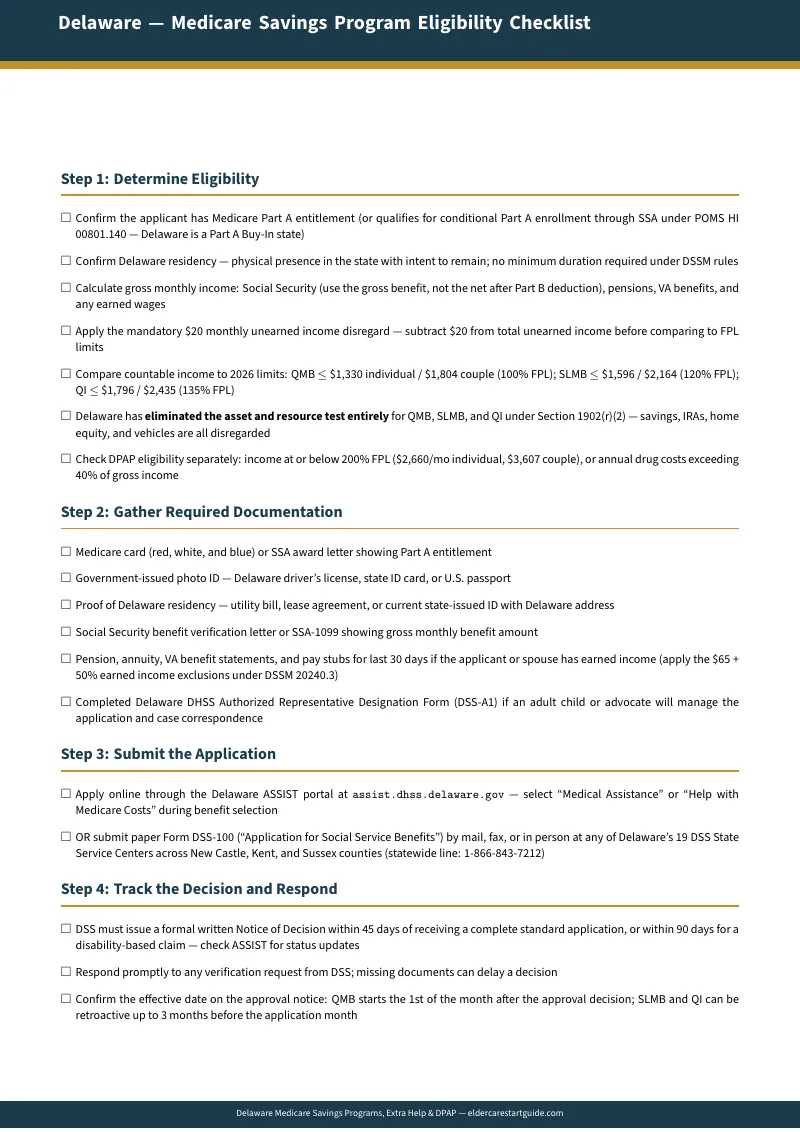
- The eligibility checklist — a two-page quick-reference covering income limits, documents needed, and application steps for all MSP tiers and DPAP
- MSP eligibility screening worksheet — fill-in income calculation that mirrors how DSS caseworkers evaluate an application, including the $20 disregard and earned income exclusions
- ASSIST application document checklist — check-off list of every document DSS needs for a complete submission, organized by category with space to track each item
- Agency communication log — fillable tracker for recording every call and visit with DSS, DMMA, SSA, DMAB, and Gainwell Technologies
- QMB billing dispute letter — ready-to-customize letter citing the federal prohibition for providers who improperly bill a QMB beneficiary for Medicare cost-sharing
- DPAP and Part D coordination tracker — log each prescription fill with Part D, Extra Help, and DPAP payments alongside your running $3,000 annual balance
- Annual renewal calendar — 12-month calendar marking MSP renewal deadlines, DPAP re-certification windows, Medicare Open Enrollment, and reportable changes
Who This Is For
- Adult children helping a parent in Delaware pay for Medicare — especially if the parent's Social Security check barely covers premiums and copays
- Seniors managing their own benefits who want a clear, start-to-finish process instead of scattered state agency pages
- Families who assumed their parent's savings disqualified them and never applied (Delaware's $0 asset rule means they probably qualify)
- Caregivers who need to navigate the system as an authorized representative without having Power of Attorney
- Anyone helping a QMB enrollee who received a medical bill they should not have been charged
Why Not Use Free Resources?
Free resources exist, and the guide points you to every one of them. The Delaware Medicare Assistance Bureau (DMAB) provides free counseling from trained volunteers. State agency websites publish eligibility rules. Medicare.gov covers federal program basics.
What none of them do is give you an organized system. DMAB counselors carry heavy caseloads and cannot maintain a personal document checklist, track your parent's application timeline, or prepare you for what each official notice means before it arrives. State portals explain rules but not the operational steps — they do not tell you that ASSIST's document upload frequently triggers submission errors, or that the application still asks about assets even though Delaware does not count them, or that the effective income limit is $20 higher than the published figure. Medicare.gov covers federal baselines but says nothing about Delaware's ASSIST portal, its 19 service centers, or DPAP.
This guide bridges the gap between knowing the rules and successfully navigating the process. It is the preparation you do before the DMAB appointment, the reference you keep beside the computer while filling out ASSIST, and the decoder you pull out when a letter from DSS arrives in language no family member was trained to read.
Your Money Back If It Does Not Help
If the guide does not help your family, email [email protected] for a full refund — no time limit, no questions.
Every month your parent stays unenrolled in programs they qualify for is another $202.90 that did not need to leave their Social Security check. The application takes about an hour when you know what to bring.
Get the Delaware Medicare Savings Guide — or download the free eligibility checklist to see if your parent qualifies before you decide.
Frequently Asked Questions
What if the rules change after I buy?
We update the guide when the rules change. Email us any time, even years later, and we'll send you the current edition free.