Your Parent Pays $202.90 a Month for Medicare Part B. Alabama Might Pay It for Them.
If your parent is on a fixed income in Alabama, Medicare premiums and doctor bills are eating into their Social Security check every single month. The Medicare Savings Programs — QMB, SLMB, and QI — exist specifically to stop this. Alabama Medicaid can pay your parent's Part B premium, and if they qualify for QMB, wipe out deductibles and coinsurance too. But the application has traps. The wrong district office. A missing disregard calculation. A caseworker who thinks bank accounts matter when they don't. One mistake can delay approval by months or get the application denied outright.
The Alabama Medicare Cost Relief System
This is a step-by-step process guide built specifically for Alabama — not a generic Medicare overview and not an insurance sales pitch. It covers the Medicare Savings Programs (QMB, SLMB, QI) and Extra Help (the Part D Low-Income Subsidy) the way Alabama actually administers them: Form 210 field by field, the correct district office for your parent's county, the income disregard calculation that published limits leave out, and what to do after approval when the premium keeps coming out of the Social Security check for another 60 to 90 days.
Every figure is dated to the 2026 benefit year. Every form reference, phone number, and office address has been verified against current Alabama Medicaid records.
What's Inside the Guide
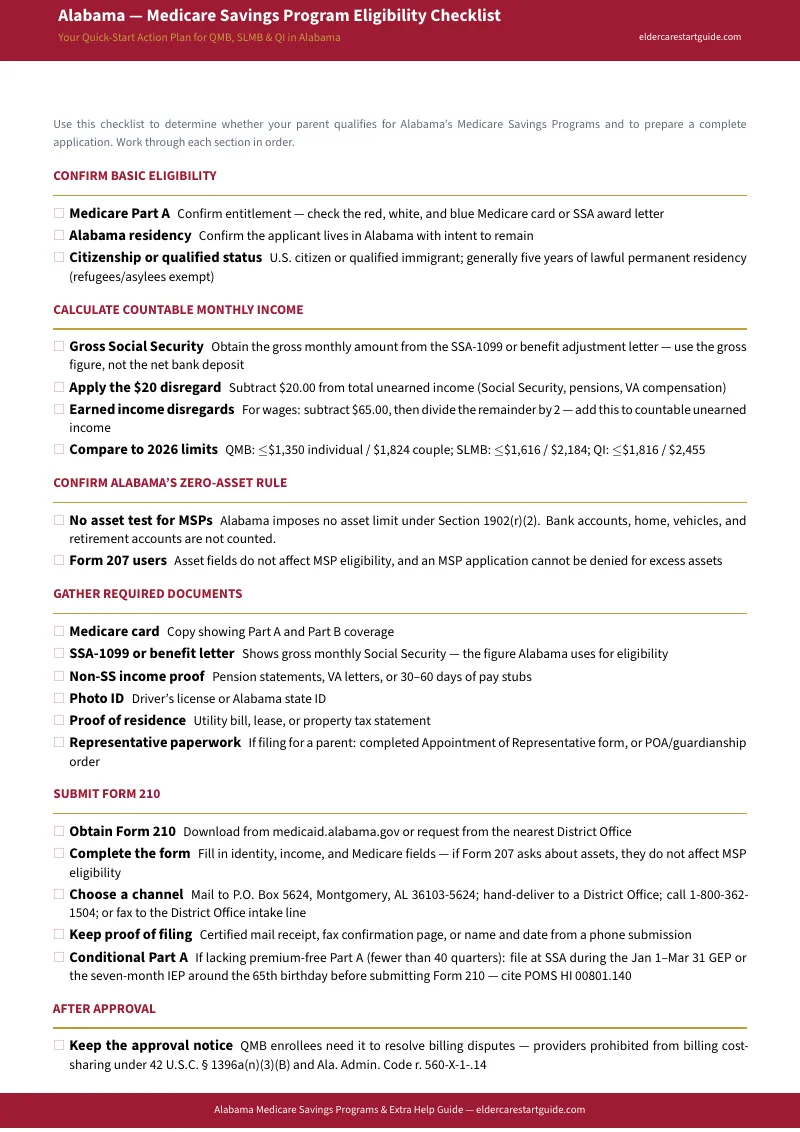
- Alabama's Zero-Asset Rule Explained — Unlike regular Medicaid, the Medicare Savings Programs in Alabama have no asset test. Bank accounts, home equity, vehicles, retirement funds — none of it is counted. The guide provides the Alabama Medicaid policy citations so you can shut down the "your parent has too much in savings" objection from anyone, including caseworkers who confuse MSP rules with standard ABD Medicaid.
- Form 210 Field-by-Field Walkthrough — Alabama's dedicated MSP application is shorter than most states' combined forms, but the income section trips up applicants who don't know about the $20 general income disregard. The guide shows which lines matter, what to write, and how to avoid the errors that trigger requests for additional information.
- Income Disregard Worksheets — Published income limits ($1,350/month QMB, $1,616 SLMB, $1,816 QI for an individual in 2026) are gross figures. Alabama subtracts a mandatory $20 general income disregard before comparing. The guide includes calculation worksheets so you know which program tier your parent actually falls into — not which one the raw numbers suggest.
- District Office Routing Map — Alabama Medicaid has 11 district offices, and the correct one depends on your parent's county of residence. The guide maps every Alabama county to its district office, with addresses, phone numbers, and the email submission route, so the application goes to the right place the first time.
- QMB Balance-Billing Dispute Protocol — Federal law prohibits providers from billing QMB enrollees for Medicare deductibles and coinsurance. Alabama providers do it anyway — especially smaller practices and rural clinics. The guide includes a dispute protocol with the specific federal citations (42 U.S.C. § 1396a(n)(3)(B), 42 C.F.R. § 447.15) and a letter framework to stop illegal bills before they go to collections.
- Conditional Part A for Seniors Without 40 Work Quarters — Alabama is a group payer state for Part A. If your parent lacks premium-free Part A, there is a specific two-step process — a Conditional Part A filing with Social Security during the January–March General Enrollment Period, followed by Alabama Medicaid Buy-In Unit notification. The guide scripts the exact conversation and documents needed. Missing the window means waiting a full year.
- Extra Help Auto-Conferral and SenioRx — MSP approval in Alabama triggers automatic Extra Help (Part D Low-Income Subsidy) — no separate SSA-1020 application needed. The guide also distinguishes Alabama SenioRx (a manufacturer assistance referral service) from true State Pharmaceutical Assistance Programs, since the two are routinely confused and serve completely different purposes.
- Renewal Tracking and Fair Hearing Deadlines — Alabama conducts annual recertification. Missing the renewal window means your parent's Part B premium snaps back to full deduction with no warning. The guide sets up a tracking system and covers the 30-day fair hearing request window if the renewal is denied.
- Remote Caregiver Filing Blueprint — If you live out of state and your parent is in Alabama, the guide covers how to establish legal authorization with Alabama Medicaid, submit the application by mail or email, and manage the approval process remotely — including the consent forms Alabama requires before they will discuss your parent's case with you.
Who This Guide Is For
- Adult children helping a parent in Alabama who is paying the full Medicare Part B premium on a fixed income
- Seniors in Alabama whose Social Security check is shrinking because of Medicare costs and who want to find out if the state will cover some or all of it
- Families who have been told their parent doesn't qualify because of savings or assets — and want to verify that against Alabama's actual rules
- Caregivers managing a parent's benefits from out of state who need a clear filing path through Alabama Medicaid
- Anyone helping a QMB enrollee in Alabama fight an illegal medical bill
Why Not Just Use the Free Information?
Alabama Medicaid publishes Form 210 as a fillable PDF — without a completion guide. The state website lists district offices — without mapping which counties go where. Federal sites confirm Alabama's zero-asset rule — while displaying the $2,000 standard Medicaid limit on the same page, confusing applicants into thinking they don't qualify. SHIP counselors provide excellent free guidance — but they cannot manage your submission log, act as your administrative representative, or draft a balance-billing dispute letter.
The information is scattered across Medicare.gov, medicaid.alabama.gov, SSA policy manuals, and Reddit threads where people piece together conflicting advice. This guide puts the Alabama-specific process in one place, in the order you need it, with the calculations already set up and the common traps flagged.
What's Not in This Guide
This guide does not recommend Medicare Advantage plans, Medigap policies, Part D drug plans, or insurance brokers. It does not provide legal advice. It is not affiliated with CMS, SSA, the Alabama Medicaid Agency, or any state agency. It is process navigation — the steps to get your parent's Medicare costs covered by programs that already exist, explained in plain language with Alabama-specific procedures.
For insurance plan comparisons, the guide directs families to Alabama SHIP (1-800-AGE-LINE), which provides free, unbiased counseling. For complex situations involving significant assets or contested guardianship, the guide recommends consulting an Alabama elder law attorney.
Satisfaction Guarantee
If the guide doesn't deliver what you expected, email [email protected] for a full refund. No time limit, no conditions.
Get Started
Download the free Alabama Medicare Savings Program Eligibility Checklist to see if your parent qualifies. If the numbers look right, the full guide gives you everything you need to file, follow up, and protect your parent's benefits after approval.
The full Alabama Medicare Savings Programs & Extra Help Guide is — less than a single month's Part B premium, for a process that can save over $2,400 a year.
Frequently Asked Questions
What if the rules change after I buy?
We update the guide when the rules change. Email us any time, even years later, and we'll send you the current edition free.