
Your Parent Needs Help at Home. You Have a NASC Referral, an interRAI Assessment Coming, and Nobody Has Told You What to Say.
Your parent fell last month. Or maybe it was the kitchen incident — the pot left on the stove, the smoke alarm going off while they stood confused in the hallway. Their GP said they need a needs assessment. The hospital discharge planner handed you a pamphlet about NASC and told you someone would call.
You found the government website. It says personal care is funded. Household management requires a Community Services Card. The interRAI assessment evaluates 236 items. But nobody has told you what actually happens in that assessment, why your parent being polite to the assessor could halve their funded hours, or that household help disappears entirely if your parent earns a dollar over the income threshold.
Meanwhile, the private agencies want $45 to $60 an hour and your parent insists they are managing fine.
The NZ Home Care System Navigator
This is not a directory of agencies you can find on the Health New Zealand website. It is the process around the system — the sequence of decisions, forms, conversations, and legal preparations that determines whether your parent gets two hours of funded help per week or daily support, and whether you burn out before the first reassessment comes around.
The guide covers the entire home care pathway from NASC referral through interRAI assessment preparation, Community Services Card qualification, funded hours allocation, Carer Support Subsidy claims, EPOA activation, home modifications, hospital discharge protocols, and reassessments — organised in the order a New Zealand family actually encounters them.
What's Inside
- The interRAI Preparation Protocol — The assessment scores your parent on worst-day performance. If they tell the nurse they "manage well," the algorithm allocates minimal hours. The guide shows you how to keep a five-day daily-struggle log, translate family descriptions into the clinical terminology (ADLs and IADLs) the system recognises, and document informal carer distress — which directly justifies funded respite allocations your family would otherwise miss entirely.
- The Community Services Card Gateway — Household management (cleaning, shopping, meal preparation) is only funded if your parent holds a CSC. The guide walks through the income thresholds for every applicant situation — single, couple, NZ Super recipient — and shows you how to check qualification before the NASC assessment, so you are not blindsided by a "not eligible for household help" result after the assessment is already done.
- The Four Funding Agencies — Mapped — New Zealand splits home care funding across Health NZ, Disability Support Services, ACC, and Work and Income. Most families only know about Health NZ. The guide maps all four agencies, shows which one takes priority in each situation, and explains the critical fact most families never learn: ACC-funded home help after a fall is not income-tested, not capped by CSC rules, and generally more generous than Health NZ allocations — but only if the attending doctor files an ACC claim.
- Carer Support Subsidy and the 1 April 2026 Flexible Funding Rules — For full-time carers providing more than four hours of daily unpaid care, the subsidy pays approximately $83 to $85 per day. Since 1 April 2026, updated purchasing rules restore flexibility — carers can use allocations for self-directed respite activities and support workers. The guide covers the $1,500 prior-approval threshold, the IRD IR56 tax classification for hired support carers, and the mandatory spending restrictions that apply to every claim.
- EPOA Activation — Before It Is Too Late — An ordinary Power of Attorney dies the moment your parent loses mental capacity. The guide explains the two separate Enduring Powers of Attorney (Property and Personal Care and Welfare), when each activates, how to get a medical capacity certificate, and what happens when no EPOA exists — including the cost and timeline of a Family Court application under the PPPR Act, which can run $3,000 to $7,000 in legal fees.
- Hospital Discharge Without Getting Ambushed — When your parent is admitted, the discharge clock starts immediately. The guide gives you the exact sequence: request the urgent NASC assessment within 48 hours, get the occupational therapist home safety assessment before discharge, confirm the care plan with provider allocation, and know your rights if the hospital pressures early discharge before support is in place.
- Reassessments and Getting More Hours — If your parent's health declines, you do not have to wait for the annual phone review. The guide covers the clinical triggers for an urgent reassessment, how to request one through the NASC, what documentation to prepare, and the difference between a routine annual review and a full clinical reassessment that can significantly increase funded hours.
- The Residential Care Subsidy Safety Net — If home care is no longer enough, the guide explains the Option A ($164,731 threshold, family home excluded) versus Option B ($300,811 threshold, home included) asset test, the five-year gifting lookback rules ($8,500/year couple limit), the interest-free Residential Care Loan for homeowners, and the application process — so the family home is protected before a crisis forces a rushed decision.
Plus: Printable Standalone Worksheets
- interRAI Assessment Preparation Worksheet — Five-day daily struggle log template, medication list, falls record, and carer distress self-evaluation
- Community Services Card Eligibility Calculator — Income thresholds for every applicant category with a step-by-step qualification check
- Carer Support Subsidy Claim Tracker — Days used, days remaining, spending log with the $1,500 prior-approval flagging
- EPOA Pre-Drafting Worksheet — Attorney decisions, powers scope, successor planning, and medical-directive preferences — completed before the solicitor appointment to reduce billable hours
- Home Safety Assessment Checklist — Room-by-room walkthrough covering grab rails, lighting, trip hazards, bathroom modifications, and kitchen safety
- Provider Comparison Worksheet — Side-by-side evaluation of contracted home support agencies: services offered, staffing continuity, rostering flexibility, and complaint history
- Quick Reference Sheet — All key forms, phone numbers (NASC, CSC, Carer Support, ACC, HDC complaint line), deadlines, and thresholds on one printable page
Plus: Printable Quick-Start Checklist
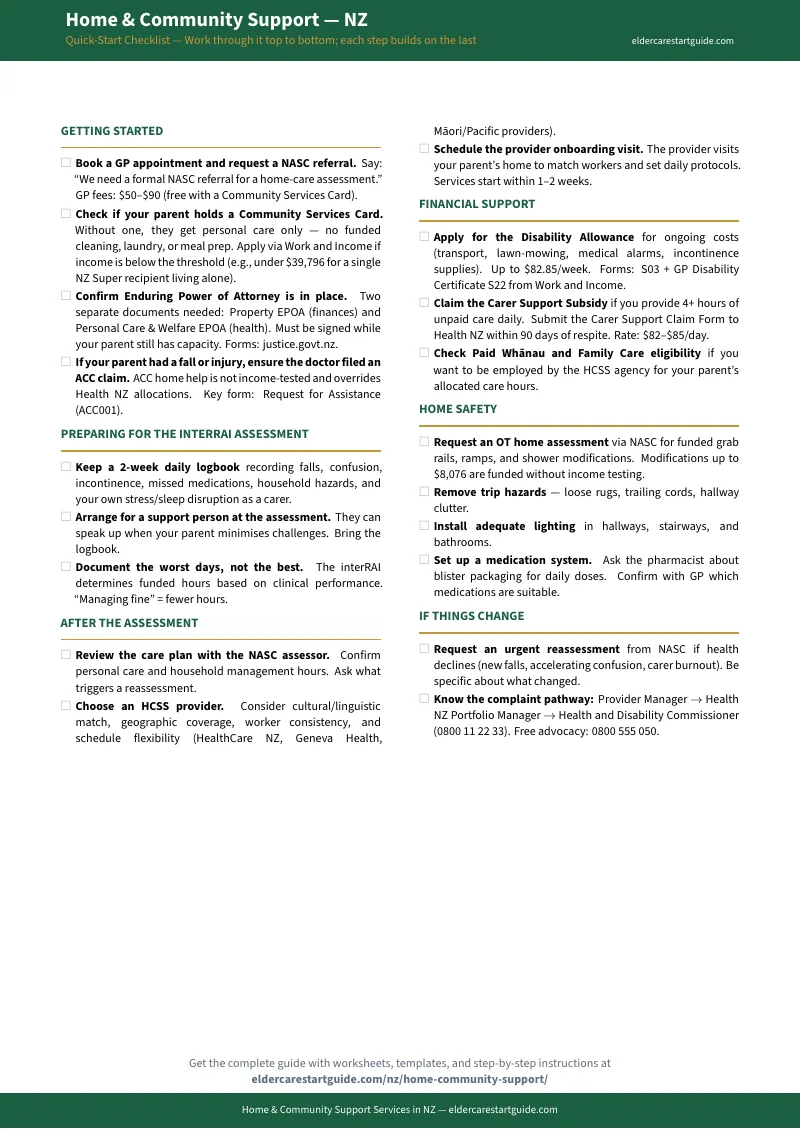
- Home and Community Support Checklist — A one-page action list covering the 20 most critical steps: request the NASC referral, prepare for the interRAI assessment, check CSC eligibility, choose a provider, set up EPOA, claim carer support, and plan for reassessment. Every threshold, phone number, and deadline at a glance.
Who This Is For
- Adult children whose parent's GP has recommended a needs assessment and the family has no idea what happens next, how many hours the government funds, or what they will need to pay privately
- Families preparing for an interRAI home visit who want to make sure the assessment captures their parent's real level of need — not the polite, minimised version
- Full-time carers providing daily unpaid support who need to understand the Carer Support Subsidy, funded respite, and the new flexible funding rules before they hit burnout
- Out-of-town family members trying to coordinate a parent's home care from another city or country — without legal authority, without knowledge of the local system, and without a clear plan
- Families whose parent has been discharged from hospital with a vague promise of "home help will be arranged" and no concrete timeline or provider assignment
- Anyone who has been told their parent "doesn't qualify" for funded household support and wants to understand whether the CSC income test, the assessment scoring, or the referral pathway is the actual barrier
Why Not Free Government Resources?
Health New Zealand publishes the eligibility rules. The NASC agencies explain their referral process. Eldernet maintains a comprehensive provider directory. Carers NZ offers support packs. Age Concern runs advocacy services.
Here is what none of them provide:
- A step-by-step preparation protocol for the interRAI assessment showing how worst-day reporting and carer distress documentation directly affect the hours your parent is allocated — not a generic "be honest with the assessor" suggestion
- A single sequence from GP referral through provider onboarding — not isolated rules scattered across four government websites, two ministries, and a dozen non-profit resource pages
- The four-agency funding map showing how Health NZ, Disability Support, ACC, and Work and Income interact — including the ACC override that most families never discover until it is too late
- The Carer Support Subsidy claiming process with the 1 April 2026 flexible funding rules, prior-approval thresholds, and IRD tax classification — not a one-paragraph summary
- EPOA pre-drafting worksheets that reduce billable solicitor hours from two consultations to one — not a referral to "consult a lawyer"
Government sites administer rules. Elder-law solicitors explain them for $300 to $500 per hour. Private care coordinators charge $150 to $200 per session. This guide bridges the gap — translating hundreds of pages of legislation, policy manuals, and operational guidelines into a sequence you can work through in an evening.
Satisfaction Guarantee
If the guide doesn't give you a clearer path forward, email [email protected] and we'll make it right.
— Less Than One Hour With an Elder-Law Solicitor
An initial consultation with a New Zealand elder-law solicitor costs $300 to $500 per hour. The Public Trust charges $219 for a single Enduring Power of Attorney online, or $385 in-centre. A private care manager runs $150 to $200 per session. A Family Court guardianship application can cost $3,000 to $7,000.
This guide won't replace a solicitor for contested PPPR Act proceedings or complex trust litigation. But for the NASC assessment, CSC qualification check, carer support claims, EPOA preparation, provider selection, hospital discharge protocol, and reassessment process that most New Zealand families need, it covers the vast majority of the work at a fraction of the professional fee — and if you do need a solicitor, you'll walk in with an organised file instead of a panicked phone call.
Start with the free checklist to see if the approach fits your situation. The full guide goes deeper — every threshold, every strategy, every form, every phone number.