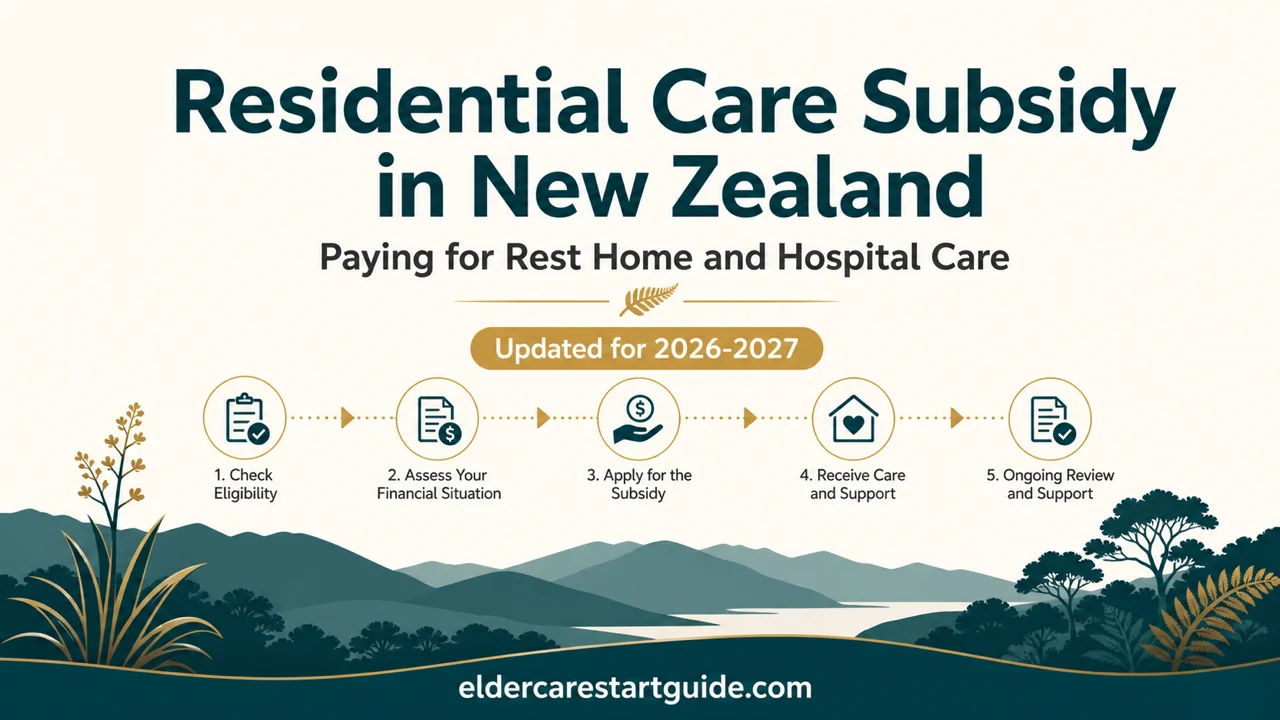
Your Parent Needs Rest Home Care. You Have Six Weeks of Private-Pay Bills and a Stack of Forms Nobody Explained.
Your parent has been assessed as needing long-term residential care. The rest home costs $1,400 a week. Work and Income says there's a subsidy — but first you need to pass an asset test, an income test, produce three months of bank statements, account for every gift made in the past five years, and explain why the family trust shouldn't disqualify the application entirely.
You called the RSU in Whangārei. They sent you Form RSU01. You searched online and found the asset threshold — $300,811 for a single person — but nobody told you how the Option A versus Option B choice works for couples, what happens if your parent gifted money to the grandchildren three years ago, or whether the family home sitting in a trust will be counted against the application. Meanwhile, the facility wants private-pay from day one and the bills are already climbing.
The NZ Care Funding Navigator
This is not a list of eligibility thresholds you can find on the Work and Income website. It is the process around the thresholds — the part that $350/hour elder-law solicitors explain in billable consultations and that government portals never assemble into a single sequence.
The guide covers the entire funding pathway from the initial NASC clinical assessment through the MSD financial means assessment, the gifting and trust rules that trip up most families, the Residential Care Loan for homeowners, facility selection and contract negotiation, and what to do if the application is declined — organised in the order you will actually need it.
What's Inside
- The Two-Gate System — Demystified — New Zealand splits residential care funding into a clinical gate (NASC/interRAI) and a financial gate (MSD means assessment). The guide walks through both in sequence: how to request the NASC assessment, what the interRAI evaluates, what the four care levels mean for your costs, and the critical fact most families miss — that the resident's maximum contribution is capped at the rest home rate regardless of whether they are in hospital-level or psychogeriatric care.
- Asset Test Strategies for Couples — When one partner enters care and the other stays at home, you must choose between Option A ($164,731 threshold, family home excluded) and Option B ($300,811 threshold, home included). The guide shows you the exact formula for when Option A wins — in almost every case where the home is worth more than approximately $136,000 — and walks through the relationship property implications of each choice.
- The Gifting and Deprivation Audit — Work and Income reviews every gift made in the past five years against an $8,500/year couple allowance, and gifts beyond five years against a $27,000/year limit. The guide details what counts as deprivation, how excess gifts are added back to the asset total, the "Gifting in Recognition of Care" exception (12 months continuous co-resident care, $42,500 cap), and the documentation you need to prove legitimacy.
- Family Trust Look-Through Rules — Placing assets in a family trust does not automatically protect them. MSD can examine the trust's history to determine whether the transfer was made to qualify for the subsidy. The guide explains how the look-through works, what triggers a trust contribution request, when MSD can decline the subsidy if trustees refuse to cooperate, and the specific trust structures that survive scrutiny versus those that do not.
- The Residential Care Loan — Step by Step — For single homeowners whose assets exceed the threshold solely because of their home, this interest-free loan lets them fund care without a rushed property sale. The guide covers eligibility ($15,000/$30,000 liquid asset cap), how the Crown caveat works, retirement village ORA security, repayment terms (12 months after death or sale), and how to transition from the loan to the subsidy once total assets drop below the threshold.
- Facility Selection and Contract Negotiation — Not every rest home holds an ARRC contract with Health New Zealand. The guide explains how to verify contract status, the difference between standard rooms (subsidy-covered) and premium rooms ($5–$100+/day out of pocket), the admission agreement clauses to watch for, and the legal right to request a transfer to a standard room with a three-month deadline for the facility to comply.
- The RSU01 Application Walkthrough — The complete application sequence: every document you need (bank statements, investment records, property valuations, trust deeds, gifting records, income verification), the 90-day backdating window, how to respond to information requests without triggering administrative decline, and the six-to-eight-week processing timeline. Covers what to do during the private-pay waiting period and how to claim refunds once approved.
- Decline, Review, and Appeal — If MSD declines the application or you disagree with the assessed contribution, the guide covers the internal review process (within three months), the Benefits Review Committee hearing, and escalation to the Social Security Appeal Authority — with the grounds most likely to succeed.
Plus: 7 Printable Standalone Worksheets
- Asset Calculator Worksheet — Map every account, property, vehicle, KiwiSaver balance, and insurance policy with countable-vs-exempt status under MSD rules
- Five-Year Gifting Audit — Year-by-year gift log with running totals against the $8,500/$27,000 annual limits and the Recognition of Care exception
- Income Contribution Estimator — NZ Super, overseas pensions, interest, trust distributions, deductions, and estimated weekly subsidy calculation
- RSU01 Document Checklist — Every clinical, identity, asset, gifting, and income document you need before submitting the application
- Option A vs Option B Comparison — Side-by-side calculation worksheet for couples deciding which asset test option protects more wealth
- Facility Comparison Worksheet — Standard vs premium room costs, ARRC contract status, care levels, and admission agreement checklist
- Quick Reference Sheet — All key forms, phone numbers, deadlines, and asset thresholds on one printable page
Plus: Printable Quick-Start Checklist
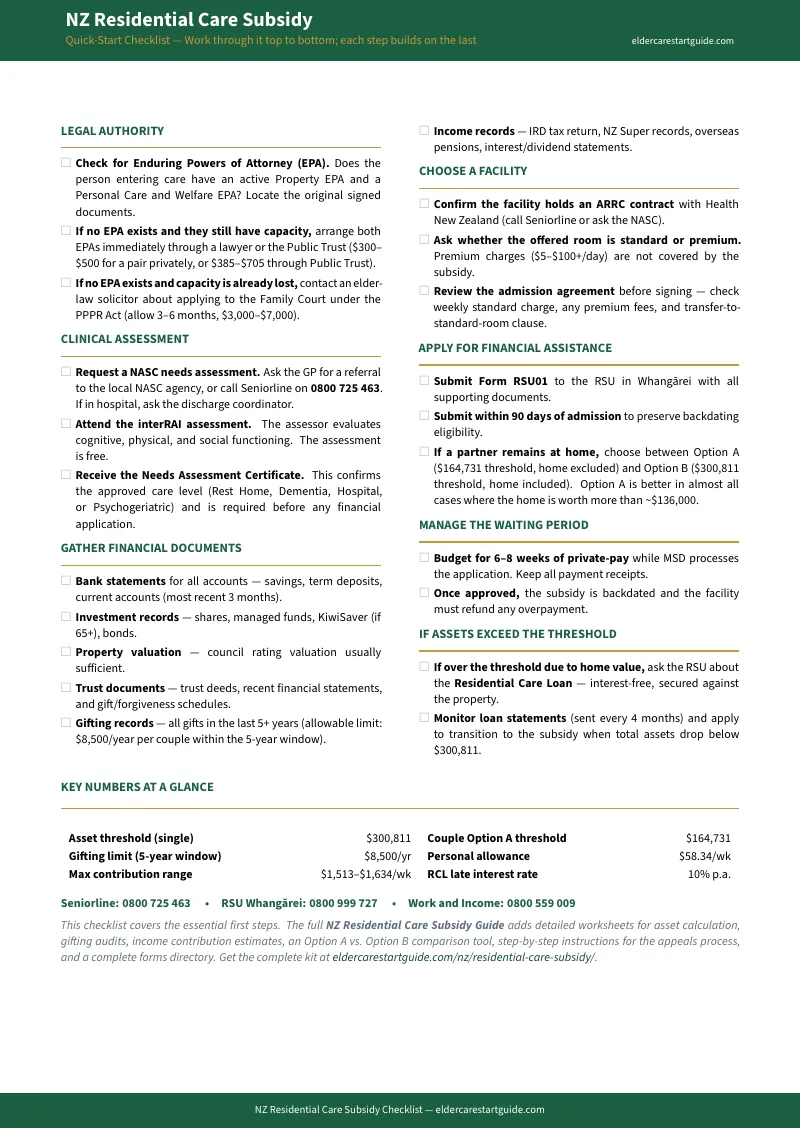
- Residential Care Subsidy Eligibility Checklist — A one-page action list covering the 20 most critical steps: confirm legal authority (EPA), request the NASC assessment, gather financial documents, choose a facility, submit Form RSU01 within 90 days. Every threshold, phone number, and deadline at a glance.
Who This Is For
- Adult children whose parent has been assessed for residential care and the family needs to work out whether the subsidy covers the costs — or whether they are about to spend down every asset they have
- Community-dwelling spouses trying to keep the family home and car while their partner enters a rest home — and nobody has explained the Option A versus Option B choice clearly
- Families with a family trust who need to understand whether MSD will look through the trust and count those assets against the application
- Families who made gifts to children or grandchildren in the past five years and need to know whether those gifts will be added back as deprivation before it appears on the assessment
- Homeowners who exceed the asset threshold and need to understand the Residential Care Loan before being pressured into a rushed property sale
- Out-of-town family members coordinating a parent's care transition remotely and trying to assemble the right documents from a distance
- Anyone who has been told "your parent has too many assets to qualify" and wants to know what the rules actually allow
Why Not Free Government Resources?
Work and Income publishes the asset thresholds. Seniorline and Eldernet provide overviews. Citizens Advice Bureau and Community Law offer free options counselling. Your local NASC explains the clinical assessment.
Here is what none of them provide:
- A step-by-step walkthrough from NASC referral through RSU01 submission — not isolated rules on separate pages across four different government websites
- The Option A versus Option B formula with worked examples for real property values — not a one-line definition
- A full gifting and trust audit framework showing exactly how MSD calculates deprivation — not a warning to "consult a solicitor"
- The Residential Care Loan eligibility check and caveat process in plain language — not buried in the Social Security Act
- A facility selection checklist covering ARRC contract verification, premium room negotiation, and the admission agreement clauses that protect the resident's right to a standard room
Government sites administer rules. Elder-law solicitors explain them for $300 to $500 per hour. This guide bridges the gap — translating hundreds of pages of legislation, policy manuals, and MSD operational guidelines into a sequence you can work through in an evening.
Satisfaction Guarantee
If the guide doesn't give you a clearer path forward, email [email protected] and we'll make it right.
— Less Than One Hour of an Elder-Law Solicitor's Time
An initial consultation with a New Zealand elder-law solicitor runs $300 to $500 per hour. The Public Trust charges $385 for a single Enduring Power of Attorney, or $705 for a couple. A guardianship application through the Family Court can cost $3,000 to $7,000.
This guide won't replace a solicitor for complex trust litigation or multi-million dollar estate disputes. But for the asset test, gifting audit, loan eligibility check, facility contract review, and RSU01 application process that most New Zealand families need, it covers the vast majority of the work at a fraction of the cost — and if you do need a solicitor, you'll walk in with an organised file instead of a box of unsorted bank statements.
Start with the free checklist to see if the approach fits your situation. The full guide goes deeper — every threshold, every strategy, every form, every phone number.