Your Parent Needs More Help Than You Can Give. The System That Funds It Doesn't Explain Itself.
You've noticed the signs — missed medications, a fall that didn't get reported, a kitchen that's no longer safe. Or maybe the hospital just called and your parent is being discharged in 48 hours, and someone mentioned a "needs assessment" you've never heard of.
In New Zealand, every dollar of government-funded elder care — home support hours, residential care subsidies, respite allocations — flows through one gateway: the Needs Assessment and Service Coordination (NASC) system. The clinical tool it uses, the interRAI assessment, determines what level of support your parent qualifies for. The financial means test that follows determines how much your family pays.
The problem is that these two systems — the clinical assessment run by Health NZ and the financial assessment run by Work and Income — operate independently, use different terminology, and are documented across dozens of government web pages that assume you already understand the framework. There is no single government resource that walks a family through the process in the order decisions actually happen.
The NASC Navigator Toolkit — One Sequence, From First Referral to Funded Care
This is a step-by-step operational guide built around the actual decision sequence families face in the New Zealand elder care system. It doesn't just explain what NASC is — it shows you how to prepare for the assessment so your parent's real needs are captured, how to model the financial means test before you file official paperwork, and how to exercise your legal rights if the allocated care level is wrong.
What's Inside
- NASC Referral Pathways — the three ways to request an assessment (GP referral, hospital social worker, family self-referral), what documentation to attach, and the clinical keywords that distinguish a standard referral from a 2-working-day urgent assessment.
- InterRAI Assessment Preparation — a 7-day daily functional log template designed to counter your parent's natural tendency to mask symptoms during a brief clinical visit. The assessor relies on objective, documented evidence — families who present structured records consistently secure more accurate care-level allocations.
- Financial Means Test Walkthrough — worked examples for all three asset threshold options (Threshold B Option 1: $164,731 with the family home excluded for couples; Threshold A or B Option 2: $300,811 with the home included), the 5-year gifting lookback with annual limits, the 90-day rule for recent asset transfers, and the interest-free Residential Care Loan for homeowners whose assets are tied up in property.
- Legal Authority Essentials — when an Enduring Power of Attorney is sufficient, when a Family Court application under the PPPR Act becomes necessary, what medical certification triggers activation, and what to do when siblings disagree about a parent's capacity.
- Home Support vs Residential Care Decision Framework — the mathematical tipping point where part-time private home care exceeds capped rest home fees, the four levels of certified residential care (Rest Home, Dementia Unit, Hospital, Psychogeriatric), and how to evaluate facility audit reports.
- Dispute Resolution Pathways — how to request an internal review, an independent peer review from another district, and formal escalation through the Health and Disability Commissioner. Includes a pre-formatted Section 101 allocation appeal template.
- Pre-Formatted Letter Templates — urgent NASC assessment request, EPOA activation and notification letter, care-level appeal submission. Written with the precise clinical terminology the system responds to.
- Retirement Village Considerations — the ORA (Occupation Right Agreement) structure, deferred management fees, and how village-to-care-facility transitions interact with the Residential Care Subsidy.
Who This Is For
This guide is built for adult children in New Zealand who are arranging care for an ageing parent — whether you live nearby or are coordinating from another city or overseas. It is especially relevant if:
- Your parent has been referred for a NASC assessment and you want to know what to expect and how to prepare
- A hospital discharge is imminent and you need to understand the fast-track assessment pathway
- You need to model the financial means test privately before initiating the official Work and Income application
- No Enduring Power of Attorney exists and you're unsure what legal options remain
- You've received a care-level allocation that doesn't match your parent's actual daily needs
- Siblings disagree about whether a parent can still live independently
Why Not Just Use the Free Government Pages?
Government websites document the regulations, but they're organised by agency — Health NZ handles clinical assessments, Work and Income handles financial assessments, the Ministry of Justice handles EPOA law, and community agencies handle service delivery. For a family encountering this system for the first time, the information is accurate but operationally fragmented. You'd need to cross-reference at least six government sites to build the complete picture.
The alternative is hiring a private care coordinator or elder-law attorney to walk you through the basics, which in New Zealand runs $300–$550 per hour. This guide gives you the same operational framework as a briefing document — so that when you do engage a professional, every billable hour goes toward execution, not orientation.
What You Get
A comprehensive digital toolkit — 11 PDFs including the full guide, a quick-start checklist, and nine printable planning tools. Download everything immediately after purchase.
- guide.pdf — 13 chapters covering the full NASC pathway from referral through funded care, with worked financial examples and decision frameworks
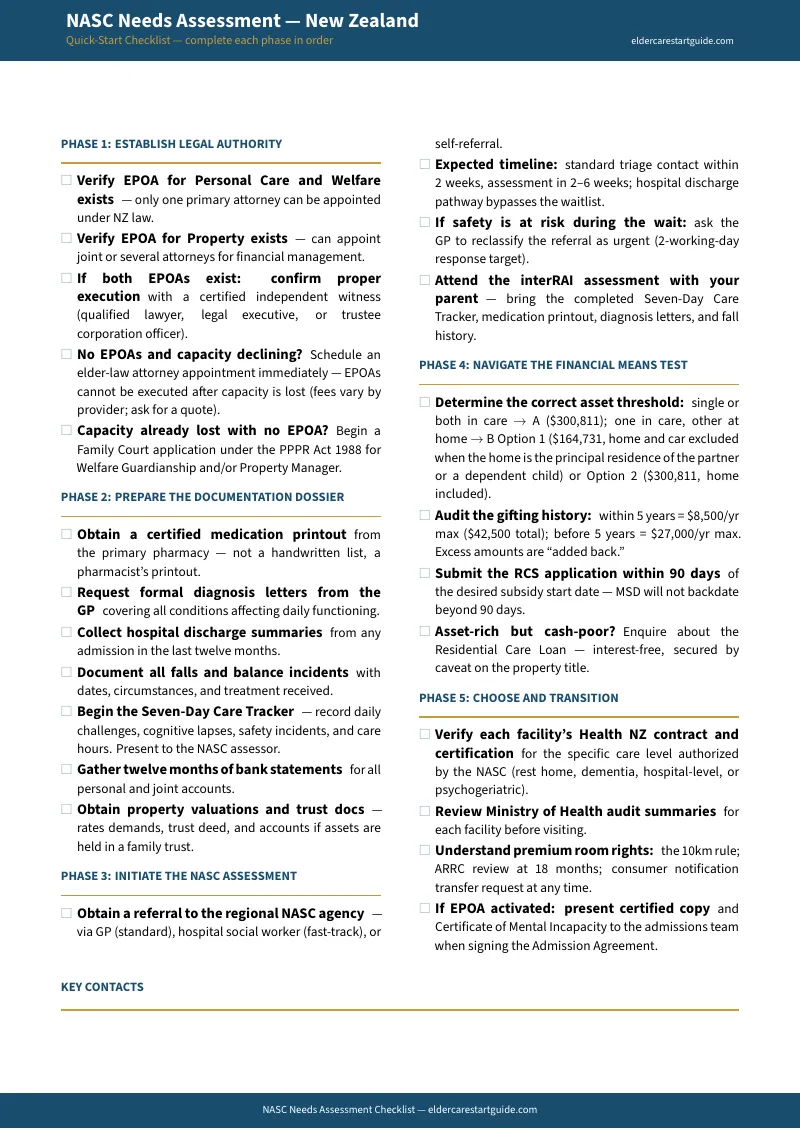
- checklist.pdf — 24-item phased checklist covering legal preparation, clinical documentation, the assessment itself, financial modelling, and care transition
- seven-day-care-tracker.pdf — Structured daily log to present to the NASC assessor, countering social masking
- epoa-status-audit.pdf — Diagnostic checklist for verifying your family's legal authority is current and ready
- documentation-dossier-checklist.pdf — Every document needed for the NASC assessment and means test, with status tracking
- asset-threshold-calculator.pdf — Model your parent's financial position against the three threshold options
- care-cost-comparison.pdf — Compare the true long-term cost of home care versus residential care
- facility-evaluation-scorecard.pdf — Evaluate care facilities side by side before committing
- family-decision-matrix.pdf — Align siblings on roles, responsibilities, and key care decisions
- agency-communication-log.pdf — Running record of every interaction — evidence if disputes arise
- letter-templates.pdf — Three pre-formatted letters: urgent NASC request, EPOA activation notice, and care-level appeal
Or start with the free quick-start checklist — the key milestones in a printable 2-page format. If the checklist gives you what you need, that's a win. If you want the full process guidance behind each step, the complete toolkit is here.
Satisfaction Guarantee
If the guide doesn't help you navigate the NASC process more clearly, email us within 30 days for a full refund. No questions, no forms.