
Your Parent Has Dementia. The System Has 14 Different Schemes. You Have No Map.
The GP said "dementia." The hospital social worker handed you a leaflet. Your sister sent you a link to Citizens Information. And now you're sitting at the kitchen table at midnight trying to figure out whether you need a Public Health Nurse first, or a Fair Deal application, or an Enduring Power of Attorney — and whether doing them in the wrong order will cost your family the house.
Every source gives you a piece. The HSE website explains Home Support eligibility. Citizens Information describes the Fair Deal financial assessment. The Decision Support Service covers EPA registration. The Alzheimer Society lists local support groups. But nobody connects them. Nobody tells you: do this first, then this, then this — in the order an Irish family actually faces these decisions.
That's what this guide does.
The Dementia Care Coordination System
The Dementia Care in Ireland Guide is not a medical resource and not a government explainer. It's a coordination system — a single document that connects the clinical, financial, legal, and family dimensions of dementia care into one chronological action plan. It tells you what to do at each stage of the disease, which applications to file in which order, and how the schemes interact so you don't trigger the financial traps that catch families who navigate by Google.
Stage 1: The Diagnosis Window
How to get a memory clinic referral (Ireland has 25 operational clinics — the guide covers the Regional Specialist Memory Clinics and the MASS teams). What to bring to the appointment. Why collateral history from you matters as much as the clinical assessment. And the three things to start immediately after diagnosis: contact the Alzheimer Society's Dementia Adviser, request a PHN assessment, and begin the EPA process — before capacity declines and the option closes permanently.
Stage 2: Home-Based Care
The HSE Home Support Scheme (free, state-funded personal care hours) versus Consumer Directed Home Support (same funding, but you choose the provider). How to prepare for the PHN home visit so your parent is allocated adequate hours — because the assessment is a scored evaluation, and families who describe challenges in vague terms get fewer hours than families who describe specific risks. Private top-up options at current market rates, plus the Revenue tax relief mechanism most families don't claim.
Stage 3: Financial Support for Carers
Carer's Allowance (means-tested, up to €308/week), Carer's Benefit (PRSI-based, not means-tested), the annual €2,000 Carer's Support Grant, and the GP Visit Card. The guide covers eligibility, income disregards, the CARMed1 medical form, and the specific mistake that causes most rejections — describing care hours inaccurately on the application.
Stage 4: The Fair Deal Decision
When home care is no longer enough: the Nursing Homes Support Scheme financial assessment (80% of income, 7.5% of assets), the 3-year property cap that protects the family home, and the Nursing Home Loan that defers the property contribution until after death. The guide explains the home-sale cash trap — the specific timing mistake that converts capped property into uncapped liquid assets — and the application sequence that protects your family's financial position.
Stage 5: Legal Authority
A dementia diagnosis does not give you the right to manage your parent's bank accounts, sign medical consents, or submit state funding applications. The guide covers the EPA process under the Assisted Decision-Making (Capacity) Act 2015, the functional test of capacity, the MyDSS portal, and the five-tier decision-support framework. It explains why timing matters: once capacity is lost, an EPA is impossible, and the alternative — a court-appointed Decision-Making Representative — costs €5,000 to €10,000 in legal fees.
Stage 6: The Support Network You Don't Know About
The Alzheimer Society of Ireland provides free, confidential Dementia Advisers across every region. Community Day Centres offer structured activities and social connection. Alzheimer Cafes provide informal peer support. Respite care — both HSE-funded and private — gives exhausted caregivers a break. The guide maps all of these services and explains how to access each one, because most families don't discover them until they're already in crisis.
What's in the Download
Your download includes 12 printable PDFs — the full guide, a quick-start checklist, and 10 standalone worksheets you can print individually and bring to appointments, fill in at the kitchen table, or post on the fridge.
- The Full Guide — 14 chapters covering every stage from GP referral through residential care, plus 4 appendices with contact directories, fee schedules, and document checklists
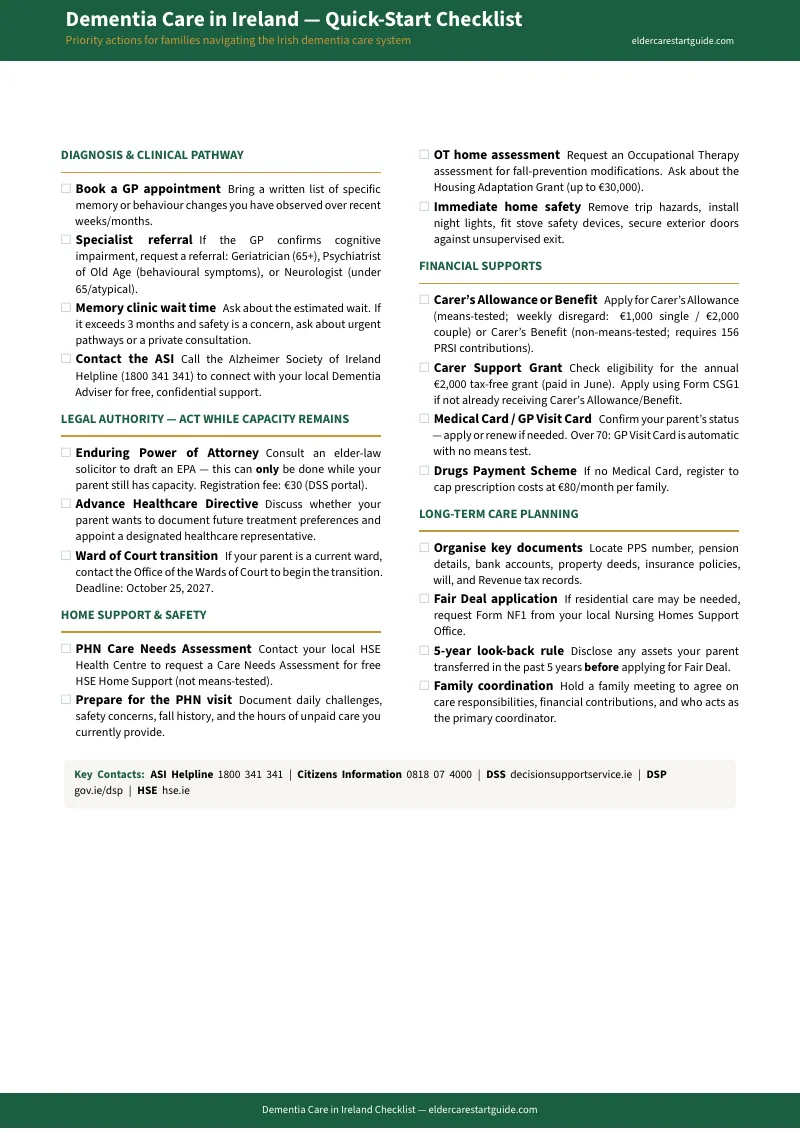
- Quick-Start Checklist — One-page printable with the critical action items in priority order, every key deadline, and the phone numbers you'll need this week
- Care Pathway Timeline — Three-stage visual roadmap from diagnosis through residential care, with every timing-critical action flagged
- Fair Deal Contribution Worksheet — Estimate your parent's weekly contribution before the official assessment — income, assets, and the 3-year property cap
- PHN Home Visit Preparation — Document checklist and structured prompts to describe daily challenges in the terms the assessment scoring system recognises
- GP Consultation Planner — Print a fresh copy before each appointment — changes since last visit, current medications, and referrals to request
- Carer's Payment Navigator — Side-by-side comparison of Carer's Allowance vs Carer's Benefit, eligibility worksheet, and the Carer's Support Grant
- Key Contacts and Resources — Fridge sheet with every organisation, phone number, and website, plus a fillable section for your own care team
- Home Safety Checklist — Room-by-room modifications to make the home dementia-friendly: fall prevention, wayfinding, kitchen safety, and security
- Medication Management Sheet — Current medication tracker, safety checklist, prescription cost coverage, and 12-month review reminder
- Essential Documents Organiser — Locate and record your parent's critical documents — identity, medical, legal, and financial — in one worksheet
- Family Care Plan — Family meeting agenda, task assignment worksheet, and shared care log setup for coordinating across siblings
Who This Is For
- The adult child who just heard the word "dementia" — and needs the full administrative roadmap, not just a leaflet
- The family caregiver at breaking point — providing care for months without formal supports, too exhausted to fight the application process alone
- The sibling coordinating from abroad — managing Irish bureaucracy from London, Sydney, or New York without being physically present for every PHN visit and solicitor appointment
- The family paralysed by Fair Deal fears — delaying care decisions because they believe the scheme will take the family home (it won't — the guide explains exactly why)
- The family dealing with sibling conflict — needing factual, documented information to turn emotional arguments into informed decisions
Why Not Just Use Free Government Websites?
Because they describe each scheme in isolation. The HSE website explains Home Support eligibility but doesn't tell you that applying for CDHS gives you provider choice. Citizens Information describes the Fair Deal assessment but doesn't warn you about the home-sale cash trap. The DSS website covers EPA registration but doesn't explain that the six-month processing time means you need to start the day after diagnosis, not the day before the bank freezes the account.
Free resources define the rules. This guide connects them into a sequence — and explains the timing dependencies, the common mistakes, and the financial traps that the official sources deliberately avoid advising on.
100% Money-Back Guarantee
If the guide doesn't save you time, stress, or money within 30 days, email us for a full refund. No questions, no hassle. The only risk is continuing to navigate one of the most complex care systems in Ireland without a map.
Get Started Now
Download the free Quick-Start Checklist to see the priority action items — or get the full Dementia Care in Ireland Guide for and have the complete coordination system in your hands tonight.