Your Parent Still Has Capacity. The Window Is Open. Here's Exactly How to Use It.
Right now, your parent can still sign their name, understand a conversation, and make decisions about their future. That window doesn't announce when it's closing. And once it does — once a GP writes "lacks capacity" on a form — the Enduring Power of Attorney route is gone. What's left is a Circuit Court application that costs €5,000 to €10,000, takes six months, and strips your parent of the right to choose who manages their affairs.
The EPA is the tool that prevents that outcome. But the process to create one in Ireland — under the Assisted Decision-Making (Capacity) Act 2015 — is not a form you download and sign. It's a multi-party, multi-portal, multi-professional sequence that runs through the Decision Support Service, requires a verified MyGovID, and currently takes up to six months just for the administrative registration.
Most families don't find out any of this until they're already in crisis.
The EPA Registration Roadmap — A Complete Process Navigation System
This isn't a legal document or a template. It's the missing instruction manual for the entire EPA pipeline — from the initial family conversation through the DSS portal, the solicitor's office, and the GP appointment, all the way to activation if capacity eventually declines.
Every step is laid out in the exact order you'll face it, with the decisions pre-mapped, the portal workarounds documented, and the financial traps (particularly the Fair Deal home-sale reclassification) explained before they catch you. The name exists because what families need isn't another explanation of what an EPA is — it's a roadmap for how to actually get one registered in a system designed by people who assumed everyone has a smartphone and six months to spare.
What's Inside
The Full EPA Creation Sequence
The 15-chapter guide walks through every phase in chronological order: deciding who to appoint as attorney (and the statutory exclusions that disqualify people), selecting notice parties, setting up MyDSS portal accounts, navigating the manual Identity Verification Form when your parent can't use a smartphone, generating the portal documents, coordinating the solicitor and GP appointments, gathering dual-witness signatures, and submitting the €30 registration — sequenced so that each step is done in the right order and nothing triggers an avoidable rejection.
The Manual IDVF Pathway
The DSS portal assumes everyone has a verified MyGovID, which requires a Public Services Card and a smartphone. If your parent has neither — and many elderly donors don't — there's an offline manual Identity Verification Form. The guide documents exactly how to request it, what documentation to include, and how the rest of the application proceeds without a MyGovID. This single workaround saves families weeks of frustration searching the DSS website for an alternative it doesn't prominently advertise.
The Activation Protocol
Creating an EPA is only half the system. When capacity actually declines, you need to activate it — which means obtaining two independent capacity statements from healthcare professionals, notifying the donor and every designated notice party, waiting through a mandatory 5-week objection window, paying the €90 notification fee, and receiving the certified copy from the DSS. The guide covers the full activation sequence, including what to do if a notice party objects.
The Fair Deal Integration
If your parent needs nursing home care, someone with legal authority must execute the Fair Deal application. The guide explains how the EPA intersects with the Nursing Homes Support Scheme — the 3-year property contribution cap, the home-sale cash trap (where selling the family home converts a capped 22.5% liability into an uncapped liquid asset drain), and the timing that protects inheritance without delaying care access.
The Decision-Support Tier Framework
The 2015 Act created five tiers of decision support — not just the EPA. The guide explains all five (Assistance, Co-Decision-Making, Decision-Making Representative, EPA, and Advance Healthcare Directives), when each applies, their statutory fees (€15 to €90), and how to choose the least restrictive option that actually fits. Many families default to an EPA when a simpler agreement would suffice.
Banking and Institution Protocols
What happens when you present a registered EPA to a bank or credit union. Which documents institutions typically require, how "frozen account" situations are resolved, and the common delays that trip up families who assumed the EPA alone was enough to walk in and transact.
Solicitor Visit Preparation
Irish law requires a solicitor's sign-off — there's no "DIY EPA." But there's a massive difference between walking in unprepared (paying €300/hour for basic explanations across multiple visits) and walking in with every decision made, every form pre-completed, and every piece of documentation gathered. The guide structures the entire preparation so the solicitor visit is a single short sign-off, not an expensive education session.
8 Standalone Printable Tools
Print what you need, when you need it: an EPA creation checklist (tick each step as you go), an EPA activation checklist (for when capacity declines), a Fair Deal application checklist (with the home-sale trap warning), a solicitor preparation sheet (everything to bring and every decision to make before your appointment), a decision-support pathway flowchart, a complete DSS fee schedule with waiver rules, a banking visit sheet (what to bring when presenting an EPA to a bank), and a key contacts fridge sheet with every helpline, portal, and official body.
The Quick-Start Checklist
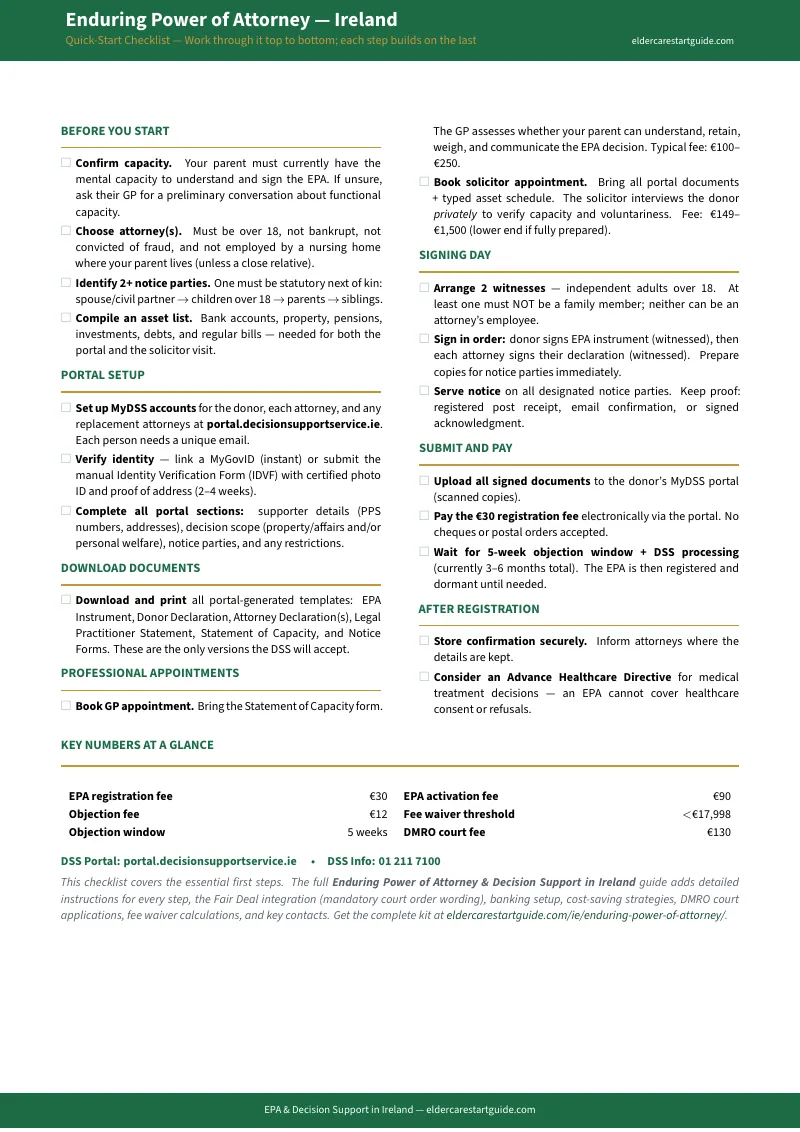
A one-page printable reference with the critical action items in priority order — what to do first, what documents to gather, who needs to be involved, and every key phone number and deadline at a glance.
Who It's For
- The proactive adult child whose parent still has capacity but is showing early signs of decline — and who wants the EPA registered before a crisis forces the €5,000+ court route
- The crisis-stage family whose parent was just hospitalised or had a sudden cognitive event — racing against a closing capacity window
- The sibling navigator dealing with family disagreement about care, money, and authority — who needs the EPA's formal structure as both protection and proof of legitimacy
- The digitally-excluded family whose parent has no smartphone, no Public Services Card, and no way to use the default MyDSS portal pathway
- The cost-conscious coordinator who needs a solicitor's sign-off but can't afford to pay €300/hour for basic orientation that a preparation guide can handle
Why Free Government Resources Won't Get You There
Citizens Information defines every term. The DSS website lists every rule. Neither one will tell you what to do when your parent has no smartphone. Neither explains the Fair Deal home-sale trap. Neither gives you a script for the brother who thinks you're after the house. Neither sequences the steps so that one doesn't accidentally delay another.
Government sites are legally restricted to explaining rules. They cannot give you a strategy. They tell you what an EPA is — not how to get one registered when the system's assumptions don't match your family's reality. This guide connects the legal framework, the portal mechanics, the financial planning, and the family dynamics into one chronological action plan.
What About a Solicitor?
You need one — the law requires it. But solicitors in Ireland charge €500 to €1,500 for a full EPA engagement, much of it spent explaining basics and gathering information you could have brought in prepared. This guide doesn't replace the solicitor. It replaces the expensive hours you'd otherwise spend being educated by one. Families consistently report turning multi-visit engagements into a single focused appointment — often saving hundreds of euros in billable time.
Satisfaction Guarantee
If the guide doesn't save you time, confusion, or money in your EPA process, email us for a full refund. No conditions, no time limit.
— Less Than One Hour of Solicitor Time
A solicitor charges €300 or more per hour. This guide costs less than one hour of that time — and it's designed to eliminate multiple hours of billable explanations. Download instantly. Print and bring to your solicitor. Start the process today while the capacity window is still open.
Not sure yet? Download the free EPA Quick-Start Checklist — a one-page printable with the first 20 action items in priority order. No email sequence, no upsell barrage. Just the checklist.