Your Parent Wants to Stay at Home. The HSE System Decides Whether They Can.
Somewhere between the 24-page application form, the interRAI assessment visit, and the phone calls to an office that never seems to answer, most families lose their footing. They end up with fewer care hours than their parent needs — or none at all — because nobody explained how the system actually makes its decisions.
The information exists. Citizens Information has the eligibility rules. The HSE website has the forms. But none of it tells you what to write on the form so the assessor sees your parent's real needs, or what to say when the discharge coordinator pushes for a quick release without a care package in place.
That gap between knowing the rules and knowing how to use them is where families lose hours, lose time, and lose sleep.
The Home Support Navigator: A Complete System for Securing Care Hours
This is not another summary of HSE eligibility criteria. This is the preparation system that sits between you and the bureaucracy — the one that turns a stressful, disorienting process into a sequence of steps you can follow from anywhere, whether you live down the road or across the world.
The guide covers every stage of the care journey, from the first phone call to your local HSE office through to filing a formal complaint if the service falls short. It includes worked examples, preparation tools, and the specific language that makes applications and assessments go the way they should.
What's Inside
- HSE Application Companion Checklist — a printable preflight for the 24-page form, used alongside the guide's section-by-section notes on the care needs narrative (Section 6), the informal care disclosure (Section 8), and the legal consent declaration (Part 12) under the Assisted Decision-Making (Capacity) Act 2015
- Assessment Evidence Log — a structured two-to-four-week diary template for documenting daily incidents, missed meals, falls, and cognitive changes, designed to hand directly to the interRAI assessor so the allocation reflects your parent's actual needs rather than what they claim in front of a stranger
- Hospital Discharge Playbook — a chronological timeline for securing an expedited assessment before your parent leaves the ward, including the critical questions to ask the discharge coordinator and medical social worker
- Traditional vs CDHS Decision Tool — a comparison framework for choosing between HSE-managed care (less administrative burden) and Consumer Directed Home Support (you pick the provider, better caregiver consistency), with a written request to switch between models
- EPA Preparation Checklist — the five tiers of decision support under the 2015 Act, Enduring Power of Attorney steps and documents, DSS registration, and a clear explanation of why the EPA window closes permanently once capacity is lost
- Cost-Sharing Worksheet — a structured agreement template for splitting private care top-up costs, administrative duties, and hands-on responsibilities across siblings, designed to prevent the resentment that fractures families during long-term care
- Section 467 Tax Relief Calculator — how to claim up to 40% back on private home care costs (capped at €75,000 per year per incapacitated person) using Form HK1 through Revenue myAccount
- Grant Application Planner — application guidance for the Mobility Aids Grant (up to €8,000), Housing Adaptation Grant (up to €40,000), and Housing Aid for Older People (up to €10,700), including OT assessment coordination and contractor quote requirements
- Complaints & Appeals Templates — fillable "Your Service Your Say" complaint and 20-day hour-allocation appeal submissions, with the correct timelines (20 days for hour-allocation appeals, 12 months for service complaints, escalation to the Ombudsman). Fair Deal financial-assessment appeals use the separate Fair Deal Appeal Template (40 working days, Ballyshannon)
Who This Is For
- The long-distance coordinator — you're in Dublin, London, or Sydney while your parent is in a rural Irish county. You need a system you can follow remotely, with clear steps and specific questions for phone calls to HSE offices that you can't visit in person.
- The burned-out local caregiver — you're providing daily unpaid care while holding down your own job and family life. Your back is giving out, your sleep is gone, and you need the HSE system to share the load before you break.
- The crisis-driven discharge coordinator — your parent is on a hospital ward. The discharge meeting is tomorrow. You need to know exactly what to demand and what to refuse, right now.
Why Not Just Use the Free Information?
You absolutely should start with Citizens Information and the HSE website — they are excellent, objective, and up-to-date on the eligibility rules.
But they don't give you a strategy. They don't tell you how to write the care needs narrative so the assessor sees the reality behind "I'm grand, I manage fine." They don't show you how to time the hospital discharge referral so your parent doesn't end up in the standard community queue. They don't walk you through the Section 467 tax relief claim that recovers up to 40% of your private care costs.
An elder law solicitor can handle the legal pieces — the EPA, the capacity disputes, the DSS registrations — but a typical initial consultation is €150–€250, and EPA drafting starts from €395. Most families can only afford one focused session. This toolkit is the preparation system that makes that consultation count, and handles everything outside the solicitor's scope: the HSE application, the assessment preparation, the financial planning, the sibling coordination.
For less than a typical initial consultation, you get the complete system.
The Guarantee
If the guide doesn't give you a clearer path through the HSE system than you had before, email [email protected] for a full refund, no time limit. Every email is read by a person.
Frequently Asked Questions
Does my parent need a medical card to apply for home support?
No. The HSE Home Support Scheme is available to everyone regardless of medical card status, income, or assets. It is completely free and not means-tested.
How is this different from the free checklist?
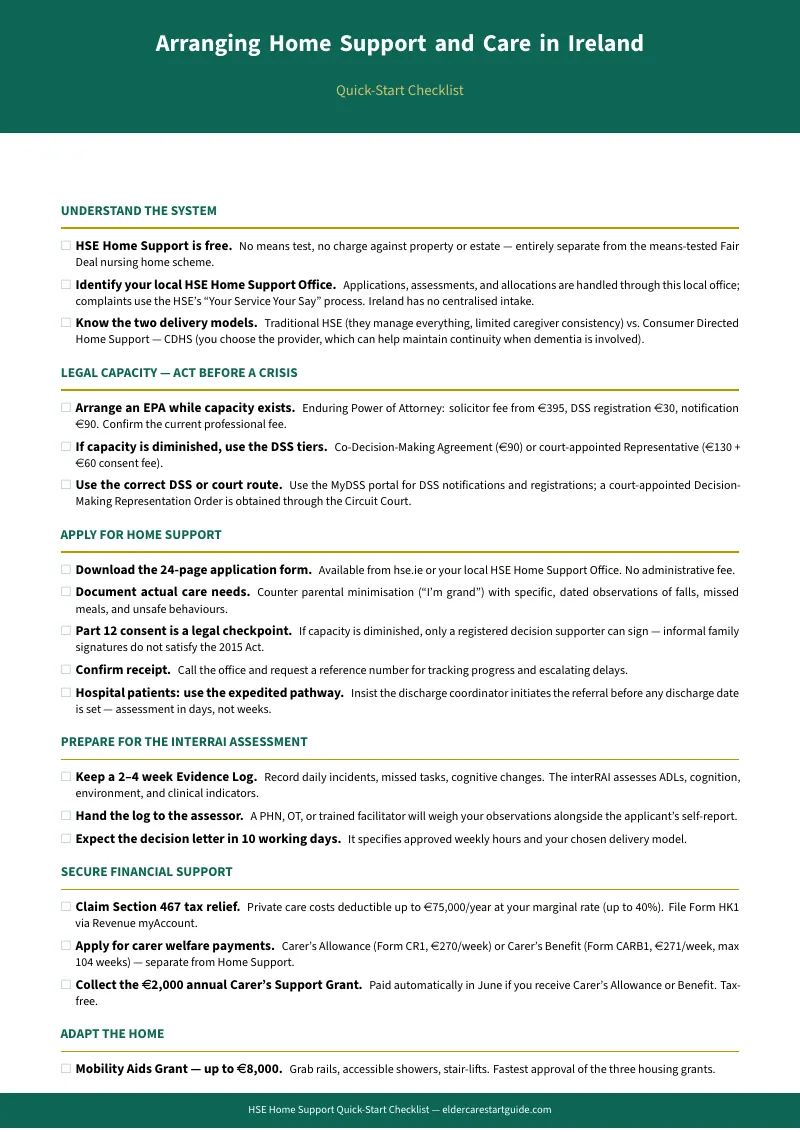
The checklist gives you the essential action items — what to do, in what order. The full guide gives you the strategy behind each action: how to write the care needs narrative, how to prepare for the interRAI assessment, how to time the hospital discharge referral, and how to claim every financial support you're entitled to. It includes worked examples, templates, and preparation tools that the checklist references but doesn't contain.
Can I use this if my parent is already receiving some home support hours?
Yes. The guide covers the full lifecycle, including how to appeal an inadequate allocation, how to switch between Traditional and Consumer Directed Home Support, and how to supplement HSE hours with private care while claiming tax relief on the private costs.
Is this a substitute for legal advice?
No. For complex capacity disputes or contested EPA registrations, you should consult a solicitor. This guide is the preparation system that helps you organise your parent's situation, understand the legal framework, and walk into a solicitor's office with a complete file — which typically reduces the billable hours you need.
What if the HSE system changes after I buy?
The guide already incorporates the Health (Amendment) (Home Support Providers) Act 2026 — the landmark legislation establishing HIQA registration and inspection of home care providers. If major regulatory changes occur, updated editions are available to existing purchasers.