Your parent needs residential aged care. The paperwork has already started. And nobody is telling you what to actually do.
Hospital discharge wants a bed secured. Services Australia wants financial disclosures. Providers are quoting Refundable Accommodation Deposits of $500,000 or more. And every form you fill in wrong — or fill in too early — can lock your family into years of excess fees that are almost impossible to reverse.
Meanwhile, the free government information tells you what the rules are, scattered across dozens of pages — but never what to do about them, or in what order, or which decisions are reversible and which aren't.
The Aged Care Fee Navigation System
This isn't a summary of the government website. It's the Aged Care Fee Navigation System — a sequenced, decision-by-decision walkthrough of every financial and administrative step between "Mum needs care" and "Mum is settled, and we haven't overpaid."
It works where government websites and free placement brokers don't because it gives you a clear sequence of actions tied to your family's actual financial position. Free placement services like Aged Care Decisions are paid $2,950 per placement by providers — so their recommendations are limited to their partner network. Financial advisers charge $3,300 to $6,600 for a Statement of Advice and take weeks to deliver it. Hospital social workers can't give financial advice at all.
This guide is completely independent. No provider commissions. No industry affiliations. Just the full administrative and financial pathway, laid out in the order you need it.
What's Inside
- Legacy vs reformed fee framework mapping — the Aged Care Act 2024 created two parallel fee systems, and which one applies depends entirely on when your parent entered care. The guide lays out both tracks with current 2026 indexed figures, so you know exactly which fees, caps, and protections apply to your family.
- The means assessment walkthrough — a step-by-step sequence for compiling documents, understanding what Services Australia actually assesses, and submitting the forms correctly the first time. An incomplete or incorrect SA457 can result in providers charging the maximum default fee while Centrelink manually reviews — delays that cost families hundreds of dollars per week in unnecessary charges.
- RAD vs DAP vs combination decision framework — the exact conversion formula, current MPIR rates, and the new 2% annual retention rule explained with worked examples. Most families choose the wrong payment structure because they don't understand how the daily equivalent is calculated or what the retention deduction means for their refund.
- Family home protection strategies — who qualifies for a full exemption, how the $214,884 cap works when no protected person is in the home, the two-year pension assets test window, and why selling often increases total fees by converting a capped asset into fully assessable cash.
- Couples and half-share rules — Services Australia automatically deems each partner to own 50% of combined assets regardless of individual titles. The guide covers income and asset splitting, protected person provisions, and what happens when only one partner needs residential care.
- Provider contract red flags — the specific clauses to question before signing any Resident Agreement: mandatory guarantor requirements, higher everyday living fees, and termination notice periods that providers sometimes slip in.
- Hardship provisions and safety nets — eligibility criteria, the gifting traps that disqualify applicants, and a walkthrough of Form SA462. These provisions exist but are rarely advertised by providers or government websites.
- Enduring Power of Attorney audit — the legal authority checks that must happen before cognitive capacity declines further. Without a valid EPOA, banks, medical professionals, and aged care providers refuse to accept signatures — forcing families into costly, months-long tribunal applications at the worst possible time.
- Family conflict resolution framework — structured approaches for sibling disputes over care placement, caregiving load distribution, and the inheritance anxieties that surface when accommodation deposits enter the picture.
Who This Is For
You're an adult child — probably between 45 and 65 — and you've been thrust into coordinating your parent's move into residential aged care. Maybe it started with a fall or a hospital admission. Maybe your Home Care Package is no longer enough. Either way, you're now responsible for navigating a system that even aged care professionals find confusing.
This guide is built for two financial profiles:
- Pension-backed families — your parent's primary wealth is the family home, and your biggest fear is that aged care fees will erode the modest estate they intended to leave behind. The guide covers home protection strategies, pension impact analysis, and how to avoid triggering unnecessary means-tested fees.
- Self-funded retiree families — your parent has superannuation, investments, or high-value property. You have the capital to cover a RAD, but you need to understand how accommodation payment choices interact with the means test, ongoing fees, and your parent's Age Pension eligibility.
Why Not Free Information?
The My Aged Care website has the right information — buried across dozens of pages, structured around the government's categories rather than your family's timeline. It doesn't tell you which decisions to make first, which forms to submit before others, or which common mistakes trigger maximum default fees.
Free placement brokers like Aged Care Decisions provide fast service — but they're paid $2,950 per placement by the facilities they recommend. They can't offer unbiased guidance on negotiating room prices or suggest out-of-network options that might be better value.
A specialist aged care financial adviser will give you personalised modelling — but charges $3,300 to $6,600 for a written plan, and delivery takes weeks. When you're facing a hospital discharge deadline measured in days, that timeline doesn't work.
This guide gives you the foundational understanding to navigate the system yourself — or to walk into a professional appointment with the right questions already formed, cutting their billable hours significantly.
What You Get
- The complete guide — 18 chapters covering every financial, legal, and administrative step of the residential aged care placement process, with 2026 indexed figures throughout.
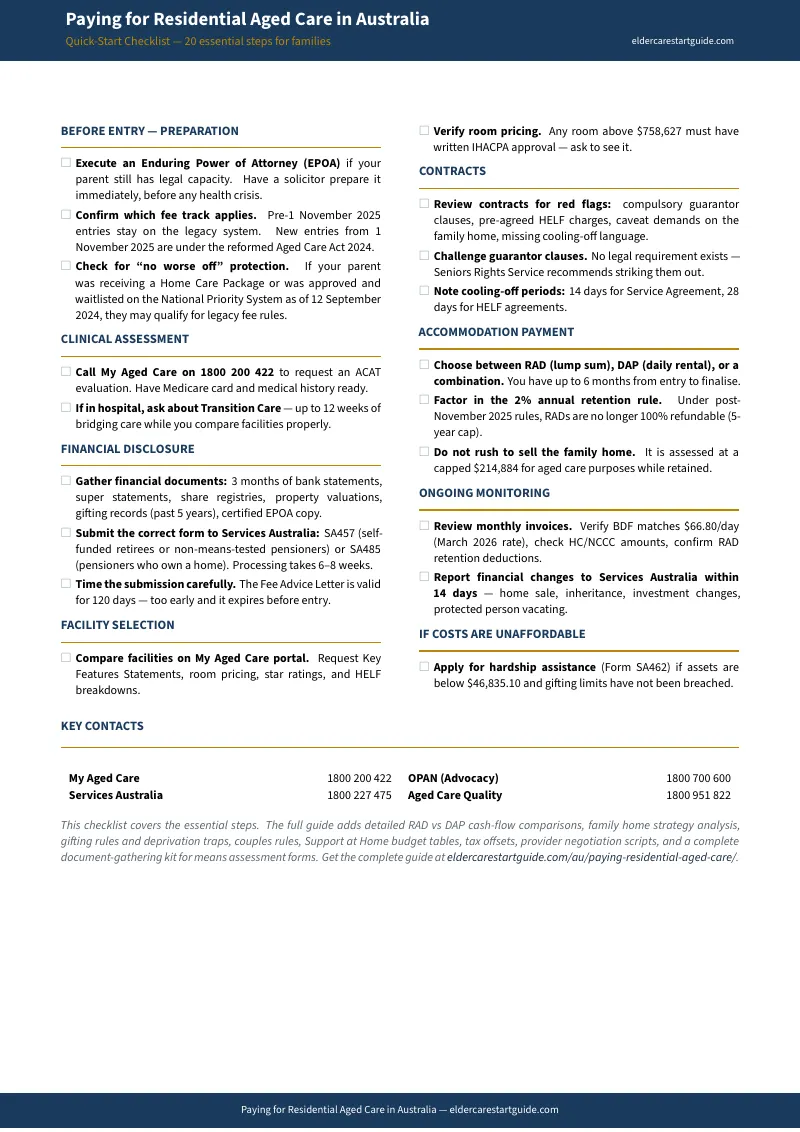
- The 20-item actionable checklist — the document-gathering and decision sequence as a printable, checkbox-format reference that keeps the process on track during a stressful transition.
- Fee Track Identifier — tick the entry date and Home Care Package / National Priority System facts, then record which fee track applies before you sign.
- Admin Timeline Tracker — date every step from the My Aged Care call through the 120-day Fee Advice Letter and the six-month accommodation payment deadline.
- Means Assessment Document Checklist — the SA457 / SA485 gathering list with a column for where each document is filed.
- RAD vs DAP Decision Worksheet — fill in the room price, MPIR, and three payment scenarios before you tell a provider your preference.
- Family Home Strategy Worksheet — protected-person test and the four keep / rent / sell / move-in paths, completed before any disclosure.
- Gifting History Log — five-year gift register against the $10,000 / $30,000 limits (landscape).
- Provider Contract Audit — red-flag clauses and the seven questions to take to the signing meeting.
- Hardship Eligibility Checklist — the $46,835.10 asset test and Form SA462 lodgement steps.
- EPOA Audit Checklist — capacity, document, and tribunal-path checks before banks or providers lock you out.
- Monthly Statement Review Log — invoice check and 14-day change reports after move-in (landscape).
Satisfaction Guarantee
If the guide doesn't give you a clearer understanding of your family's aged care financial pathway, email us and we'll refund you in full. The information in this guide can save families thousands of dollars in excess fees, unnecessary professional charges, and preventable pension reductions. For , it's the most affordable first step in the process.
Download the free checklist to get the essential document-gathering sequence for the means assessment. If you're ready for the complete system — every fee structure, every protection strategy, every provider contract question — get the full guide now.