
The government uses an algorithm to decide your parent's aged care funding. This guide teaches you how the algorithm works — and how to prepare so it captures what's actually happening.
Your parent can't shower safely anymore. Or the dementia is progressing and you're fielding calls from neighbours. Or there was a fall, and now the hospital wants a discharge plan by Thursday. You go to My Aged Care, and the first thing you learn is that the system you've heard about — ACAT assessments, Home Care Packages — no longer exists. It was replaced nine months ago, and nobody told you.
So you start reading. My Aged Care has one version. Services Australia has another. The Department of Health has a third. You find something called the "Single Assessment System" and something called the "Integrated Assessment Tool" and you have no idea whether these are the same thing, different things, or things you need to apply for separately. Meanwhile, a "free" placement broker is calling your mobile offering to "sort it all out" — and you have no way of knowing they earn up to $2,950 in commission from the provider they recommend.
You're not confused because this is too hard for you. You're confused because the system was rebuilt and the instruction manual never arrived.
What actually happens — and where families lose
Here is the sequence most families discover too late. Your parent registers with My Aged Care. A triage operator decides whether they need a basic home support assessment or a comprehensive clinical assessment. An assessor visits your parent's home — once — and uses the Integrated Assessment Tool to score their functional needs across twelve domains. The IAT is a rules-based algorithm. The assessor has limited ability to override its output.
During that visit, your parent will almost certainly mask their real difficulties. They'll stand up straighter. They'll say "I manage." They'll perform capability for a stranger the same way they've been performing it for you. And the algorithm will record their performance as their reality — producing a lower classification, less quarterly funding, and a longer wait for services your parent actually needs.
Then the clock starts. Your parent has 56 days to sign a service agreement with a registered provider, or the allocated funding is withdrawn. The government indefinitely deferred mandated price caps in May 2026, so two providers in the same suburb can charge vastly different rates for the same service. And if your parent hasn't submitted a means test form to Services Australia, they're automatically locked into the maximum contribution bracket — 50% for personal care and 80% for cleaning, meals, and gardening — with no retroactive correction.
The My Aged Care Assessment Navigator
This is the tactical manual for the person standing between their parent and a system that was designed for administrators, not families. Not another government summary. Not a broker's sales funnel. Not a $750 consultation that tells you to "gather your documents." It's the exact preparation tools, comparison frameworks, and sequential checklists an Australian family needs to register with My Aged Care, prepare for the assessment home visit, secure the right classification, choose a provider without overpaying, and protect a parent's finances through the means test — all under the 2026 rules.
A comprehensive 16-chapter guide plus 11 standalone printable tools — organized around the precise moments where families lose time, money, or funding they can't recover.
What's inside — and the problem each tool solves
The Complete Assessment and Care Navigation Guide
A 16-chapter walkthrough of the entire system from first registration to provider management and appeals. Covers the Single Assessment System, the twelve IAT scoring domains, the eight Support at Home classification levels and their quarterly budgets ($2,753 to $20,034 per quarter), the three contribution categories by pension status, the means test, the 56-day provider deadline, unspent funds rules, Registered Supporter and EPOA pathways, family conflict frameworks, hospital discharge advocacy, and the formal appeal process. Written for adult children, not aged care professionals.
7-Day Functional Diary
The problem: The SAS assessment is a one-shot home visit, and parents routinely mask their real limitations in front of assessors — resulting in a lower classification and thousands of dollars less in annual funding.
A daily tracking template to record your parent's physical and cognitive struggles in the seven days before the assessment. Balance loss, medication errors, cognitive episodes, near-falls, refusals to eat — documented in the exact functional categories the IAT evaluates. When the assessor asks your parent how they're managing and they say "fine," you hand over a week of objective evidence that says otherwise.
Parental Masking Interception Script
The problem: Your parent tells the assessor they can shower independently. You know they haven't showered alone safely in three months. The IAT records their answer, not yours.
A face-saving verbal script that lets you gently supplement your parent's answers during the assessment without embarrassing them. Phrased as "adding context" rather than contradicting — because your parent's dignity matters, and so does getting the right classification.
GP Clinical Support Letter Template
The problem: Most GPs write general referral letters that don't use the clinical risk terminology the IAT recognises. A letter saying "Mrs Smith has mobility issues" carries less weight in the algorithm than one describing "immediate risk of premature residential care entry due to recurrent falls."
A pre-formatted template that prompts the GP to describe your parent's functional limitations using the specific phrases that signal safety risks to the assessment algorithm.
Support at Home Contribution Breakdown
The problem: Under Support at Home, what your parent pays depends on both their pension status and the type of service — and if they don't submit the means test form, they're locked into the highest bracket permanently.
A plain-language breakdown of the three contribution tiers (clinical at 0%, independence at 5–50%, everyday living at 17.5–80%), the means test preparation checklist, deeming rates, the family home exemption, the two-year vacant home rule, and the $135,319 lifetime cap.
Provider Comparison Scorecard
The problem: Price caps were deferred indefinitely in May 2026. Providers set their own rates. You have no benchmark to know whether a quoted hourly rate is fair, and no framework to compare two providers who package their services differently.
A fillable comparison tool that calculates real care hours delivered per quarter for each provider, factoring in the 10% care management cap, weekend surcharges, and subcontractor fees. Uses the government's National Summary of Support at Home Prices as the benchmark.
Assessment Appeal Letter Template
The problem: Your parent was assessed at Classification 2 when their needs clearly warrant Classification 4 — and missing the appeal window means living with the wrong classification until the next scheduled review.
A structured letter formatted for the Department of Health's Internal Review process, plus a checklist of supporting clinical evidence and the clinical risk phrases that trigger urgent reclassification. Covers all three stages: Internal Review, Secretary escalation, and Administrative Appeals Tribunal.
Family Care Coordination Templates
The problem: The adult child who lives nearest carries the full burden. The others call with opinions. And the conversation about whether Mum needs residential care or home support becomes a proxy war for twenty years of unresolved family dynamics.
A family meeting agenda, a home-vs-residential care decision worksheet, and a non-legal care coordination agreement for distributing responsibilities based on capacity and proximity — not guilt.
Who this is for
- The adult child managing everything from interstate or overseas who needs one document that replaces forty browser tabs
- The family preparing for an SAS assessment who cannot afford to have their parent under-classified because of a one-hour performance
- The self-funded retiree's family facing 50% to 80% contribution rates and needing to understand the means test before submitting it
- The sibling coordinator trying to align a divided family on a shared care plan before resentment becomes estrangement
- The family whose parent hasn't signed an EPOA and is losing capacity — and needs the Registered Supporter and Guardianship Tribunal pathways explained clearly
- The family managing a hospital discharge and needing the transition care and crisis navigation sequence right now
Why not the free alternatives?
My Aged Care? It has the rules — across hundreds of pages spread over three government websites. It will tell you the Single Assessment System exists. It will not hand you a diary to document your parent's worst days before the assessor arrives, a script to correct masking during the visit, or a scorecard to benchmark one provider's rates against the national median. The information is there. The action sequence isn't.
Free placement brokers like Aged Care Decisions or CareAbout? When the service is "free," you are not the client — the provider is. These brokers earn commissions of up to $2,950 per placement from the providers they recommend. They are structurally unable to advise you on self-managing a care budget or negotiating a provider's rates down, because both of those actions reduce their revenue. This toolkit takes zero commissions from any provider and shows you how to evaluate every registered provider in Australia independently.
A fee-for-service aged care consultant? For complex situations — severe family conflict, complicated estate structures — absolutely worth the $750 to $3,000+ fee. But walking into that appointment with disorganized paperwork is an expensive mistake at $300 to $500 an hour. Use this guide as the intake organiser: arrive with your parent's functional diary, asset inventory, means test documentation, and provider shortlist already prepared, and compress a multi-hour engagement into one efficient session.
A fair, simple guarantee
If this guide doesn't give you a clearer, more confident path through the system than the free tools you've been fighting with, reply to your receipt at any time and we'll refund you in full. No forms, no friction. You are already dealing with enough of both.
Start where you are
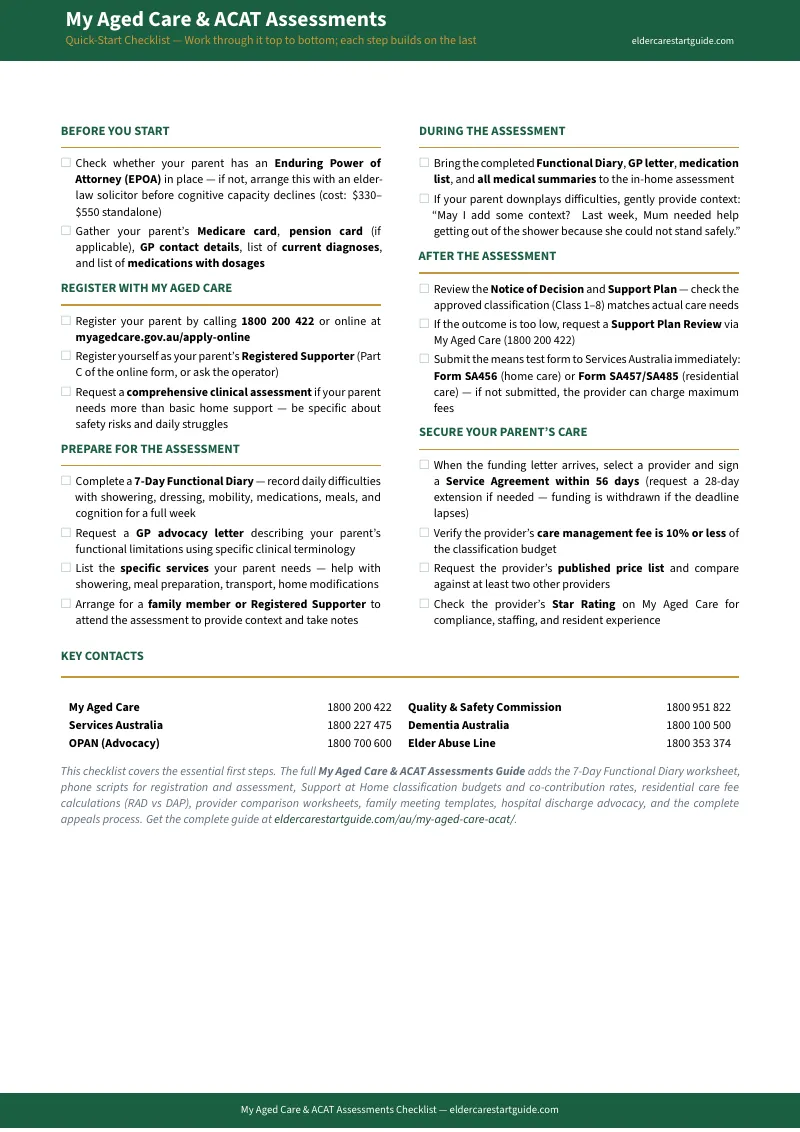
Not ready to buy? Start with the free My Aged Care Quick-Start Checklist — a printable map of the registration steps, assessment preparation essentials, key deadlines, and government contacts. When you're ready to move from "what exists" to "here's exactly how I prepare," the full Assessment Navigator is — less than a single hour of a care consultant's time, and yours to keep.
Download the guide today and stop losing weeks to a system that was redesigned without telling you how it works.