Your Parent Has Dementia. The Government Has 47 Forms. Nobody Gave You a Sequence.
Your parent's GP just confirmed what you've been dreading. The diagnosis is dementia. Now you need to set up an Enduring Power of Attorney before your parent loses capacity — but NSW requires two separate documents while Queensland uses one. You need to register with My Aged Care, but the assessment team only prioritises referrals that use specific clinical language. You need to apply for Support at Home funding, but the program only launched eight months ago and the rules changed again in July 2026.
You called My Aged Care. They explained what services exist. They did not tell you in what order to apply for them, which forms to submit first, or what happens if you miss the means-test deadline while your parent is being discharged from hospital.
Meanwhile, you've read that an aged care financial adviser charges $3,300 to $6,600 for a Statement of Advice. An elder-law solicitor bills $500 per hour. And your parent's family home — the one you grew up in — may or may not be at risk depending on who lives in it, when your parent entered care, and whether you sell it before or after the two-year Centrelink exemption expires.
The Dementia Care Action Map
This is not a pamphlet explaining that aged care services exist. It is the chronological process around the services — the part that $6,000 financial advisers explain in billable consultations and that My Aged Care was not designed to provide.
The guide covers every step from the first GP appointment through legal safeguards, government funding applications, carer payments, behavioural crisis management, home modifications, respite planning, and the residential aged care transition — organised in the order an Australian family actually faces them. Every form number, agency phone number, dollar figure, and deadline is current as at July 2026.
What's Inside
- State-by-State Legal Safeguards — Every state and territory has different rules for Enduring Power of Attorney and guardianship. NSW requires a separate EPA for finances and an Enduring Guardian for health decisions. Queensland combines them into one document. Victoria operates under the Powers of Attorney Act 2014. The guide covers all eight jurisdictions with the specific forms, witnessing requirements, and capacity timing rules. If your parent has already lost capacity, it covers the tribunal application process for VCAT, QCAT, NCAT, and their equivalents.
- My Aged Care Assessment Preparation — The assessment team bases its classification on what you report. Using vague language like "Mum's a bit forgetful" produces a low-priority classification. Using specific clinical language — "changes in cognition," "safety risks," documented wandering incidents — produces a classification that matches the actual severity. The guide provides the exact phrases, the documentation checklist, and the process for appointing yourself as a Registered Supporter or Representative on your parent's account.
- Support at Home Funding Calculator — The program that replaced Home Care Packages has 8 classification levels with quarterly budgets ranging from $2,752 to $20,034. The guide breaks down each level, explains how unspent funds roll over, details the co-contribution calculation under the SA456 form, and highlights the critical October 2026 change: personal care services (showering, dressing, toileting) become fully government-funded with zero co-contributions.
- Family Home Protection Rules — The home is exempt from the Age Pension assets test for up to two years after entering residential care. It stays exempt indefinitely if a protected person lives there. For the aged care means test, the assessable value is capped at $214,884 even if the market value is $1.2 million. But if you sell it at the wrong time, the proceeds become fully assessable assets and can eliminate the pension entirely. The guide walks through every exemption, every timing trap, and the RAD-vs-DAP decision that determines how accommodation is paid.
- Carer Payment and Carer Allowance Walkthrough — Carer Allowance pays $162.60 per fortnight and is not means-tested. Carer Payment pays up to $1,200.90 per fortnight but requires a means test. Since March 2025, the old 25-hour weekly work limit has been replaced with a flexible 100-hour rolling four-week limit. You can receive both simultaneously. The guide covers the eligibility criteria, the application sequence through Services Australia, and the assets test thresholds.
- Behavioural Crisis Playbook — When your parent becomes aggressive, wanders, or experiences sundowning, you need immediate clinical support. The guide covers Dementia Support Australia (1800 699 799, 24 hours), the DBMAS referral process, Severe Behaviour Response Teams for residential settings, non-pharmacological strategies for BPSD management, and the consent requirements for formal referrals. Includes the 3-step referral process and expected response timelines.
- Residential Aged Care Financial Breakdown — If your parent moves into a nursing home, they pay a Basic Daily Fee ($66.80/day from March 2026), potentially a Means-Tested Care Fee, and an accommodation payment (RAD or DAP or a combination). The guide explains AN-ACC classifications (Classes 6, 7, and 8 specifically account for cognitive decline), the new 2% annual RAD retention rule for entries after November 2025, and the MPIR rate of 8.43% used to convert RADs to Daily Accommodation Payments.
- Respite Care Planning — Up to 63 days of residential respite per financial year, plus in-home respite and community day programs through Support at Home. The respite supplement is funded at the maximum accommodation supplement rate without means-testing. The guide covers how to access each type, typical hourly rates ($105 to $121 for flexible respite), and how to plan respite into your quarterly Support at Home budget.
Plus: 10 Printable Reference Sheets
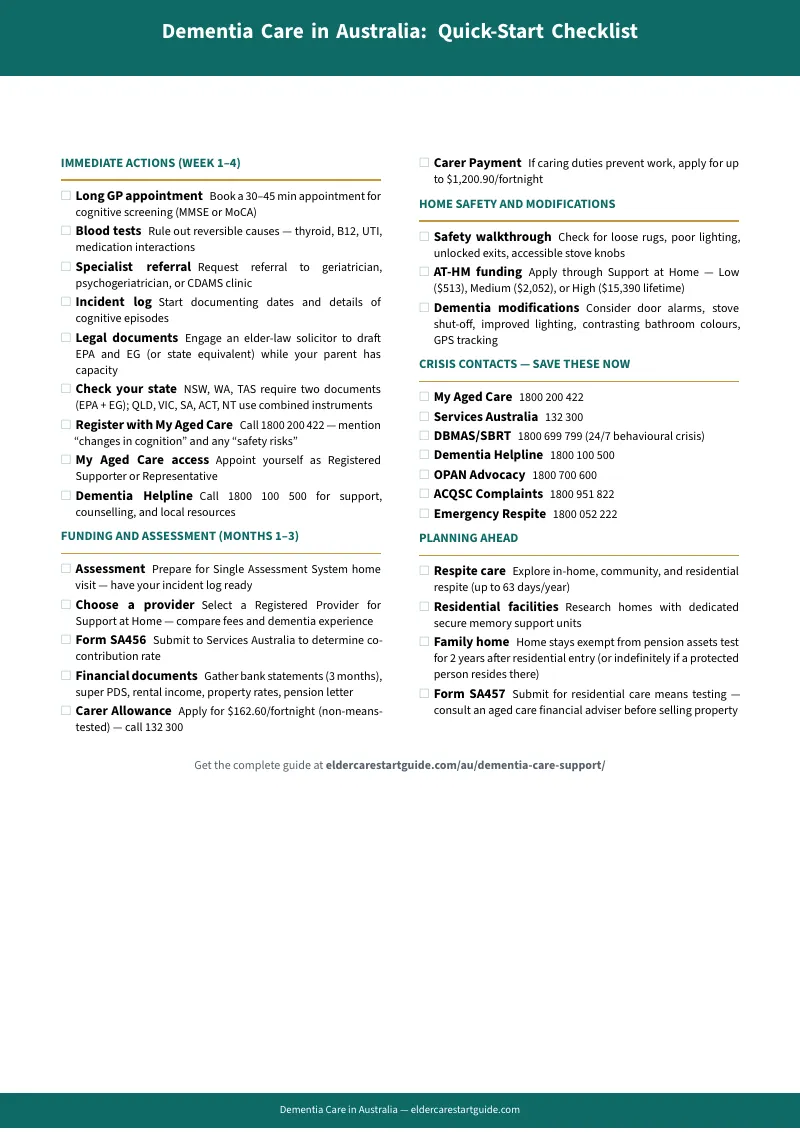
- 29-Item Action Checklist — Every critical step across five sections: immediate actions (Week 1–4), funding and assessment (Months 1–3), home safety modifications, crisis contacts, and planning ahead
- EPA State-by-State Comparison — Which legal documents each jurisdiction requires, with tribunal contacts if capacity is already lost
- My Aged Care Assessment Prep Sheet — The clinical phrases, evidence checklist, and representative setup to bring to the assessment
- Support at Home Funding Levels — All 8 classification levels with quarterly budgets, co-contribution rates, and AT-HM tiers
- Means Test Document Checklist — Every document to gather before submitting Form SA456 or SA457
- Crisis Contacts Fridge Sheet — One-page printout with every crisis and support phone number
- Family Home Decision Guide — Exemptions, timing traps, and the sell-or-keep decision framework
- RAD vs DAP Comparison — Accommodation payment options with worked examples at different RAD amounts
- Carer Payments Reference — Carer Payment vs Carer Allowance rates, eligibility rules, and the 100-hour work flexibility reform
- Action Timeline — Printable timeline poster with checkboxes from Week 1 through residential care
Who This Is For
- Adult children who just received a parent's dementia diagnosis and need to know what to do first, second, and third — not what services theoretically exist
- Families trying to set up legal authority before a parent's cognitive capacity is lost — who need to know whether their state requires one document or two
- Carers navigating the Support at Home program for the first time and trying to understand what their parent's quarterly budget actually covers
- Families terrified about losing the family home to aged care costs — who need to understand the exemptions, the caps, and the timing traps before making an irreversible decision
- Working caregivers who want to access Carer Payment without giving up their job — and need to understand the new 100-hour flexibility rule
- Families managing BPSD episodes at home — aggression, wandering, sundowning — who need immediate crisis contacts and a referral process
- Anyone who has been told to "just call My Aged Care" and found that the portal explains rules but never tells you what to do in what order
Why Not Free Government Resources?
My Aged Care explains what services exist. Services Australia publishes eligibility limits. Dementia Australia offers emotional support and clinical education. State health departments maintain medical directories.
Here is what none of them provide:
- A chronological sequence that tells you what to do in Week 1, Month 1, and Month 3 — not an alphabetical list of services that assumes you already know the system
- A side-by-side state comparison of EPA and guardianship requirements — so you know whether you need one document or two, and what happens if your parent has already lost capacity
- The specific language to use when calling My Aged Care to ensure your parent's assessment reflects the actual severity of their cognitive decline
- A means-test preparation checklist that tells you which documents to gather, how the family home cap works, and why selling the property at the wrong time can eliminate the pension
- A single document that connects the legal, financial, clinical, and administrative systems into one actionable plan — because no government agency is responsible for all of them at once
Government portals administer rules. Professional advisers explain them for $3,300 to $6,600 per engagement. This guide bridges the gap — translating hundreds of pages of legislation, policy, and reform updates into a sequence you can execute while managing a full-time job and your own family.
100% Satisfaction Guarantee
If this guide does not give you a clearer understanding of the steps ahead, email [email protected] for a full refund. No forms, no questions.
Start with the free checklist — 29 critical items that show you the full scope of what needs to happen. If you need the complete process with step-by-step instructions, form numbers, dollar figures, and state-by-state legal requirements, the full guide is .