
You're Already Doing the Work — You Just Aren't Getting Paid for It
You manage medications. You handle bathing, dressing, transfers. You drive to every doctor's appointment, argue with insurance companies, and sleep with one ear open in case something happens overnight.
Meanwhile, you've cut your work hours, burned through your savings, and absorbed costs that your siblings don't see — the grab bars, the disposable supplies, the endless gas to the pharmacy.
Here's what nobody told you: there are programs that will pay you for this. Medicaid self-directed care. VA caregiver stipends. State paid family leave. Private personal care agreements. The money exists. The problem is that getting it requires paperwork that nobody explains in plain language — and getting it wrong doesn't just mean a denied application. It can mean a Medicaid penalty that costs your family tens of thousands of dollars.
The Caregiver Compensation System
Free articles from AARP and government websites tell you that paid caregiver programs exist. They give you a list of program names and a phone number to call. Then you spend three hours on hold with your state Medicaid office, talking to someone who tells you to "check the website."
The Getting Paid to Care for a Family Member toolkit gives you the diagnostic pathway first — four questions that determine exactly which programs your family qualifies for — then walks you through each one with the application steps, forms, and compliance tools that keep you paid and audit-proof.
It's the difference between knowing that Medicaid has a self-directed care program and knowing how to enroll with a Fiscal Intermediary, set up payroll withholding, and pass the daily documentation review that keeps your hours approved year after year.
What's Inside
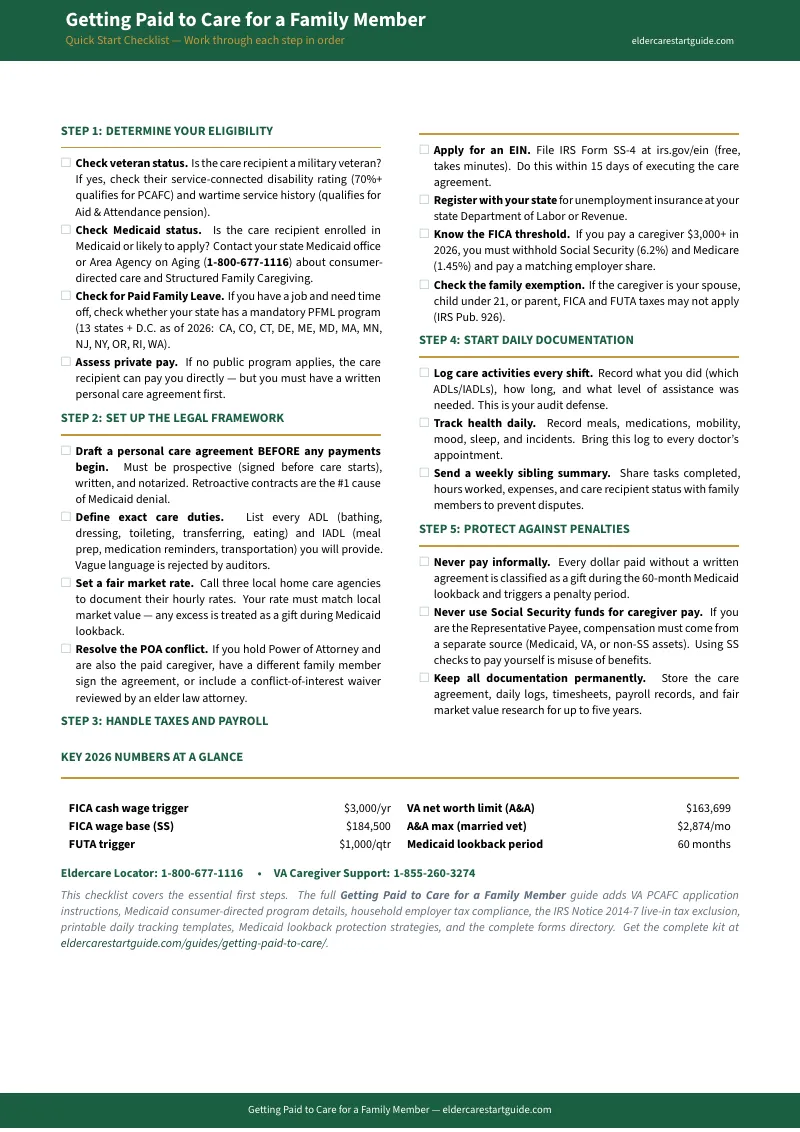
A 12-chapter guide, an 18-item quick-start checklist, and 10 standalone printable worksheets covering every compensation pathway available to family caregivers:
- Payment Pathway Diagnostic — four questions that tell you which programs apply to your family, so you stop wasting time on applications you don't qualify for. Covers VA benefits, Medicaid waivers, state paid leave, and private-pay agreements in a single decision tree.
- VA Caregiver Benefits Deep Dive — the exact eligibility criteria, application forms, and monthly stipend calculations for both PCAFC (the tax-free stipend of $1,200 to $3,900/month) and Aid & Attendance (up to $2,874/month for married veterans). Includes the clinical assessment questions they'll ask and how to prepare.
- Medicaid Self-Directed Care Enrollment — how consumer-directed programs actually work: the Fiscal Intermediary's role, hourly pay ranges by state, the difference between HCBS 1915(c) waivers and Structured Family Caregiving, and the documentation that keeps your hours approved during annual reassessments.
- Personal Care Agreement Template Framework — the exact contract sections that make a family caregiver arrangement Medicaid-compliant: prospective payment clauses, defined scope of ADL/IADL services, fair market rate documentation, respite provisions, termination clauses, and POA conflict-of-interest waivers. Without this structure, every dollar paid is classified as a gift during the 60-month lookback.
- Tax Compliance Package — the IRS Notice 2014-7 "Difficulty of Care" exclusion (exempts live-in caregivers from federal income tax on Medicaid waiver payments), Schedule H filing for household employers, FICA thresholds, the family member exemption, and step-by-step instructions for filing amended returns to claim retroactive refunds on previously taxed payments.
- Daily Care Tracking System — the 5-Minute Medicaid Care Log (what you did, how long, what level of assistance), the Caregiver Daily Log (health, medication, mobility, incidents), the Shift Handoff Report, and the Sibling Transparency Report. These aren't just good practice — they're your audit defense when a Medicaid caseworker questions your approved hours.
- Medicaid Lookback Protection — the penalty formula, how states calculate ineligibility periods, the Caregiver Child Exemption for home transfers, and the specific documentation that proves your payments were legitimate compensation and not gifts.
- Representative Payee Warning — why using Social Security funds to pay yourself as a caregiver is classified as benefits misuse, how the SSA audits Representative Payees, and the separate funding sources you must use instead.
- Professional Escalation Guide — the exact situations where you need an elder law attorney (POA conflicts, contested guardianship, multi-sibling disputes over assets), a geriatric care manager (complex clinical needs beyond family capacity), or a Medicaid planning specialist (spend-down timing, trust structures). Includes cost ranges so you know what to budget.
Who This Is For
- The adult child who already provides daily care — and needs to turn that unpaid labor into a real income stream before it drains their savings and career
- Families facing a Medicaid application — who need a caregiver payment structure that survives the 60-month lookback without triggering penalties
- Caregivers of veterans — who know the VA offers caregiver benefits but can't figure out whether PCAFC, Aid & Attendance, or Veteran-Directed Care is the right program
- Siblings splitting care — who need a transparent, documented system to compensate the one doing the physical work without creating estate disputes
- The employed caregiver — who needs to know whether their state's paid family leave program lets them care for a parent without losing their paycheck
Why Free Resources Aren't Enough
Government websites tell you that Medicaid consumer-directed programs exist. They don't tell you that applying without the right daily documentation leads to a reassessment that cuts your approved hours — or that paying yourself from a parent's account without a written agreement signed before care begins converts every payment into a Medicaid gift penalty.
AARP articles explain what a personal care agreement is. They don't give you the contract structure that satisfies a Medicaid auditor, or the fair market rate documentation that prevents the excess from being classified as a gift, or the tax compliance steps that keep you from filing a 1099 when the IRS says you're a household employee.
Etsy templates sell caregiver contracts for a few dollars. They skip the Medicaid lookback provisions, the POA conflict-of-interest language, the prospective payment clause, and the ADL scope definitions that are the entire point of having a written agreement.
An elder law attorney will get all of this right — for $195 to $500 per hour. A comprehensive Medicaid planning package runs $2,000 to $10,000. This toolkit covers the same territory for a fraction of one consultation.
100% Satisfaction Guarantee
If the toolkit doesn't give you a clear pathway to caregiver compensation with the templates, tax guidance, and documentation systems to make it legally defensible, email us for a full refund. No questions, no time limit.
— Less Than One Hour With an Elder Law Attorney
An elder law attorney charges $195 to $500 per hour. A geriatric care manager runs $75 to $250 per hour for a single assessment. One Medicaid lookback penalty can cost your family $10,000 to $80,000 in denied coverage.
This toolkit gives you the diagnostic pathway, contract framework, tax compliance tools, and daily tracking system that covers the same ground — for a fraction of what one professional consultation costs.
Download the free Quick-Start Checklist to diagnose your family's payment pathway and take the first compliance steps. When you're ready for the full guide with every template, form reference, and tracking system, upgrade to the complete toolkit.