
Your Parent Is Probably Paying Medicare Costs That Vermont Will Cover
Every month, $202.90 comes out of your parent's Social Security check for the Part B premium. On a fixed income in Vermont, that deduction can mean choosing between prescriptions and heat — especially during a Northeast Kingdom winter where fuel assistance is already stretched.
Here is what most families do not know: Vermont expanded its Medicare Savings Programs well beyond the federal floor. Under Act 113, QMB now covers seniors up to 150% of the Federal Poverty Level — absorbing the former SLMB category entirely. QI extends to 202% FPL. And Vermont eliminated the asset test completely. Savings accounts, retirement funds, home equity — none of it counts.
A single Vermont senior earning $2,500 per month would be told by every national website that they do not qualify. In Vermont, that income falls within the QI limit. The state pays their entire Part B premium.
The problem is that nobody puts it all together. Green Mountain Care handles applications but does not explain how to coordinate VPharm with Extra Help and a Part D plan. SHIP counselors at Age Well or Senior Solutions give excellent advice but face three-to-six-week waits during enrollment periods. National websites publish the wrong income limits. And insurance brokers dominate Bing search results with "free Medicare help" pages designed to sell Advantage plans, not to help with state premium assistance.
The Vermont Medicare Cost-Help Navigator
This guide consolidates every layer of Vermont's Medicare cost-assistance system — the Medicare Savings Programs (QMB, QI, QDWI), Extra Help, and VPharm — into a single process you can follow from eligibility check through application, approval, and annual renewal. It is built for the way Vermont actually administers these programs through DVHA and the Green Mountain Care processing center, not the way the federal government describes them on Medicare.gov.
If you are an adult child coordinating this from Burlington, Boston, or anywhere across New England for a parent in rural Vermont, or a senior doing it yourself, this is the reference that replaces scattered state websites, outdated web articles, and confusing DVHA notices with one organized workflow.
What the Guide Covers
- 2026 Vermont income limits with Act 113 expansion — the actual Vermont thresholds (QMB at 150% FPL, QI at 202% FPL), not the lower federal numbers that most websites publish, with the $20 general income disregard and the Dependent Relative Rule (effective April 2026) explained and pre-calculated in worked examples
- Vermont's zero-asset rule — why savings, retirement accounts, and home equity do not count for QMB, QI, or VPharm, and how this differs from full MABD Medicaid which still enforces a $2,000/$3,000 resource limit
- Green Mountain Care application walkthrough — step-by-step instructions for completing Form 202MED, uploading documents through the my.vermont.gov Document Uploader, and tracking your application through the Waterbury processing center
- VPharm coordination with Extra Help and Part D — how VPharm's three income tiers ($15, $20, $50 monthly premiums) wrap around Part D and Extra Help to bring prescription copays down to $1–$2 per medication, plus how to apply using Form 201P and what happens when the 1115 waiver renews
- Part A buy-in procedure — how Vermont's buy-in state status lets a senior without 40 work quarters enroll in Part A year-round through QMB, without waiting for the General Enrollment Period or paying late-enrollment penalties
- Premium refund tracking after approval — the 60–90 day timeline for Social Security to process the state buy-in accretion file and stop deducting the Part B premium, with a month-by-month tracker to verify the retroactive reimbursement arrives
- QMB billing protections — the federal law that prohibits providers from billing QMB beneficiaries for deductibles, coinsurance, and copays, plus a ready-to-customize dispute letter for when a Vermont medical provider sends a bill anyway
- Extra Help auto-enrollment — how any QMB or QI approval automatically triggers the federal Part D Low-Income Subsidy, eliminating a separate application
- Renewal and redetermination management — what the green-striped Form 202MED envelope means, how to handle the annual review packet, the consequences of missing the deadline, and how to report income changes with Form 200GMC
- Denial and fair hearing strategy — the 60-day internal DVHA appeal, the 90-day Human Services Board fair hearing process, how to preserve continuous coverage during an appeal, and when to contact Vermont Legal Aid or the Office of the Health Care Advocate
- Estate recovery exemption — why MSP-only benefits are statutorily exempt from Medicaid estate recovery under federal law (42 U.S.C. § 1396p(b)(1)(B)(ii)), and where the exemption ends if a beneficiary later receives long-term care Medicaid
Who This Guide Is For
- Adult children helping a parent in Vermont apply for Medicare cost assistance — whether you live in-state or are coordinating everything remotely from across New England
- Seniors in Vermont handling the application process on their own and looking for clear, step-by-step instructions instead of dense DVHA policy bulletins
- Families who were told their parent earns too much or has too many savings — and want to check whether that assessment used the federal numbers or Vermont's actual, expanded limits with the zero-asset rule
- Anyone helping a parent coordinate VPharm with Extra Help and a Part D plan to minimize prescription costs
- Families dealing with a Green Mountain Care closure notice or denial who need to understand the 60-day DVHA appeal deadline and 120-day fair hearing window
- Caregivers looking to stack every available dollar of help — MSP premium coverage, Extra Help for prescriptions, and VPharm for residual drug copays
Why Free Resources Are Not Enough
Vermont does have free help available. SHIP counselors through Age Well, Senior Solutions, CVCOA, and SVCOA provide unbiased Medicare advice. Green Mountain Care's phone line answers general eligibility questions. Vermont Legal Aid handles benefit denials and fair hearings.
But SHIP appointment wait times stretch to three to six weeks during peak enrollment periods and early-year redetermination windows. Green Mountain Care phone staff confirm rules but do not walk families through income disregard calculations, VPharm-Extra Help coordination, or SSA accretion timelines. And a web search for "help paying Medicare Part B in Vermont" mostly returns insurance broker landing pages designed to capture your phone number and sell Advantage plans. They will not help you file a state MSP application, dispute a QMB balance bill, or apply for VPharm.
This guide is not an insurance company. It does not sell plans, collect health data, or earn carrier commissions. It is an independent, self-paced reference that prepares your family to file a complete application, avoid the processing errors that cause multi-month delays, and manage the ongoing paperwork so the help does not lapse.
What You Get
The download includes the full guide, the eligibility checklist, and 7 standalone printable tools — 9 PDFs total:
- The full guide — 46 pages covering eligibility under Act 113's expanded limits, the zero-asset rule, the Green Mountain Care application process, VPharm tiers and coordination, Part A buy-in, post-approval premium refunds, QMB billing protections, Extra Help, renewals, appeals, estate recovery, and key contacts
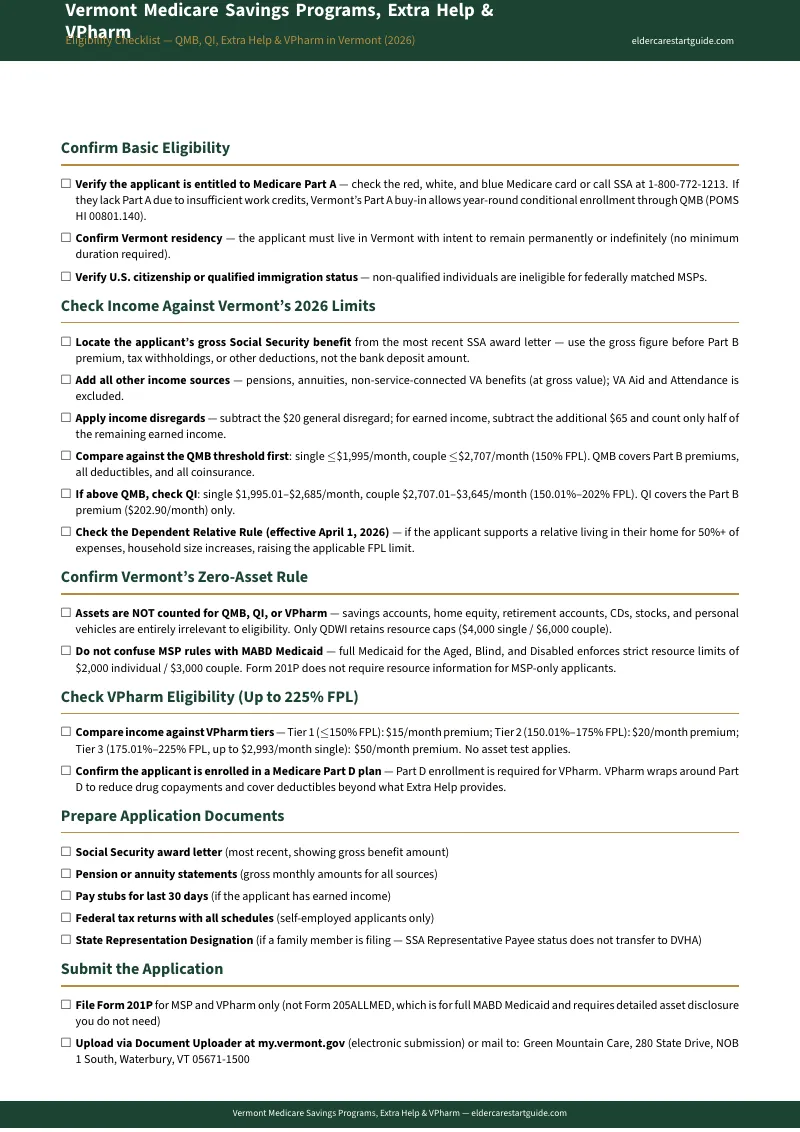
- The eligibility checklist — a printable 2-page action list you can work through in one sitting to determine eligibility, gather documents, and submit the application
- MSP eligibility worksheet — fill-in worksheet that replicates HAEEU's income counting method with the $20 disregard, earned income exclusions, and VPharm tier placement
- Premium refund tracker — month-by-month log for the 60–90 day SSA processing window after QMB or QI approval, with a refund calculation and a prompt for calling SSA
- QMB billing dispute letter — ready-to-customize letter citing federal law to stop providers from illegally billing QMB beneficiaries for deductibles and copays
- Agency communication log — landscape-format record for every interaction with DVHA, Green Mountain Care, SSA, and providers — your primary evidence for appeals
- Renewal calendar — 12-month timeline tracking the annual redetermination cycle and the green-striped Form 202MED deadline
- Appeal deadline calendar — maps the 60-day internal DVHA review and 90-day fair hearing deadlines with a hearing preparation checklist
- Application document checklist — everything to gather before filing Form 201P through Green Mountain Care
Satisfaction Guarantee
If the guide does not help your family navigate Vermont's Medicare cost-assistance system, email [email protected] for a full refund — no time limit, no questions.
Get Started
Download the free eligibility checklist to see if your parent qualifies. If you are ready for the full process — application walkthrough, VPharm coordination, billing protections, renewal management, and appeal strategy — get the complete guide for less than one month's Part B premium deduction saves your family.
Frequently Asked Questions
What if the rules change after I buy?
We update the guide when the rules change. Email us any time, even years later, and we'll send you the current edition free.