
Your Parent Is Probably Paying Medicare Costs That Pennsylvania Will Cover
Every month, $202.90 comes out of your parent's Social Security check for the Medicare Part B premium. On a fixed income of $1,400 or $1,600 a month, that single deduction reshapes the entire household budget. And in many cases, Pennsylvania will pay that premium — along with deductibles, coinsurance, and prescription co-pays — for families who never realize they qualify.
The reason most families never apply is not stubbornness or pride. It is that the system looks impenetrable from the outside. Three separate government agencies run the programs. The rules differ depending on whether you are applying for an MSP, Extra Help, or PACE. Income eligibility uses net calculations that few state websites bother to explain. And Pennsylvania's 67 County Assistance Offices each handle intake with their own processing norms, wait times, and quirks.
Families who try to figure this out from web searches end up on national Medicare sites publishing the wrong income limits for Pennsylvania, or on insurance broker pages designed to funnel their parent into a plan, not help them claim cost assistance.
The Pennsylvania Medicare Cost-Help System — In One Document
This guide maps every layer of Pennsylvania's Medicare cost-assistance system — the Medicare Savings Programs (QMB, SLMB, QI), federal Extra Help, and the state-funded PACE and PACENET prescription programs — into a single workflow. Instead of calling three agencies, navigating two portals, and hoping you filed the right form, you follow one document from eligibility check through application, approval, and annual renewal.
It is written for the way Pennsylvania actually administers these programs: how County Assistance Offices process applications, what COMPASS accepts and rejects, where the processing lags happen, and what to do when a provider sends a bill they are not allowed to send. National guides skip all of it.
What the Guide Covers
- 2026 income limits with deductions pre-calculated — the actual Pennsylvania thresholds after the $20 general income disregard, not the raw federal poverty numbers that most sites publish. Worked examples show how a parent who looks ineligible at gross income often qualifies at net.
- The resource test in plain numbers — exactly which assets count toward the $9,950 individual limit and which are excluded (the home, one car, burial funds, and more), with a line-by-line calculation you can complete in ten minutes
- Spousal deeming walkthrough — how income and resources are divided when only one spouse applies, with a worked example that follows a real scenario from gross household income to the final countable figure
- Four application pathways — COMPASS online, in-person at the County Assistance Office, mail-in via PA 600M, and authorized representative filing for long-distance caregivers. The guide covers which path fits each situation and what each one requires.
- Part A buy-in procedure — the step-by-step process for seniors without 40 work quarters to get Part A through QMB enrollment, including how to file the conditional SSA application alongside the state MSP application
- Post-approval premium refund tracking — what happens to the Social Security check after MSP approval, how the 60-to-90-day SSA processing window works, and how to verify the retroactive lump-sum reimbursement when it arrives
- QMB billing protections with dispute tools — the federal law (42 U.S.C. § 1396a(n)(3)(B)) that prohibits providers from balance-billing QMB enrollees, and a ready-to-use dispute letter for when a provider bills anyway
- Extra Help auto-enrollment — how MSP approval triggers the federal Part D Low-Income Subsidy automatically, what it covers, and how to use it at the pharmacy before the system fully updates
- PACE and PACENET coordination — how Pennsylvania's lottery-funded prescription programs work alongside Medicare Part D and Extra Help, the 2026 income limits, the Act 49 COLA moratorium protecting current enrollees through December 2027, and how to avoid confusing these with the federal PACE/LIFE managed care model
- Renewal and recertification management — the annual redetermination process, the 90-day reconsideration window for late filings, change-reporting requirements, and how to prevent accidental termination from a missed deadline
- Fair hearing procedures — how to request a hearing through the Bureau of Hearings and Appeals within Pennsylvania's strict 30-day deadline, how to preserve existing benefits while the appeal is pending, and when to bring in legal help from the Pennsylvania Health Law Project
- Estate recovery clarification — why MSP benefits are federally exempt from Medicaid estate recovery, with the statutory citations to counter the common fear that the state will take the family home
Who This Guide Is For
- Adult children helping a parent in Pennsylvania apply for Medicare cost assistance — whether the parent lives in Philadelphia, Pittsburgh, or a rural county where the nearest County Assistance Office is an hour away
- Seniors managing the process on their own and looking for clear instructions instead of dense regulatory language
- Long-distance caregivers who need to file on a parent's behalf without physically visiting a CAO
- Families who were told their parent earns too much — and want to run the actual net income calculation before accepting that answer
- Anyone already enrolled who needs to understand what comes next — premium refunds, billing protections, PACE enrollment, renewals, and how to keep benefits from lapsing
Why Free Resources Leave Gaps
Pennsylvania has genuine free help. PA MEDI (formerly APPRISE) counselors are knowledgeable and unbiased. The Pennsylvania Health Law Project offers legal assistance for low-income applicants. But PA MEDI counselors face high appointment demand — particularly during Open Enrollment — and limited meeting times. They cannot act as ongoing case managers or gather documents on a family's behalf.
Meanwhile, the state's own DHS website publishes eligibility tables using gross federal poverty figures without explaining how Pennsylvania's income disregards actually work. And the top search results for Medicare savings help in Pennsylvania are either national resources using the wrong state thresholds, or insurance lead-generation sites offering "free guides" in exchange for personal contact information they sell to plan brokers.
This guide is not a replacement for free counseling — it is a preparation tool that makes free counseling faster and more productive. Families who arrive at a PA MEDI appointment with their documents organized, their net income calculated, and the right application form already started get further in one session than families who spend their first appointment asking what forms to file.
What You Get
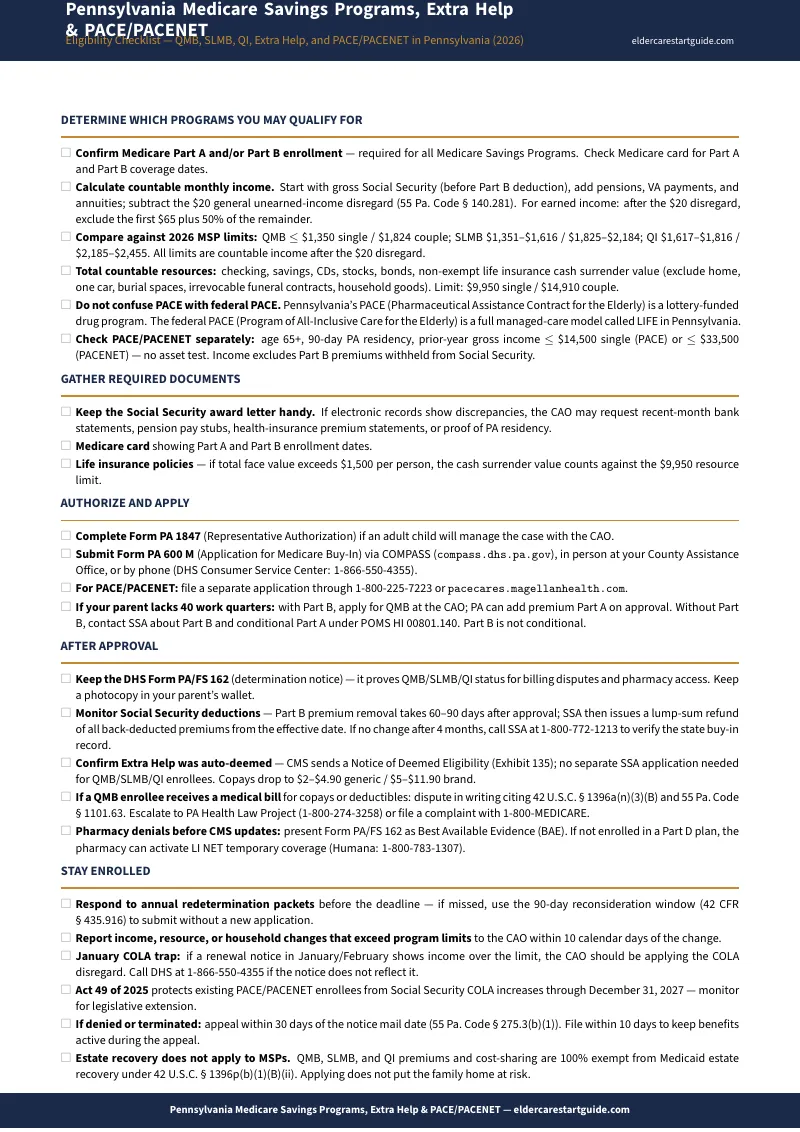
The download includes 10 PDFs — the full guide, the eligibility checklist, and eight printable planning tools:
- The full guide — 47 pages covering the four MSP tiers, income and resource calculations, four application pathways, Part A buy-in, post-approval procedures, QMB billing protections, Extra Help auto-enrollment, PACE/PACENET coordination, renewals, fair hearings, estate recovery, and a key resources directory
- The eligibility checklist — a printable 2-page action list covering eligibility screening, document gathering, application submission, post-approval steps, renewal management, and where to get help
- MSP Eligibility Worksheet — fill-in income and resource calculator using Pennsylvania's $20 disregard and earned income exclusions, with 2026 limits pre-printed
- QMB Billing Dispute Letter — ready-to-customize letter citing the federal statute that prohibits providers from balance-billing QMB enrollees
- Premium Refund Tracker — month-by-month log for tracking the 60–90 day Part B premium refund lag after MSP approval
- Application Document Checklist — organize every document needed to file Form PA 600 M before visiting the County Assistance Office or opening COMPASS
- Agency Communication Log — landscape-format record of every call, visit, and letter with dates, contact names, and outcomes
- MSP Renewal Calendar — 12-month timeline tracking the redetermination cycle, change-reporting log, and safety-net deadlines if renewal fails
- Appeal Timeline Worksheet — map the 30-day and 10-day deadlines from a denial or termination notice
- PACE/PACENET Income Calculator — determine eligibility using prior-year gross income with Part B premium exclusion, plus Act 49 COLA moratorium check
Satisfaction Guarantee
If the guide does not help your family navigate the process, email [email protected] for a full refund — no time limit, no questions asked.
Your parent may qualify for help that covers the Part B premium, deductibles, and prescription costs. The checklist shows you whether they likely qualify. The full guide shows you exactly how to get it — from eligibility math to submitted application to approved benefits.
Download the free checklist to check eligibility, or get the complete kit with the application walkthrough, income worksheets, billing dispute letter, renewal calendar, and all eight planning tools.
Frequently Asked Questions
What if the rules change after I buy?
We update the guide when the rules change. Email us any time, even years later, and we'll send you the current edition free.