Oklahoma's Medicaid system has rules that punish families who don't know them
Your parent needs long-term care. The nursing home is billing $5,000 to $7,500 a month. Medicare's 100-day rehabilitation coverage is running out. You've searched "Oklahoma Medicaid eligibility" and discovered your parent has too much income, too many assets, or both — and the state websites tell you what the limits are without explaining a single strategy for meeting them.
What they won't tell you: Oklahoma is one of a handful of states with a hard income cap. If your parent's Social Security and pension exceed $2,982 a month by even one dollar, they're disqualified from long-term care Medicaid entirely. There is no partial spend-down for excess income. The only solution is a legal trust structure that most families have never heard of — and that facility billing offices rarely explain.
Meanwhile, the state is running a 60-month audit of every bank statement, looking for any gift, family loan, or property transfer that wasn't made at fair market value. A birthday check to a grandchild three years ago can trigger penalty months where nobody pays — not Medicaid, not your parent — and the nursing home starts billing the family directly.
The Oklahoma Dual-Track Protection System
The Oklahoma Medicaid Long-Term Care & Asset Protection Guide is a 57-page process manual built specifically for Oklahoma's regulatory structure. It maps both eligibility tracks — the clinical assessment through DHS Aging Services and the financial audit through your county DHS office — so you can navigate them simultaneously instead of waiting for one to stall the other.
This isn't a summary of federal Medicaid rules with "Oklahoma" pasted into the title. Every dollar figure, agency name, form reference, and legal citation comes from the Oklahoma Health Care Authority (OHCA) rules and Oklahoma Administrative Code, updated for 2026.
What's Inside
- The Income Cap Workaround — Oklahoma doesn't allow a medically needy spend-down for long-term care. If your parent's income exceeds $2,982/month, the only path is a Medicaid Income Pension Trust (MIPT). The guide walks you through setting up the trust, opening the dedicated bank account, and routing income monthly — including the $7,535 upper ceiling that most online sources don't mention.
- The Asset Classification Breakdown — Oklahoma counts IRAs in full even when they're in payout status, which catches families who assumed retirement accounts would be exempt. The guide maps every countable and exempt asset under OAC 317:35-5-41.9 — the family home (up to $1,130,000 equity), one vehicle, burial funds, and the $10,000 irrevocable funeral trust limit — so you know exactly where your parent stands before filing.
- The 60-Month Transfer Audit Defense — The guide includes a financial ledger format that organizes five years of bank statements the way OKDHS caseworkers review them. It explains the penalty divisor calculation, why the IRS $19,000 annual gift exclusion does not apply to Medicaid, and how to cure a penalty by returning transferred assets before the application is processed.
- Spousal Protection Calculations — If your parent is married, the healthy spouse keeps up to $162,660 in assets (the Community Spouse Resource Allowance) and can claim a Monthly Maintenance Needs Allowance of up to $4,067.00. The guide explains the snapshot date, the asset-split math, and the income-first allocation rule that determines how much the at-home spouse actually keeps.
- The ADvantage Waiver Navigator — Oklahoma's in-home care waiver runs on a separate dual-track system with its own clinical and financial eligibility requirements. The guide covers the UCAT III assessment, the cognitive exclusion trap (a dementia diagnosis alone doesn't qualify), the waitlist process, CD-PASS self-direction, and the rule barring spouses from being paid as standard caregivers.
- The Probate-Only Estate Recovery Shield — Oklahoma limits estate recovery to the probate estate under Title 58. Assets that pass through Transfer-on-Death deeds, joint tenancy, or irrevocable trusts bypass state claims entirely. The guide explains how to use these legal structures, how TEFRA pre-death liens work (and when they can't be filed), and the caregiver child exception that can protect the home even through probate.
- The Application Process — Start to Finish — From gathering documentation and filing through the mySoonerCare portal, through the phone interview and patient liability calculation, to managing the Medicaid pending period while the nursing home waits for approval. Every step with the forms and contacts you need.
- Appeals and Dispute Resolution — If the application is denied or benefits are reduced, the guide covers OKDHS fair hearings, SoonerSelect managed care appeals, filing deadlines, and the most common grounds for reversal — miscounted assets, misclassified exempt property, or a flawed penalty calculation.
Who This Is For
- Adult children whose parent is in a nursing facility with Medicare coverage ending and private-pay bills mounting
- Families who were told their parent earns too much for Oklahoma Medicaid and don't know about the MIPT workaround
- Caregivers providing unpaid in-home care who need the ADvantage Waiver but haven't navigated the dual-track application
- Spouses worried about losing their home, savings, and monthly income to a partner's institutional care costs
- Families who made gifts or transfers in the last five years and need to understand the lookback audit
Why Free Government Pages Aren't Enough
Oklahoma's Medicaid policies are technically public — spread across the OHCA policy manual, the Oklahoma Administrative Code, DHS forms, and OKDHS procedural guides. The state websites tell you the $2,982 income cap exists, but they don't explain how to set up the trust that solves it. They list the $2,000 asset limit, but they don't tell you which spend-down strategies caseworkers will accept and which ones trigger penalty periods. State caseworkers are legally barred from offering planning advice.
Elder-law attorneys in Oklahoma charge $300 to $500 per hour, with initial retainers running $3,000 to $10,000. Many families need that expertise — but the ones who walk in having already organized five years of bank statements, identified their exempt assets, and understood the MIPT mechanics save thousands in billable hours. This guide is the preparation step that makes professional help more effective and less expensive when you need it.
What You Get
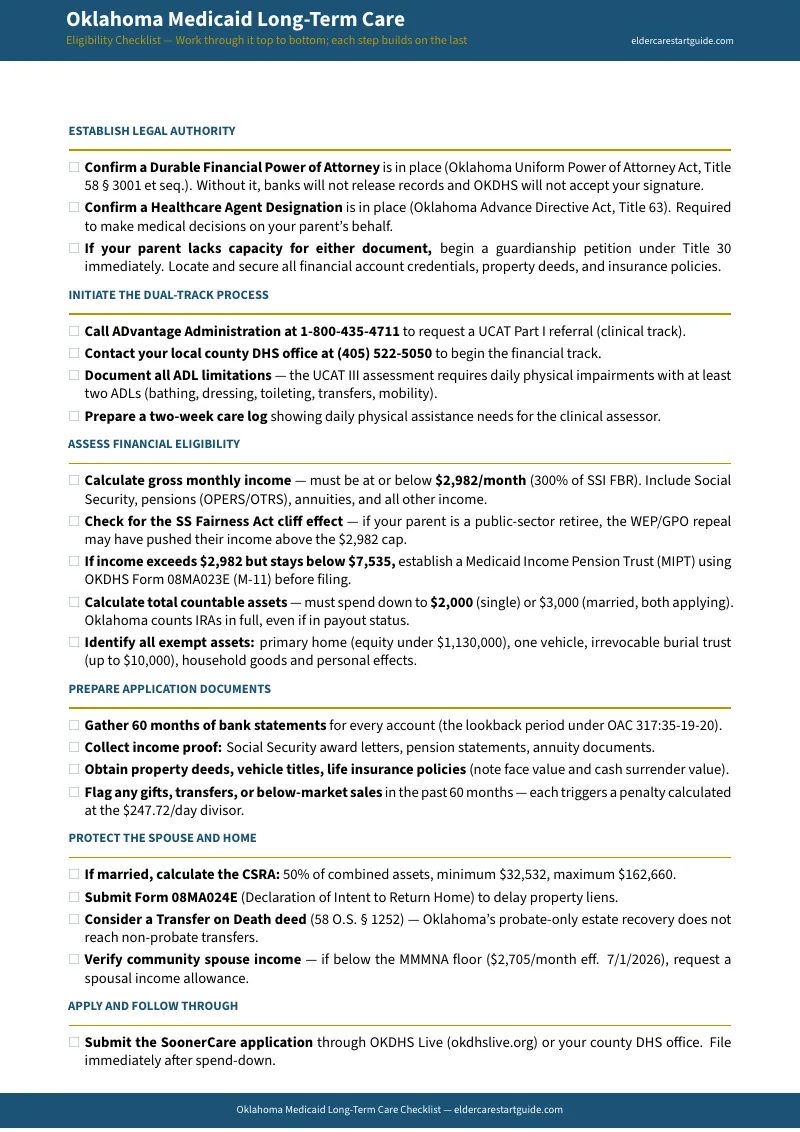
The complete guide (57 pages, 13 chapters) plus 6 printable worksheets (MIPT funding calculator, 60-month lookback ledger, asset spend-down tracker, spousal protection calculator, application document checklist, and agency communication log) plus the free checklist (25 action items in priority order). All 8 PDFs download immediately.
Every figure, threshold, and agency contact is specific to Oklahoma and current for 2026. When the rules change, the guide is updated — you're not building a plan on last year's numbers.
Frequently Asked Questions
Is this legal advice?
No. This guide provides process navigation — it explains how Oklahoma's Medicaid long-term care system works, what the eligibility rules are, and how families typically navigate them. It does not replace an attorney for complex trust structures, contested asset valuations, or guardianship proceedings. The guide includes a chapter on when professional help is worth the cost and how to prepare for it.
Can my parent really qualify for Medicaid with income over $2,982 a month?
Yes, through a Medicaid Income Pension Trust (MIPT). Oklahoma is an income-cap state with no medically needy spend-down option, but the MIPT channels income through a dedicated trust account that satisfies the eligibility requirement. The guide covers setup, funding, and the $7,535 upper ceiling in detail.
My parent is already in a facility. Is it too late?
No. Oklahoma allows compliant spend-down strategies even in a crisis — converting countable assets to exempt home improvements, prepaying an irrevocable funeral trust, or paying down existing debt. The guide covers each strategy with the documentation standards OKDHS requires.
Will Oklahoma take the family home?
Oklahoma limits estate recovery to the probate estate. Assets that pass outside probate — through Transfer-on-Death deeds, joint tenancy, or irrevocable trusts — are shielded from state recovery. During your parent's lifetime, the home is exempt as long as your parent intends to return or a qualifying relative lives there. The guide explains both the lifetime protections and the post-death strategies.
What's the difference between the free checklist and the full guide?
The checklist gives you the 25 most urgent steps in order — it tells you what to do. The full guide explains how to do each step, with the financial thresholds, agency processes, legal structures, and worked examples that make the difference between a smooth application and a denial.
How current are the financial figures?
All income caps, asset limits, spousal allowances, and penalty divisors reflect 2026 Oklahoma rules. The guide incorporates the Social Security Fairness Act changes (GPO/WEP repeal) and their impact on Oklahoma Medicaid income eligibility.
Get the Oklahoma Medicaid Long-Term Care & Asset Protection Guide →