Your Parent Pays $202.90 a Month for Medicare Part B. Oklahoma Can Pay It for Them.
If your parent lives on Social Security in Oklahoma, Medicare premiums hit before rent. The $202.90 monthly Part B deduction leaves some seniors with under $500 to cover everything else. Oklahoma's Medicare Savings Programs — QMB, SLMB, and QI-1 — can pay that premium in full. QMB goes further, covering all Medicare deductibles and coinsurance too. But the process fights you at every turn. OKDHSLive drops document uploads. County DHS caseworkers confuse standalone MSP rules with full SoonerCare Medicaid and tell people they don't qualify when they do. Families fear estate recovery when it doesn't even apply to these programs. One wrong step can delay approval by months — or keep your parent from applying at all.
The Oklahoma Medicare Cost Relief System
This is a step-by-step process guide built specifically for Oklahoma — not a generic Medicare overview and not an insurance sales pitch. It covers the Medicare Savings Programs (QMB, SLMB, QI-1) and Extra Help (the Part D Low-Income Subsidy) the way Oklahoma actually administers them: the dual-agency structure where Oklahoma Human Services (OKDHS) takes the application and the Oklahoma Health Care Authority (OHCA) manages the SoonerCare benefit, the OKDHSLive portal and the county DHS office alternative, the income disregard calculation that published limits leave out, the asset exemptions that include federally protected tribal trust land, and what to do after approval when the premium keeps coming out of the Social Security check while CMS catches up.
Every figure is dated to the 2026 benefit year. Every office reference, phone number, and portal instruction has been verified against current OKDHS and OHCA records.
What's Inside the Guide
- Oklahoma's Dual-Agency Navigation Map — Oklahoma splits MSP administration between OKDHS (applications and eligibility) and OHCA (benefit management and provider claims under SoonerCare). National guides ignore this split, leaving families unsure which agency to call when something goes wrong. The guide traces every step from initial application to benefit activation across both agencies so you always know who handles what.
- OKDHSLive Portal Walkthrough and County Office Bypass — The OKDHSLive portal (okdhslive.org) handles MSP applications alongside SNAP, TANF, and SoonerCare — and it is known for session timeouts, unconfirmed document uploads, and opaque application tracking. The guide details both application routes: the portal steps for families comfortable online, and the in-person county DHS office intake that creates a case record immediately. It also walks through Form 08MP003E (Rights, Responsibilities, and Signature for Benefits), including the Asset Verification System authorization block.
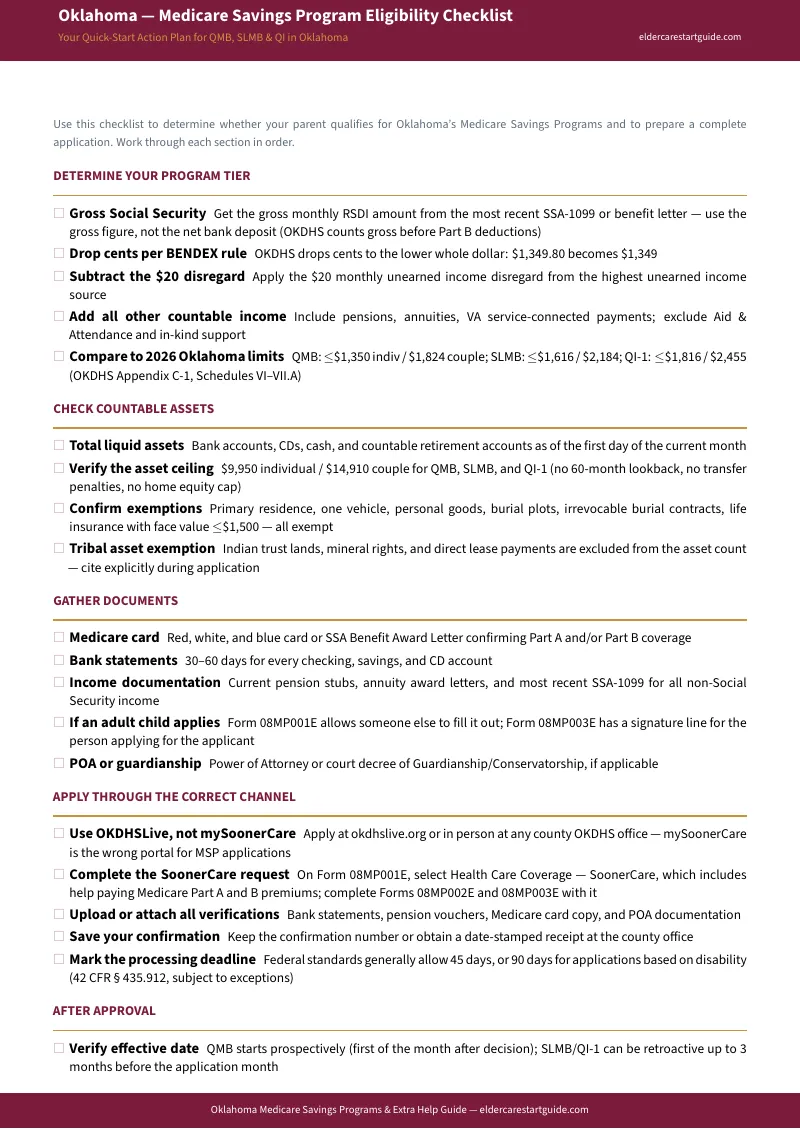
- Income Disregard Worksheets — Published income limits ($1,350/month QMB, $1,616 SLMB, $1,816 QI-1 for an individual in 2026) are countable-income limits, not gross. Oklahoma subtracts a mandatory $20 general income disregard from unearned income before comparing, and the BENDEX system's cent-drop on Social Security amounts can move the line further. The guide includes calculation worksheets so you know which program tier your parent actually falls into — not which one the raw numbers suggest.
- Asset Rules with Tribal Exemptions — Oklahoma applies asset limits of $9,950 individual / $14,910 couple to MSP applicants. But exempt assets include the primary residence, one vehicle, household goods, burial plots, and irrevocable burial funds. For tribal families, federal rules exempt Indian trust land, tribal allotments, mineral rights, and direct lease payments from the state resource calculation — exemptions that caseworkers sometimes fail to apply. The guide itemizes every exempt and countable category under Oklahoma's Appendix C-1 schedule and includes the specific federal citations for tribal asset protections.
- QMB Balance-Billing Dispute Protocol — Federal law prohibits providers from billing QMB enrollees for Medicare deductibles and coinsurance. In Oklahoma, even when OHCA pays $0 toward a Medicare deductible because of state fee schedule caps, the provider cannot bill the QMB beneficiary. But billing departments routinely do it anyway. The guide includes a dispute protocol with the specific federal citations (Section 1902(n)(3)(B) of the Social Security Act, 42 CFR § 447.15) and a letter framework to stop illegal bills before they reach collections, plus escalation to OHCA's Program Integrity Unit.
- Part A Buy-In Without Waiting — Oklahoma operates under a Part A Buy-In Agreement with CMS (State Agency Code S38). If your parent lacks premium-free Part A because they have fewer than 40 work quarters, they can apply for QMB at any time of year — no General Enrollment Period restriction. Once approved, Oklahoma pays the Part A premium directly to CMS. The guide scripts the Conditional Part A filing with Social Security and the coordination with the Oklahoma MSP application so both approvals happen together.
- Extra Help Auto-Conferral and Rx for Oklahoma Distinction — MSP approval in Oklahoma triggers automatic Extra Help (Part D Low-Income Subsidy) — no separate SSA-1020 application needed. The guide also distinguishes Rx for Oklahoma, a state program connecting residents to drug manufacturer Patient Assistance Programs, from true pharmaceutical assistance. Rx for Oklahoma does not pay Part D costs, so confusing the two can cost your parent thousands in unnecessary drug spending.
- Caseworker Escalation Protocol — Public records and forum posts confirm that understaffed county DHS offices sometimes confuse full SoonerCare Medicaid rules with standalone MSP rules and issue verbal denials that shouldn't happen. The guide provides the specific OKDHS administrative policy references you can cite to a supervisor and the step-by-step process for requesting a fair hearing using OKDHS Form H-1, including the critical 10-day rule that preserves your parent's current benefits while the hearing is pending.
- Tribal Navigation — Oklahoma has 39 federally recognized tribes, and a widespread misconception is that enrolling in a state MSP compromises the right to care at IHS facilities or tribal health centers. In reality, QMB enrollment lets IHS and tribal facilities bill Medicare directly, preserving Purchased/Referred Care funds for specialty care. The guide walks through tribal-specific asset exemptions and explains how to cite them during the application.
- Renewal Tracking, COLA Traps, and Fair Hearing Deadlines — Oklahoma conducts annual redetermination. A January Social Security COLA increase can push gross income above the MSP limit even though real purchasing power hasn't changed. The most common cause of unexpected benefit termination is a missed redetermination deadline, not an actual change in eligibility. The guide includes a 12-month document organizer and covers filing Form H-1 within 10 days to preserve benefits if a renewal is incorrectly denied.
Who This Guide Is For
- Adult children helping a parent in Oklahoma who is paying the full Medicare Part B premium on a fixed income
- Seniors in Oklahoma whose Social Security check is shrinking because of Medicare costs and who want to find out if the state will cover some or all of it
- Families who have been told their parent doesn't qualify — and want to verify that against Oklahoma's actual MSP income and asset rules
- Caregivers managing a parent's benefits from out of state who need a clear filing path through Oklahoma's OKDHS system
- Tribal families navigating MSP eligibility alongside IHS and tribal health services
- Anyone helping a QMB enrollee in Oklahoma fight an illegal medical bill
Why Not Just Use the Free Information?
Oklahoma publishes the OKDHSLive portal as an online intake tool — without a guide to navigating its quirks. The OKDHS website explains MSP eligibility — while the portal routes applicants through SoonerCare, SNAP, and TANF questions that have nothing to do with Medicare. Medicare.gov confirms that Medicare Savings Programs exist — while burying Oklahoma-specific details behind federal policy manuals meant for state administrators. Oklahoma MAP counselors provide excellent free guidance — but they cannot fill out applications on your behalf, organize your documents, or draft a balance-billing dispute letter for your parent's doctor.
The information is scattered across okdhslive.org, Medicare.gov, SSA policy manuals, Oklahoma Administrative Code, and Reddit threads where people piece together conflicting advice from caseworkers. This guide puts the Oklahoma-specific process in one place, in the order you need it, with the calculations set up and the common traps flagged.
What's Not in This Guide
This guide does not recommend Medicare Advantage plans, Medigap policies, Part D drug plans, or insurance brokers. It does not provide legal advice. It is not affiliated with CMS, SSA, OKDHS, OHCA, or any state or tribal agency. It is process navigation — the steps to get your parent's Medicare costs covered by programs that already exist, explained in plain language with Oklahoma-specific procedures.
For insurance plan comparisons, the guide directs families to the Oklahoma Medicare Assistance Program (MAP) at 1-800-763-2828, which provides free, unbiased counseling. For complex situations involving significant assets, irrevocable trusts, or long-term care Medicaid including the ADvantage waiver, the guide recommends consulting an Oklahoma elder law attorney.
Satisfaction Guarantee
If the guide doesn't deliver what you expected, email [email protected] for a full refund. No time limit, no conditions.
Get Started
Download the free Oklahoma Medicare Savings Program Eligibility Checklist to see if your parent qualifies. If the numbers look right, the full guide gives you everything you need to file, follow up, and protect your parent's benefits after approval.
The full Oklahoma Medicare Savings Programs & Extra Help Guide is — less than a single month's Part B premium, for a process that can save over $2,400 a year.
Frequently Asked Questions
What if the rules change after I buy?
We update the guide when the rules change. Email us any time, even years later, and we'll send you the current edition free.