
The Hospital Says Your Parent Is Going Home Tomorrow. You Haven't Slept in Two Days. Nobody's Mentioned That One Phone Call Can Legally Freeze the Discharge.
It's 10 PM. The discharge planner told you this afternoon that your parent — the one who still can't stand without help after a hip fracture — is being sent home in the morning. You have no hospital bed at home, no physical therapist lined up, and the pile of new medications doesn't match anything your parent was taking before the fall.
You start searching online and find scattered pieces: something about Medicare appeals, something about a QIO, a state program called SPED that might cover home care even if your parent has too many assets for Medicaid. But you can't figure out the sequence. Which call do you make first? What's the deadline? What happens if you miss it?
Here's what most families in North Dakota don't learn until it's too late: one phone call to Acentra Health at 1-888-317-0891 before midnight on the scheduled discharge day triggers an immediate, legally binding freeze. The hospital cannot move your parent. Medicare continues to pay. And the burden shifts from you to the hospital to prove the discharge is safe. That single call is worth more than the social worker's entire discharge packet — but nobody in the hospital is going to suggest it, because their job is to clear the bed.
The North Dakota Discharge Defense System
This isn't a pamphlet summarizing your rights. The North Dakota Discharge Defense System maps the exact sequence of calls, forms, assessments, and deadlines you need to navigate — from the moment your parent is admitted through post-discharge home care setup — so you don't lose leverage because you acted in the wrong order.
The critical mistake most families make: they accept the discharge, scramble to set up care at home, and only learn about their appeal rights after the window has closed. By that point, the hospital bed is gone, Medicare's coverage clock has restarted, and they're paying out of pocket for rehabilitation their parent was entitled to receive.
The guide puts you in the right order: verify admission status on day one (observation vs. inpatient changes everything), invoke the CARE Act to force the hospital to include you in planning, file an appeal if the discharge is premature, choose a facility using inspection data instead of the hospital's recommended list, and set up SPED or HCBS Waiver services while your parent still has clinical documentation fresh.
What You Get — 10 PDFs
- 14-Chapter Guide — The complete North Dakota Discharge Defense System: verifying admission status and the observation status trap, your discharge rights under federal and North Dakota law, filing fast appeals through Acentra Health, the CARE Act lay caregiver designation, choosing a rehab or SNF facility using state inspection reports, Medicare SNF coverage rules and the 3-midnight requirement, North Dakota's unique SPED and Ex-SPED home care programs, Medicaid 209(b) eligibility with the $3,000 asset limit and Medically Needy spend-down, spousal impoverishment protections, the five-year lookback and estate recovery, basic care facilities vs. skilled nursing facilities, legal authority options including DPOA and guardianship, filial responsibility protections after Senate Bill 2225, rural North Dakota challenges with critical access hospitals and swing beds, readmission prevention, key contacts and resources, and financial planning worksheets. Every phone number, every deadline, every North Dakota-specific rule — current for 2026.
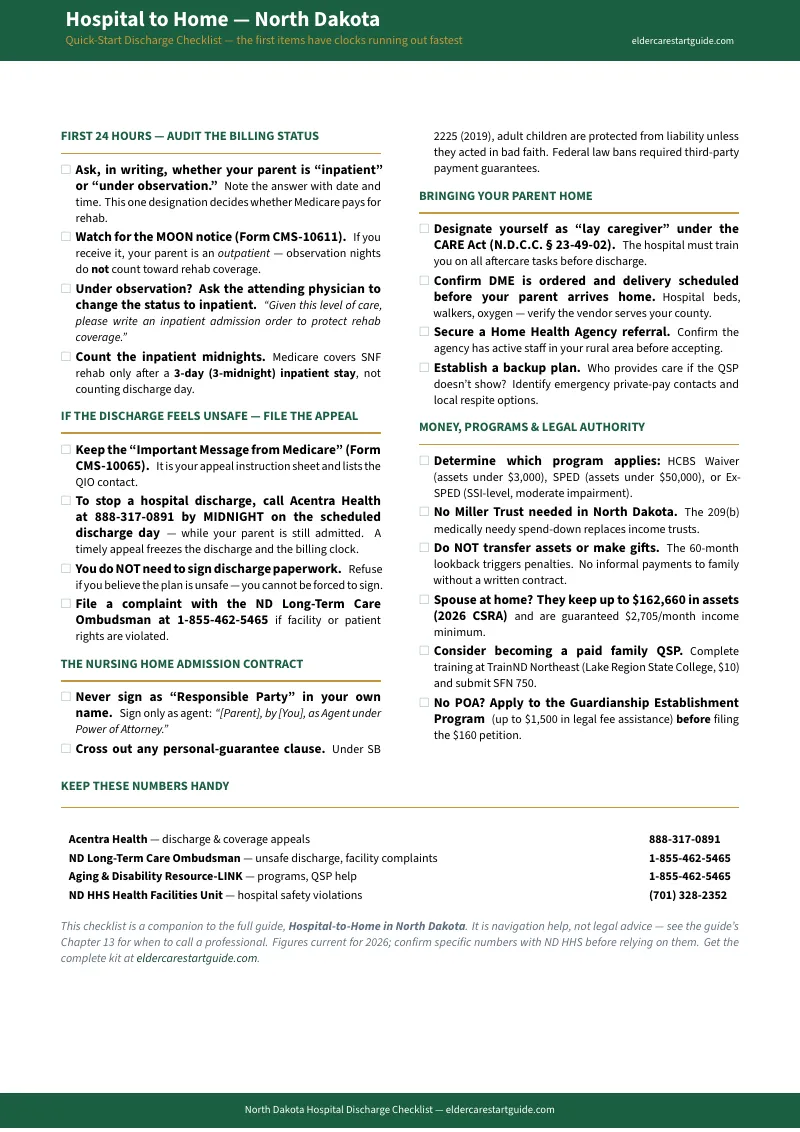
- Quick-Start Checklist (Free Download) — 20 actionable items in priority order: verify admission status, designate yourself as lay caregiver under the CARE Act, request the Important Message from Medicare, prepare for the care conference, file an appeal with Acentra Health if needed, check facility inspection reports, evaluate SPED eligibility, set up home health and DME, and protect yourself from filial responsibility exposure. Know exactly what to do tonight, this week, and before your parent leaves the hospital.
- 8 Standalone Worksheets & Reference Sheets — Print these separately and bring them to the hospital, the care conference, or the attorney's office:
- Hospital Admission Status Tracker — daily log to document inpatient vs. observation classification
- Facility Comparison Scorecard — side-by-side evaluation of up to three SNFs, swing beds, or rehab facilities
- Forms & Contacts Directory — one-page fridge sheet with every phone number, form, and 2026 financial threshold
- Discharge Day Checklist — verify medications, DME, follow-up appointments, transportation, and home safety before leaving
- Asset Inventory Worksheet — determine Medicaid ($3,000 limit) vs. SPED ($50,000 limit) eligibility
- Recipient Liability Calculator — estimate your parent's monthly share-of-cost for facility care
- Lookback Period Transfer Log — audit 60 months of transfers before applying for Medicaid
- Medication Reconciliation Log — compare pre-admission and discharge medications line by line
Who This Guide Is For
- Adult children in North Dakota managing a parent's discharge from the hospital after a fall, stroke, cardiac event, or other acute crisis — especially if you've never navigated this system before
- Families facing an immediate discharge who need to know their appeal rights and the exact phone number to call before midnight tonight
- Caregivers choosing between skilled nursing facilities with no way to compare safety records beyond the hospital's recommended list
- Families whose parent has too many assets for Medicaid but can't afford private home care — SPED covers seniors with up to $50,000 in liquid assets
- Adult children who lack formal Power of Attorney and believe they have no legal standing to participate in discharge decisions
- Rural North Dakota families whose parent was airlifted or transferred to Fargo, Bismarck, Grand Forks, or Minot and needs to transition back to a community with limited care infrastructure
- Out-of-state siblings coordinating a North Dakota parent's hospital-to-home transition and needing every ADRL office number, QSP registry link, and QIO deadline in one document
Why the Free Information Isn't Working
The hospital social worker's job is to clear the bed. Under administrative pressure to minimize length of stay, they hand you a list of nursing homes and a stack of forms. They are evaluated on bed turnover rates, not on whether your parent ends up back in the ER within a week. They cannot advise you on how to legally dispute a premature discharge or how to pass the SPED functional assessment that determines home care eligibility.
North Dakota's Aging & Disability Resource Link (ADRL) is a genuinely useful resource — but the counselors operate within strict agency boundaries and cannot sit in the hospital room with you at 11 PM explaining how to file a fast appeal before the midnight deadline. They can explain public benefits but cannot draft legal objections or stand between your family and a discharge planner who's under pressure to free the bed.
The national directories — A Place for Mom, Caring.com — rank well on Google for North Dakota elder care queries, but their business model is referral fees from assisted living and nursing home chains. They are structurally incentivized to move your parent into a facility, not to help you qualify for SPED home care that pays no referral commission. They do not cover the CARE Act, the observation status trap, Acentra Health appeals, or the Medically Needy spend-down — because none of those things generate revenue for their advertisers.
Elder law attorneys in the Fargo, Bismarck, and Grand Forks metro areas charge $300 to $500 per hour, with comprehensive Medicaid planning packages running $6,000 to $15,000. That's the right call for complex estate protection — and the guide tells you exactly when to hire one. But at midnight on the night before an unsafe discharge, you need to know which phone number to call and what words to say. You don't need a retainer agreement.
Satisfaction Guarantee
If this guide doesn't give you a clear, actionable path through your parent's hospital discharge in North Dakota, email [email protected]. We read every message.
— Less Than 10 Minutes of an Elder Law Attorney's Time
North Dakota elder law attorneys charge $300 to $500 per hour. A private patient advocate charges $150 per hour. A single missed deadline — failing to call Acentra Health before midnight, letting the observation status go unchallenged, signing a facility admission as "Responsible Party" instead of "Agent under Power of Attorney" — can cost your family thousands in uncovered rehabilitation or personal liability for nursing home bills.
This guide won't replace an attorney when you need one (and it tells you exactly when that is). But it will make sure you don't lose your appeal window because you didn't know it existed, don't accept a placement your parent can't afford because the hospital pressured you to choose in two hours, and don't miss the SPED program because nobody told you about the $50,000 asset limit alternative to Medicaid's $3,000.
Download the free Quick-Start Checklist to see the 20 most urgent action items. When you're ready for the complete system, the full guide is waiting.