
You Didn't Sign Up for This Job. But Here You Are.
One day your parent was paying their own bills. The next, you're staring at a stack of late notices, a frozen bank account, and three siblings asking why you let it get this bad.
Managing a parent's money isn't just math. It's navigating banks that won't talk to you, legal documents you've never seen before, siblings who assume the worst, and a parent who thinks you're trying to steal their independence.
Government guides tell you what a fiduciary duty is. Elder-law attorneys charge $300–$500 an hour to tell you what a durable POA means. Neither one hands you a system for actually running your parent's financial life without losing your mind — or your family.
The Financial Caregiver's Operating System
This isn't another legal explainer or generic checklist. Managing a Parent's Finances is a complete operational system — the step-by-step infrastructure that turns chaos into a documented, auditable, conflict-proof financial management process.
It bridges the gap between "understanding what a power of attorney is" and "paying Mom's electric bill on Tuesday night without getting locked out of her banking app."
What's Inside
- Emergency Financial Triage Protocol — because most people don't get to plan this transition. A prioritized first-72-hours sequence for securing accounts, halting bleeding, and establishing authority when crisis hits without warning.
- Banking Access Playbook — the exact difference between joint accounts, authorized signers, convenience accounts, and POA authority at financial institutions. Includes why joint accounts can expose your parent's savings to your creditors, and what to set up instead.
- Sibling Transparency Dashboard — a pre-built shared tracking system (compatible with Google Sheets and YNAB) that makes every medical expense, grocery run, and reimbursement instantly visible. Suspicion dissolves when the data is clean and automatic.
- Exploitation Shield Framework — trusted contact designations, bank alert configurations, phone scam intervention scripts, and the reporting pathway (Adult Protective Services, National Elder Fraud Hotline) when prevention fails.
- Medicaid Planning Roadmap — asset limits, the 60-month look-back period explained in plain English, caregiver agreements that preserve benefit eligibility, and the spend-down strategies that keep your parent's home off the table.
- Caregiver Compensation Contracts — how to get legally paid for daily caregiving labor through programs like IHSS and CDPAP without triggering a Medicaid disqualification. Includes a customizable personal services agreement template.
- Conversation Scripts — word-for-word language for the hardest moments: the initial talk with a resistant parent, the sibling meeting about money, the call to the bank when they won't honor your POA.
- 90-Day Implementation Roadmap — everything prioritized into Week 1 (emergency), Month 1 (infrastructure), and Month 2-3 (long-term systems), so you know exactly what to tackle next regardless of where you're starting.
Who This Is For
- Crisis caregivers — your parent was just hospitalized, diagnosed, or scammed, and you need to take over now
- Preventive planners — you see the warning signs (missed bills, cash hoarding, confusion) and want to build safeguards while your parent can still consent
- Sibling mediators — you're doing all the work and getting all the suspicion, and you need a system that proves your integrity
- Benefit navigators — savings are depleting fast and you need to understand Medicaid eligibility before it's too late to plan
Why Not Just Google It?
You can find every piece of this information scattered across government PDFs, Reddit threads, elder-law blogs, and caregiver forums. People do. It takes them weeks of research, dozens of conflicting answers, and usually one expensive mistake they didn't know was possible.
The CFPB tells you what fiduciary duties are — but not how to set up the separate bank account your parent's POA actually requires. Caring.com explains power of attorney types — then funnels you toward $5,000/month assisted living facilities. Nolo sells you the legal forms — without telling you that a joint bank account exposes your parent's savings to your personal creditors.
This handbook connects the dots. Legal authority, daily operations, family coordination, benefit planning, and fraud protection — organized into one sequential system where each chapter builds on the last.
The Alternative Is Expensive
A geriatric care manager charges $150–$300 per hour. An elder-law attorney bills $300–$500 per hour. A single financial exploitation event costs families an average of $120,000.
For , you get the operational system that keeps you out of the attorney's office for everything except the final review — and protects your parent from the exploitation that costs families six figures.
What You Get
- The complete 15-chapter handbook (PDF, 75+ pages)
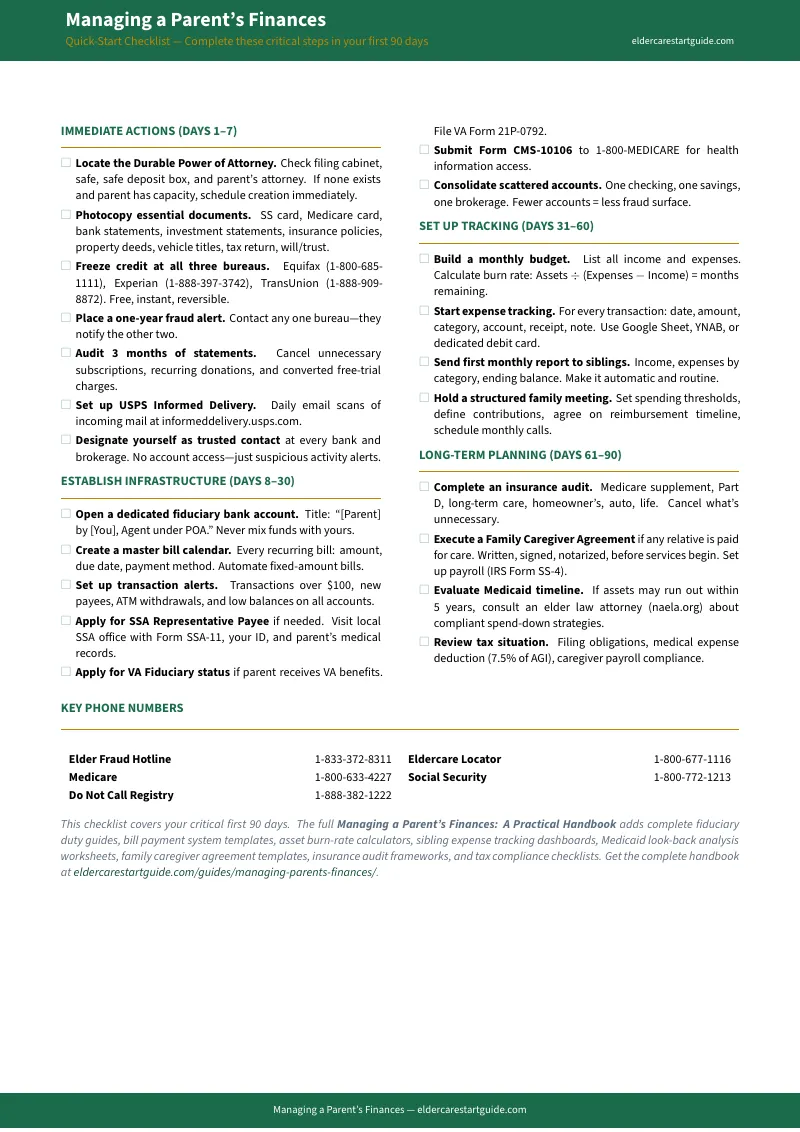
- Quick-start triage checklist (separate printable PDF)
- Emergency financial triage checklist (printable first-14-days action plan)
- Sibling expense tracking worksheet (printable monthly log with category codes)
- Caregiver compensation agreement template (fillable, notary-ready)
- 90-day implementation roadmap (phased checklist from crisis through long-term planning)
- Exploitation shield fridge sheet (reporting numbers and red flags — print and post)
- Conversation scripts (word-for-word language for parents, siblings, and banks)
100% satisfaction guarantee. If the handbook doesn't give you a clearer path forward within 48 hours of reading it, email us for a full refund. No questions, no hassle.
Start With the Free Checklist — Or Get the Full System
Not sure yet? Download the free Quick-Start Checklist — 20 critical action items you can start tonight. Already know you need the full picture? The complete handbook gives you the context, scripts, templates, and step-by-step protocols to manage your parent's finances with confidence and legal protection.