
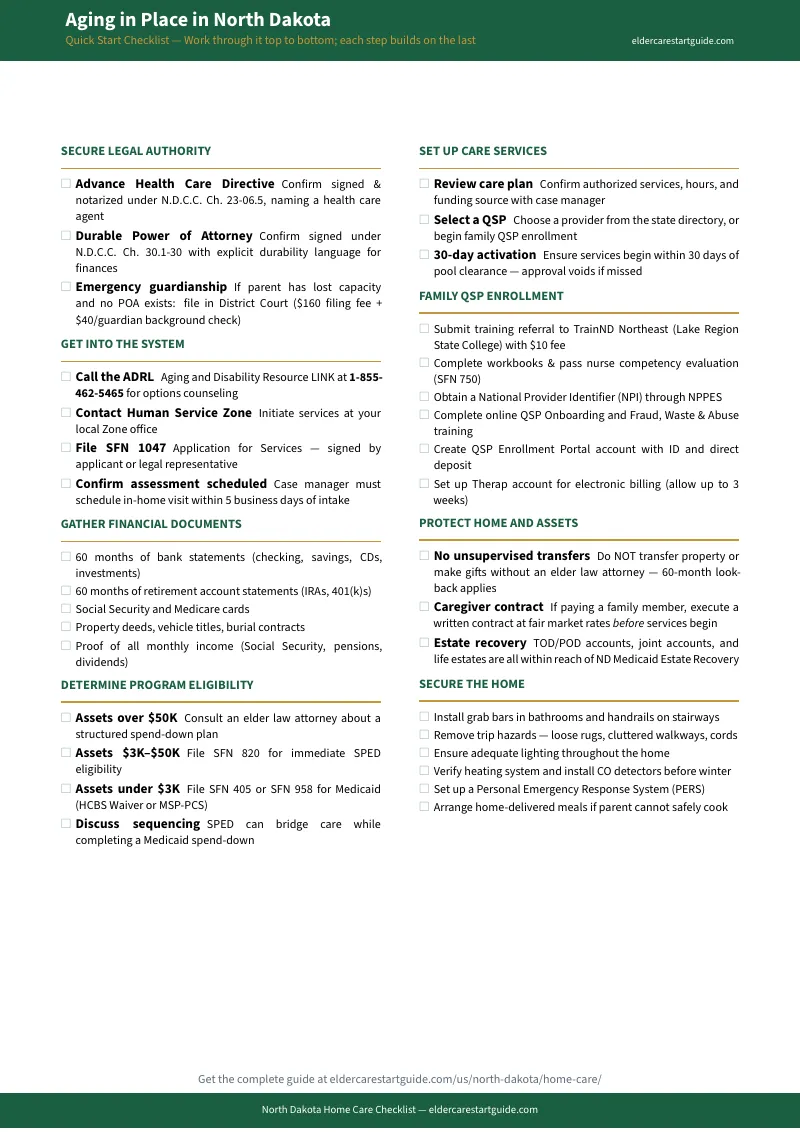
Your parent needs help at home and North Dakota buried the instructions across three Medicaid pathways, two state-funded programs, and a QSP billing system nobody explained.
Your mother fell on the farm and the discharge planner at Sanford Health wants to know your "home care plan" by Friday. Your father can no longer cook or manage his medications, and you are three hours away in Fargo watching the situation deteriorate through phone calls. You have spent four nights on hhs.nd.gov trying to understand the difference between SPED, Ex-SPED, and the Medicaid HCBS Waiver — and every page sends you to a policy manual written for case managers, not families.
Meanwhile a home care agency is quoting $35 an hour. At 30 hours a week that is $4,500 a month. Your parent's savings will not survive two winters at that rate, and you have heard that family members can get paid to provide care in North Dakota — but the QSP enrollment process involves TrainND Northeast at Lake Region State College, a competency evaluation by a registered nurse, something called an NPI number, and a billing platform called Therap that no one in your family has ever heard of.
You are not failing. You are operating inside a system that was designed for administrators, not families.
The North Dakota Home Care Navigator
This is a complete, conflict-free action plan — not a government summary, not a home care agency's brochure, and not a $300-per-hour elder law consultation. It is the exact checklists, program comparisons, contract templates, and enrollment walkthroughs a North Dakota family needs to evaluate every state-funded option, enroll a family member as a paid caregiver, protect a home or farm from Medicaid estate recovery, and coordinate care across the vast distances that define this state.
A 12-chapter guide, a 20-item action checklist, and 8 standalone printable tools — including a four-program comparison chart, QSP enrollment checklist, crisis discharge workflow, spend-down planner, estate recovery worksheet, home safety audit, forms reference, and key contacts sheet. Built for the 2026 regulatory environment and organized around the precise administrative moments where families lose time, money, or benefits they cannot recover.
What's inside — and the problem each section solves
Four-Program Comparison Framework
The problem: North Dakota runs four overlapping home care programs — SPED, Ex-SPED, the Medicaid HCBS Waiver, and Medicaid State Plan Personal Care — each with different asset limits, income thresholds, functional scoring criteria, and family caregiver rules. Applying to the wrong one first can cost months.
A side-by-side breakdown of all four programs with their 2026 eligibility numbers. SPED's $50,000 asset limit versus the Waiver's $3,000 limit. SPED's ADL/IADL scoring thresholds versus the Waiver's Nursing Facility Level of Care requirement. Which programs allow spousal caregivers and which exclude them. When to apply to SPED as a bridge while waiting for a Waiver slot.
QSP Family Caregiver Enrollment Toolkit
The problem: You discovered that North Dakota will pay you $159.54 per day for Family Personal Care. But the enrollment process spans six agencies, two training workbooks, a nurse competency evaluation, an NPI application, a state portal registration, and a billing system migration — and a single missed step means automatic claim denials.
A sequential, numbered walkthrough of every step from the TrainND Northeast referral form and $10 processing fee through the SFN 750 competency sign-off, NPI registration, QSP Enrollment Portal account creation, and Therap electronic billing setup. Includes current daily rates for all five compensation tiers and the FLSA overtime calculation that applies when you provide more than 40 hours per week.
Crisis Discharge Workflow
The problem: The hospital discharge team is pressuring you to move your parent to a nursing facility because no home care plan is in place. You have days, not weeks.
A five-step emergency protocol: secure legal authority, contact the ADRL (1-855-462-5465) and your Human Service Zone, run a financial screening against all four programs, finalize a care plan, and file an appeal if you are denied. Designed to be executed under time pressure when a parent is leaving the hospital and there is no care waiting at home.
Medicaid Spend-Down and Asset Protection
The problem: Your parent's income exceeds the $1,197 monthly Medicaid limit and you have been told they "don't qualify." That is not true in North Dakota — but nobody explained the 209(b) medically needy framework or how to use it.
A plain-language explanation of Recipient Liability — how excess monthly income becomes a deductible that, once met, triggers 100% Medicaid coverage for the rest of the month. Plus the 60-month look-back rules, the daily penalty divisor of $442.22 for disqualifying transfers, and the Community Spouse Resource Allowance of up to $162,660.
Estate Recovery and Lien Prevention
The problem: You are terrified that after your parent passes, the state will place a lien on the family home or farm to recoup Medicaid benefits paid — and you do not know what protections exist or how to activate them.
A detailed walkthrough of N.D.C.C. § 50-24.1-07, including the surviving spouse, minor child, and disabled child exemptions. Covers how to establish clean asset tracing, rebut the surviving-spouse ownership presumption, structure audit-proof personal care contracts, and apply for a post-death hardship waiver.
Home Safety Audit and Modification Funding
The problem: Your parent's home needs grab bars, a wheelchair ramp, or a walk-in shower — and you do not know that North Dakota will pay for these modifications through multiple programs.
A guide to environmental modification and adaptive equipment benefits under SPED, Ex-SPED, and the HCBS Waiver. Includes the NDAD medical equipment loan program, VA Aid and Attendance claims for veteran parents, and a room-by-room home safety checklist with winter-specific considerations for a state where subzero temperatures are routine.
Who this is for
- The adult child in Fargo, Grand Forks, or Minot managing a parent's care on an isolated farm or in a small community where home care agencies have month-long waitlists
- The family caregiver who has been providing unpaid care and wants to transition to a paid QSP but cannot navigate the multi-step enrollment process alone
- The family coordinating a sudden hospital discharge who needs to evaluate home care options, state programs, and legal authority requirements under time pressure
- The middle-class family with assets above the $3,000 Medicaid limit who needs SPED's $50,000 pathway or a structured spend-down plan — not an immediate nursing home placement
- The family protecting a home or farm from Medicaid estate recovery who needs the specific legal steps before an elder law attorney appointment at $300 an hour
Why not the free alternatives?
The ND HHS website and QSP Hub? They have the rules — across dozens of policy manuals and administrative bulletins. They will tell you the programs exist. They will not hand you a sequential enrollment checklist, a side-by-side program comparison, or an audit-proof personal care contract template. The information is there. The action sequence is not.
A Place for Mom or Care.com? These are commission-driven lead generators. The moment you enter your contact information, you receive aggressive calls steering your parent toward assisted living or memory care facilities — because those facilities pay referral commissions. They will never tell you how to avoid agency fees by enrolling a family member as a QSP, because that eliminates their revenue.
An elder law attorney? For complex estates, absolutely worth the $250 to $500 per hour. But walking into that appointment with disorganized paperwork is expensive at $5 per minute. Use this guide as the intake organizer: arrive with your parent's asset inventory, program eligibility assessment, and estate recovery protection strategy already mapped out, and compress a multi-hour engagement into one efficient session.
A fair, simple guarantee
If this guide does not give you a clearer, more confident path through North Dakota's home care system than the free tools you have been struggling with, reply to your receipt at any time and we will refund you in full. No forms, no friction. You are already dealing with enough of both.
Start where you are
Not ready to buy? Start with the free North Dakota — Aging in Place Resource Checklist — a one-page map of the key programs, contacts, and action steps you need. When you are ready to move from "what exists" to "here is exactly how I do it," the full guide is — less than five minutes with an elder law attorney, and yours to keep permanently.
Download the guide today and stop losing weeks to a system that was designed for case managers, not families.