Your parent is losing $202.90 every month — and Nebraska has programs that can stop it
That $202.90 Part B premium disappears from your parent's Social Security check before a dollar hits the bank. On a fixed income of $1,300 or $1,500 a month, it's a devastating monthly cut — before rent, utilities, groceries, or prescriptions enter the picture. Add Original Medicare's $283 annual deductible and 20% coinsurance on every doctor visit and procedure, and out-of-pocket costs can push past $5,000 a year.
You've searched for help. Every result for "help paying Medicare in Nebraska" lands on a site that wants your parent's phone number so a licensed agent can call back to sell a Medicare Advantage plan. The iServe Nebraska portal is a confusing dashboard that doesn't distinguish between a full Medicaid application and a Medicare Savings Program application. National websites list income limits that already include a $20 disregard families don't know about — so a parent earning $1,365 a month looks ineligible when they actually qualify. And the free SHIIP counsellors at the Department of Insurance, as excellent as they are, have appointment waits and can't file the application for you.
Meanwhile, the Part B premium keeps hitting the Social Security check. The drug copays keep stacking. And your parent keeps paying for benefits they may already qualify to have covered.
The Nebraska Medicare Cost-Relief Navigator
This is a step-by-step operating manual for cutting your parent's Medicare costs through every layer of help Nebraska administers — without surrendering contact information to a broker, without waiting weeks for a SHIIP counsellor appointment, and without navigating the iServe portal blind.
It covers the Medicare Savings Programs (QMB, SLMB, QI) that eliminate the Part B premium and — under QMB — all deductibles and coinsurance. It covers Extra Help, the federal Part D subsidy that MSP approval automatically triggers, slashing drug copays to a few dollars per prescription. Nebraska is a Part A group-payer state, so QMB approval also covers the Part A premium for seniors who lack 40 work quarters — no General Enrollment Period wait required. Each layer stacks. Most eligible families are enrolled in zero.
What's Inside
- The 2026 Nebraska eligibility breakdown — QMB ($1,350/mo single, $1,824 couple), SLMB ($1,616/$2,184), and QI ($1,816/$2,455) income limits as Nebraska applies them, plus the $9,950 individual / $14,910 couple resource limits and every exclusion (primary home, one vehicle, burial funds up to $6,924). Worked examples showing how the $20 general income disregard, the $65 + 50% earned-income exclusion, and impairment-related work expenses reduce a parent's countable income below the published ceiling.
- The iServe application walkthrough — Step-by-step filing through iServe Nebraska online, by mailing the paper application to Nebraska DHHS, or in person at a regional DHHS office. How to avoid the common trap of starting a full Medicaid application when a standalone MSP application is all that's needed. What documents to gather, how to attach the Authorized Representative form (EA-117) or use the representative section of Form MLTC-64 so an out-of-state adult child can manage the case, and how to confirm your submission reached the DHHS eligibility system.
- Extra Help coordination — Why MSP approval automatically deems a beneficiary eligible for the federal Extra Help subsidy (no separate application needed), how Extra Help's own income and asset limits capture parents who don't qualify for MSPs, and how the SSA-to-DHHS data exchange works in practice — including the multi-month lag that leaves families in limbo unless they know where to check.
- Part A buy-in for seniors without 40 work quarters — Nebraska is a Part A group-payer state. If your parent lacks premium-free Part A, QMB approval triggers a conditional Part A enrolment — but only through a precise dual-filing sequence at both the Social Security office and Nebraska DHHS. The guide walks through every step, including the enrolment period rules and what to bring to SSA.
- QMB billing protection steps — Federal law prohibits Medicare providers from billing QMB enrollees for deductibles, coinsurance, or copayments. Automated billing systems send those bills anyway — Nebraska families report it regularly. The guide gives you the statutory citations (42 U.S.C. § 1396a(n)(2) and 42 CFR 447.15), a ready-to-use dispute letter, and the escalation contacts when the billing department ignores you.
- Post-approval timeline — After DHHS approves the MSP, Social Security keeps deducting $202.90 while the DHHS-to-CMS-to-SSA data exchange processes — typically one to three months. The guide maps when the deduction stops, how retroactive reimbursement works, and what to do if the timeline stalls.
- Income disregard calculations — Nebraska uses Non-MAGI counting rules that most families don't know about. The $20 general disregard, the $65 + 50% earned-income exclusion, impairment-related work expenses, and the COLA disregard — with worked examples showing how a parent with gross income above the published limit can still qualify.
- The resource limit reality check — Nebraska's MSP resource limits ($9,950 individual, $14,910 couple) are dramatically higher than the standard AABD Medicaid limits ($4,000/$6,000). National websites that list the lower standard Medicaid limits for Nebraska are referencing the wrong programme. The guide details every exclusion and shows which assets count and which don't.
- Renewal system — DHHS redetermination timelines, the verification documents you'll need, change-reporting rules, the COLA disregard that protects existing enrollees from losing coverage after a cost-of-living raise, and how to avoid gaps in coverage between renewal cycles.
- Denial and appeal roadmap — How to file a Request for Fair Hearing with Nebraska DHHS under Title 477 NAC Chapter 10, the filing deadlines, the 10-day window to request continuation of benefits while the appeal is pending, and what evidence to prepare. The 90-day post-closure reconsideration window that lets families reopen a case without filing a brand-new application.
The Complete Toolkit — 7 PDFs
- 51-page guide — 13 chapters covering every programme, every step, and every edge case a Nebraska family faces
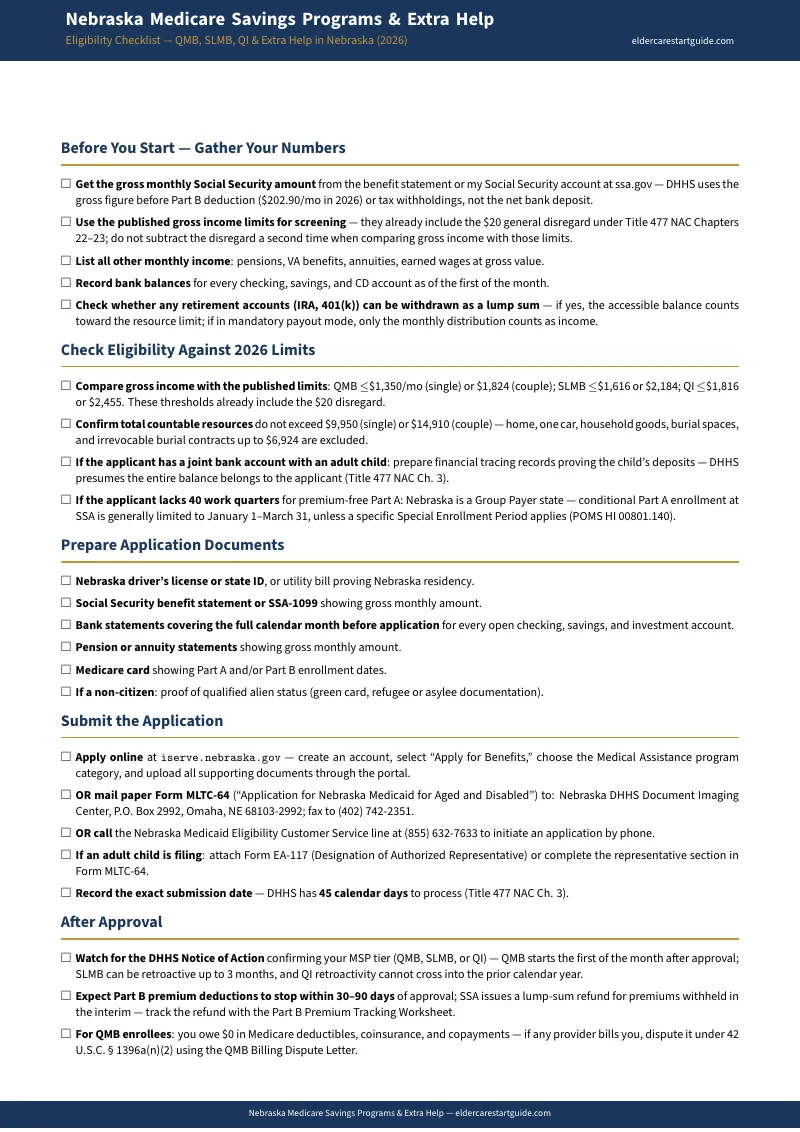
- Eligibility checklist — Confirm qualification for QMB, SLMB, QI, and Extra Help in minutes
- Income & resource eligibility worksheet — Screen gross income and countable resources against 2026 Nebraska MSP thresholds before filing
- Application document assembly checklist — Every document needed for the iServe submission or Form MLTC-64, with status tracking
- Agency communication log — Landscape tracking sheet for every call, fax, and portal interaction with DHHS, SSA, and Medicare
- Part B premium tracking worksheet — Monitor monthly deductions and verify the refund during the 30–90 day BENDEX processing window
- QMB billing dispute letter — Fill-in-the-blank letter citing federal statutes, ready to mail to any provider illegally billing a QMB enrollee
Who This Is For
- Adult children managing a parent's Medicare costs in Nebraska — whether you live in Omaha, Lincoln, Grand Island, the Panhandle, or out of state
- Seniors on fixed income paying the full $202.90 Part B premium and wondering if there's help
- Families who read the federal eligibility limits online and assumed their parent earns too much — without knowing how the $20 disregard and other exclusions reduce countable income
- Anyone who tried the iServe Nebraska portal and got stuck, or started a full Medicaid application when the standalone MSP application was all they needed
- Out-of-state adult children who need to manage a parent's DHHS case remotely and don't know how to establish authorised representative status
- Caregivers who received a DHHS notice — a verification request, a denial, or a renewal packet — and need to know what it means before the deadline passes
- Families helping a parent without 40 work quarters navigate Part A enrolment through QMB in a group-payer state
- Anyone who searched for state prescription assistance in Nebraska and found no standalone programme — Extra Help through MSP is the pathway, and the guide explains exactly how it works
Why Not Just Use the Free Resources?
The free resources are real. SHIIP counsellors (Nebraska's State Health Insurance Information Program, run by the Department of Insurance) are excellent, unbiased, and entirely free. DHHS publishes the application forms. The iServe portal accepts applications online. Medicare.gov lists the federal rules.
But here's what the free path looks like in practice:
- SHIIP call volumes spike during the Medicare Annual Enrollment Period (October 15 to December 7), leading to extended waits — and volunteer counsellor expertise varies, particularly on complex topics like income disregards, billing disputes, and administrative appeals
- The iServe Nebraska portal is a shared intake system for all Medicaid programmes — starting an MSP application without knowing which pathway to select can route you into a full AABD Medicaid application with asset declarations and spend-down calculations you don't need
- National websites list the federal MSP resource limit of $9,950, but some list Nebraska's standard AABD Medicaid limit of $4,000 instead — families with $5,000 or $7,000 in savings self-disqualify without ever applying
- DHHS sends formal correspondence with strict response deadlines, but the notices don't explain what the deadlines mean or what happens if you miss them
- Every search for "help paying Medicare in Nebraska" surfaces insurance lead-gen sites that capture contact information and route it to a Medicare Advantage or D-SNP sales call
This guide doesn't replace SHIIP counselling — it gets your parent's paperwork organised before the appointment so the counsellor's time goes to plan evaluation, not document collection. And when SHIIP isn't available for weeks, the guide lets you file the application yourself without waiting.
Your Purchase Is Protected
Full refund, no time limit. If this guide doesn't help your family's situation, email [email protected] and you get your money back. No forms, no justification.
The guide costs less than a single month's Part B deduction. A successful QMB application saves your parent $2,434 a year in Part B premiums alone — before Extra Help drug savings and QMB cost-sharing protections are counted.
Get Started
Download the free eligibility checklist to see if your parent qualifies. Ready for the full system? Get the complete Nebraska Medicare Cost-Relief Navigator — — and start the application this week.
Frequently Asked Questions
What if the rules change after I buy?
We update the guide when the rules change. Email us any time, even years later, and we'll send you the current edition free.