They Gave Your Parent the Wrong Information. Now There's a Lifetime Penalty.
An SSA representative said Part B wasn't needed yet. An HR department confirmed COBRA would count. A plan administrator said the employer coverage qualified. The advice was wrong — and now your parent faces a permanent 10% surcharge for each full 12-month period they could have had Part B but didn't, plus a coverage gap that leaves every doctor visit, lab test, and outpatient procedure uninsured.
The penalty isn't a one-time fee. It's recalculated against the standard premium every year, compounding quietly for the rest of their life. At the 2027 standard rate, three full 12-month periods without Part B means roughly $754 extra in premiums that year — for the same coverage everyone else gets at the standard rate.
The Relief Coordination System
Federal law provides two distinct mechanisms for fixing an enrollment mistake that wasn't your parent's fault. The problem is that each one has its own authority, its own form, its own evidence standard, and its own processing track. Using the wrong one is the single most common reason requests stall at a field office.
This guide is a Relief Coordination System — it matches your parent's specific situation to the correct federal remedy, then walks you through every step from evidence gathering to final resolution:
- Equitable Relief (42 U.S.C. § 1395p(h)) — when an error, misrepresentation, or inaction by a Federal Government employee or an agent authorized to act on behalf of the Federal Government in Medicare matters caused the missed enrollment. No filing deadline.
- Exceptional-Condition Special Enrollment Periods (Form CMS-10797) — for qualifying circumstances on or after January 1, 2023: disasters, employer misinformation, lost Medicaid, incarceration, and other exceptional circumstances SSA evaluates case by case.
The guide doesn't just explain that these routes exist. It gives you the diagnostic decision tree, the evidence worksheets, the attestation framework, and the escalation playbook that turns a confusing administrative tangle into a structured filing.
What's Inside
- Route-Finder Decision Tree — answers the first question every family asks: "Which form do we use?" Maps your parent's trigger event to the exact federal authority, form number, and filing window, so you never waste weeks on the wrong track.
- Chronological Evidence Log and Evidence Inventory Checklist — date your interactions, record who said what, and track supporting documents to gather. The worksheets are organized around the documentary-evidence requirements in POMS HI 00805.175.
- Form CMS-10797, Section by Section — field-by-field instructions for the five exceptional-condition categories, including how to write the Page 5 Attestation narrative so it addresses the standard instead of rambling through frustration.
- The Appeals Ladder — appeal steps for a denied exceptional-condition SEP or an underlying entitlement determination after equitable relief is denied. An equitable-relief decision itself isn't directly appealable. Includes reconsideration (Form SSA-561-U2), ALJ hearing, Medicare Appeals Council, and federal court.
- Family Coordination Workflow — a practical system for adult children helping a parent: what you can do without formal appointment, what requires the beneficiary's signature, and how to gather records across households without overstepping legal boundaries.
- Coverage Gap Strategies — what to do while the request is pending: enrolling through the General Enrollment Period as a backstop, Medicare Savings Programs that may pay the premium and waive the penalty, and negotiating medical bills during the gap.
- Two Worked Dollar Examples — a retroactive equitable relief scenario and an incarceration SEP scenario, each traced month by month through premiums, penalty calculations, and the financial outcome after relief is granted.
- Key Resources and Contacts — SSA, CMS, SHIP, Medicare Rights Center, congressional casework offices, and legal assistance programs, with current phone numbers, filing instructions, and field-office locators.
Who This Is For
- A retiree who was told the wrong thing by an SSA representative, an employer, or a plan — and is now paying a penalty or stuck without coverage
- An adult child managing an aging parent's Medicare enrollment after discovering a costly mistake that happened years ago
- Someone who lost Medicaid during the post-pandemic unwinding and missed the window to pick up Part B
- A person released from incarceration who needs to enroll in Part B within the 12-month window
- A family dealing with a disaster or emergency that disrupted enrollment during an open period
Who This Is Not For
If your parent is simply leaving active employer coverage and the employer will sign Forms CMS-40B and CMS-L564 — they don't need extraordinary relief. Submit those forms to SSA directly. If the issue is an IRMAA income surcharge, Form SSA-44 is the right path — that's a separate process covered in a dedicated guide. If the issue is an overpayment notice demanding repayment of Social Security cash benefits, that uses Form SSA-632 — also a separate guide.
Why Not Just Google It?
You can find the POMS manual text for free on SSA.gov. You can download Form CMS-10797 from CMS.gov. And you should — the guide cites every official source so you can verify it yourself.
What you won't find online is the connective tissue: which route matches your situation, what evidence standard each one actually requires, how to write an attestation narrative that addresses the regulatory criteria instead of just venting frustration, and what to do when a request stalls or gets denied. The free resources tell you that relief exists. The guide tells you how to build the case — from the first phone call log to the last appeal.
SHIP counselors and the Medicare Rights Center are invaluable allies (and the guide lists both). But appointment backlogs during open enrollment can stretch for weeks. The families who get the most out of a free counseling session are the ones who walk in with organized records. This guide is the organizational system that makes that possible.
What You'll Get
Your download includes 7 PDFs:
- The Full Guide (47 pages) — 13 chapters covering both relief paths, the evidence standards, Form CMS-10797 instructions, the appeals ladder, family coordination, worked dollar examples, and all worksheets.
- Route Finder Worksheet — diagnostic questions that match your situation to the correct federal remedy, form, and filing window.
- Evidence Inventory Checklist — every document type per relief route with checkboxes to track what you have gathered and what you still need.
- Chronological Evidence Log — a date-ordered timeline that becomes the backbone of your written statement or CMS-10797 attestation.
- Agency Communication Log — record every contact with SSA, CMS, state agencies, and employers, with escalation guidelines built in.
- SEP Deadline Tracker — enter your qualifying event date and calculate your filing window so you never miss a deadline.
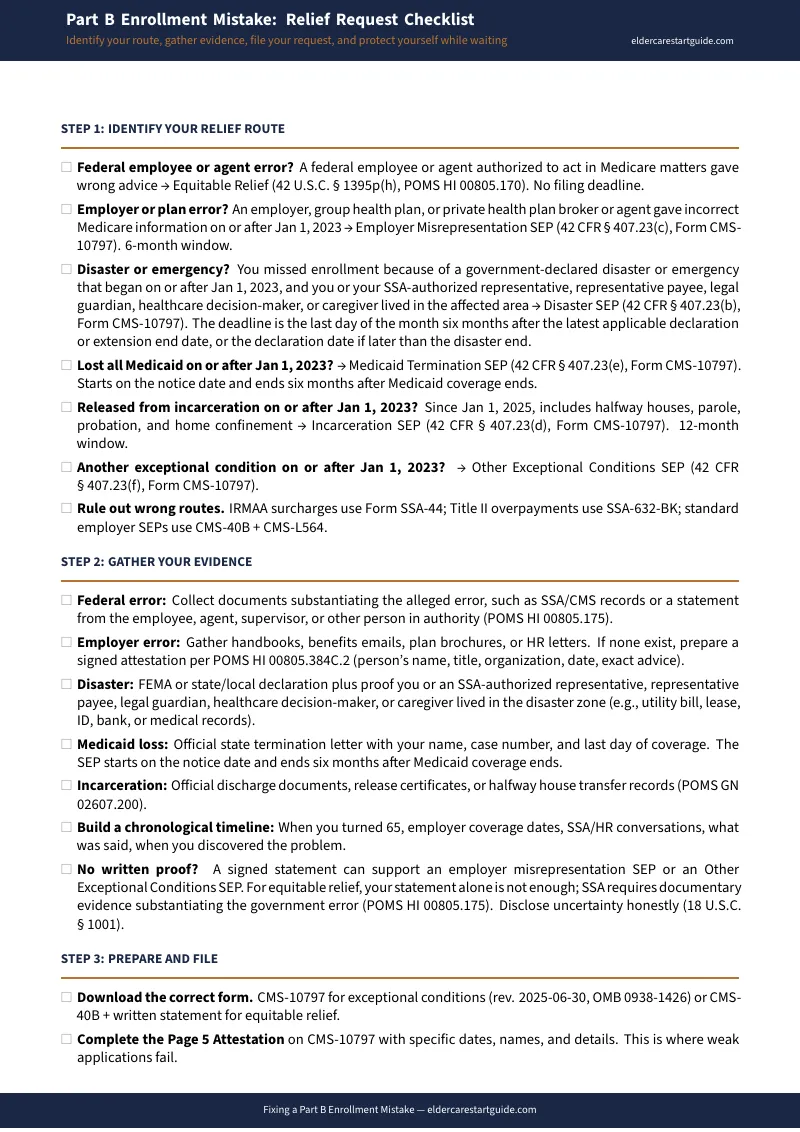
- The Checklist — a condensed reference of relief routes, evidence requirements, deadlines, and free help contacts.
Satisfaction Guarantee
If the guide doesn't help your family navigate the relief process, email [email protected] for a full refund, no time limit. We read every message.
Free Checklist Available
Not ready for the full guide? Download the free two-page checklist — it covers the relief routes, the core evidence each one needs, and contact information for Social Security, SHIP, and the Medicare Rights Center. If the checklist is enough for your situation, that's a good outcome.
Independent educational publication. Not affiliated with, endorsed by, or connected to the Social Security Administration, CMS, HHS, or any government agency.
Frequently Asked Questions
What if the rules change after I buy?
We update the guide when the rules change. Email us any time, even years later, and we'll send you the current edition free.