Half your monthly check is about to disappear — unless you can prove the overpayment wasn't your fault and paying it back would break you
Social Security says they overpaid you — or your parent — and they're taking it back. Under the current default rate (50% of the monthly Title II benefit, since EM-25029 on April 25, 2025), every check is about to get a lot smaller. The notice gives you a dollar amount, a vague reason, and a form number: SSA-632-BK. It does not walk you through how SSA evaluates the two legal tests, how to fill in the financial statement without accidentally making it look like you can afford to repay, or what happens at the personal conference SSA must offer before denying a waiver.
Meanwhile, Form SSA-632-BK is free on ssa.gov, with basic prompts but no step-by-step guide to applying the waiver standards. Legal Aid toolkits are excellent but designed for advocates, not for a retiree or an adult child who has never dealt with POMS citations. And hiring a lawyer for an overpayment waiver — where there's no back-pay to generate a contingency fee — means a retainer of $1,500 to $3,500 out of pocket, which most people facing this problem can't afford.
The Form SSA-632 Workflow: Prove Both Prongs and Get the Financial Statement Right
The Overpayment Waiver Guide is built around the standard two-part test SSA uses for waiver requests. First, SSA decides whether you were without fault by considering whether you gave a statement you knew or should have known was incorrect, failed to provide information you knew or should have known was material, or accepted payments you knew or should have known were wrong. SSA also weighs your individual circumstances. Second, paying it back would either deprive you of money needed for basic living expenses ("defeat the purpose") or be "against equity and good conscience"—for example, because you relied on the payment and changed your position for the worse or gave up a valuable right. Both prongs must hold for this standard waiver route. SSA also has an administrative-tolerance route for some original overpayments of $2,000 or less.
This is not a summary article or a re-packaged form. It is a section-by-section workflow for the form itself — with the narrative framing, expense accounting, and evidence organization that the form does not provide and the free toolkits assume you already know.
What You Get
- Two-Part Waiver Test Explained — how SSA evaluates "without fault" under POMS GN 02250.005, including the individual circumstances that matter (age, comprehension, memory, medical conditions, agency error), and when the second prong is "defeat the purpose" (you can't afford to repay) versus "against equity and good conscience" (for example, when you relied on the overpayment and gave something up)
- Form SSA-632-BK Section by Section — what each field on the current edition asks for, the common mistakes that lead to denials, and how to write the narrative explanation truthfully and completely so SSA's reviewer sees the full picture
- Financial Statement Walkthrough — structured guidance for the income, expenses, and assets sections that catches the expenses people forget: out-of-pocket medical costs, home and vehicle maintenance, insurance premiums, property taxes. Under-reporting these is the most common reason a waiver is denied on the financial hardship prong — it leaves a surplus on paper that makes it look like you can repay
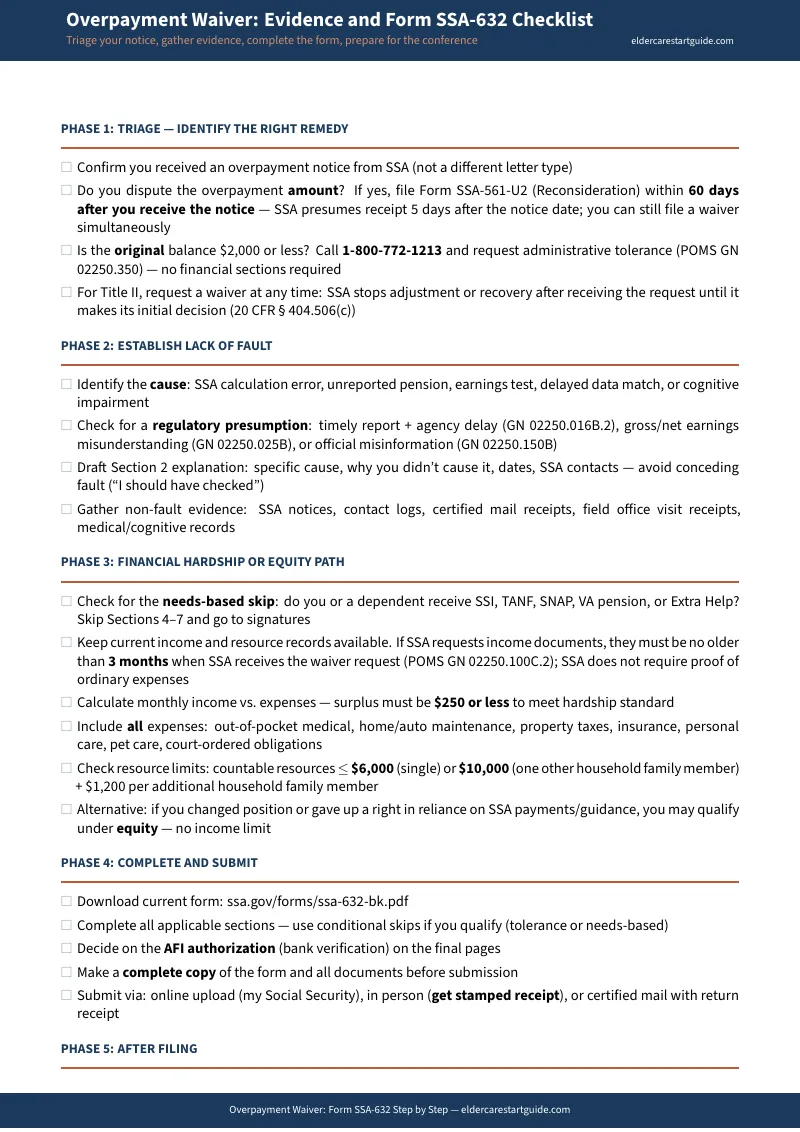
- Evidence Gathering Checklist — the bank statements, benefit letters, medical records, and housing documents that support both prongs, organized by which section of the form they accompany, with a document-tracking worksheet so nothing falls through the cracks
- Administrative Tolerance Chapter — when an original overpayment of $2,000 or less qualifies for a simplified waiver under POMS GN 02250.350 without the full financial statement, and how to request it
- Filing and Proof-of-Delivery System — certified mail tracking, field office receipt logs, and the records that prove when SSA received your request (which matters because a request filed within 30 days of the notice generally pauses benefit withholding until a decision)
- Personal Conference Preparation Kit — what happens at the personal conference SSA must offer if it cannot approve your waiver after initial review (in person, by phone, or video), the right to review the SSA claims file beforehand, how to prepare your case, and what to bring
- After the Decision — what a full or partial denial means, the reconsideration and hearing paths (Form SSA-561 and Form HA-501), and when re-filing a new waiver with updated evidence is an option
- Helper Authority Guide — why a state power of attorney alone does not authorize someone to sign an SSA waiver request, how Representative Payee appointment and Form SSA-1696 work, and what a family member can and cannot do without formal appointment
- Printable Worksheets — a living-expense accounting worksheet that maps to the POMS expense categories, a document-gathering tracker, and a personal conference preparation sheet
Plus: a 23-item action checklist that covers every phase from "read the overpayment notice" through the post-filing options, and three printable worksheets — a living-expense accounting worksheet, a document-gathering tracker, and a personal conference preparation sheet.
Who This Guide Is For
- Retirees on a fixed income who received a demand they didn't cause and need to know whether a waiver is realistic and how to request one correctly — without hiring a lawyer
- Adult children stepping in for a parent who can't complete the form alone because of memory difficulties, health limitations, or limited English — the guide starts at "you've decided a waiver is the right response" and walks through every section
- Representative payees who file on a beneficiary's behalf and need to understand the distinct rules for payee liability
- Anyone who already filed and was denied — the post-decision chapters cover the personal conference, reconsideration, hearing, and re-filing options
Why Not Just Use the Free Form or Call SSA?
Every SSA form is free, and this guide says so on the first page. Legal aid organizations publish excellent overpayment toolkits for people who qualify by income. And calling SSA's 800 number or visiting a field office is always an option — SSA staff will walk through the form's questions and enter the responses.
But the form itself does not explain the fault test or how to frame the narrative. The free toolkits were last updated at different times, mix Title II and SSI rules, and are written for paralegals who already understand POMS. When SSA staff complete the form with you over the phone, they go through its questions and enter your responses. The guide adds a system for organizing expense documentation and structuring the narrative to address the regulatory criteria.
This guide fills the gap between "here's a form" and "here's how to pass both prongs of the test with truthful, complete, well-organized evidence." It is the structured system that keeps the financial statement from accidentally working against you.
Satisfaction Guarantee
If the guide does not deliver what you expected, email [email protected] for a full refund, no time limit. Every purchase also includes the free Evidence and Form SSA-632 Checklist — download it now to get the waiver test, the key sections, and the document list immediately, even before you decide on the full guide.
Get the Overpayment Waiver Guide →
Or download the free Evidence and Form SSA-632 Checklist to start with the waiver test and document list — no purchase needed.
Frequently Asked Questions
What if the rules change after I buy?
We update the guide when the rules change. Email us any time, even years later, and we'll send you the current edition free.