
Your parent needs help. Maryland law says you have no authority to give it.
Your father had a stroke last Tuesday. The hospital discharge planner needs someone to choose a rehab facility by Friday. The bank will not let you access his checking account to pay the mortgage that is now three weeks late. The Maryland Access Point caseworker has a Community First Choice application ready — but she needs an authorized representative to sign it.
You assumed being his adult child was enough. It is not. In Maryland, no family relationship — not spouse, not child, not sibling — automatically grants legal authority over another adult's person or property. Without the right documents, you are locked out of every system your parent depends on.
The Authority Assembly System — Every Maryland Document, Every State System, One Sequence
The Maryland Power of Attorney & Guardianship Kit is not a blank form download. It is a 13-chapter process manual that bridges the gap between Maryland's scattered legal templates and the actual order of operations families must follow — financial POA execution, healthcare advance directive, Medicaid authorized representative forms, guardianship filing, and home care program navigation — sequenced so you do the right thing at the right time.
Free forms exist on four different state websites. None of them tell you which one to complete first, how to execute it under Maryland's specific witness and notary rules, how to force a bank to accept it, or how to connect it to the Medicaid programs that pay for home care. This kit does.
What's Inside
Durable Financial Power of Attorney — the document that prevents lockout
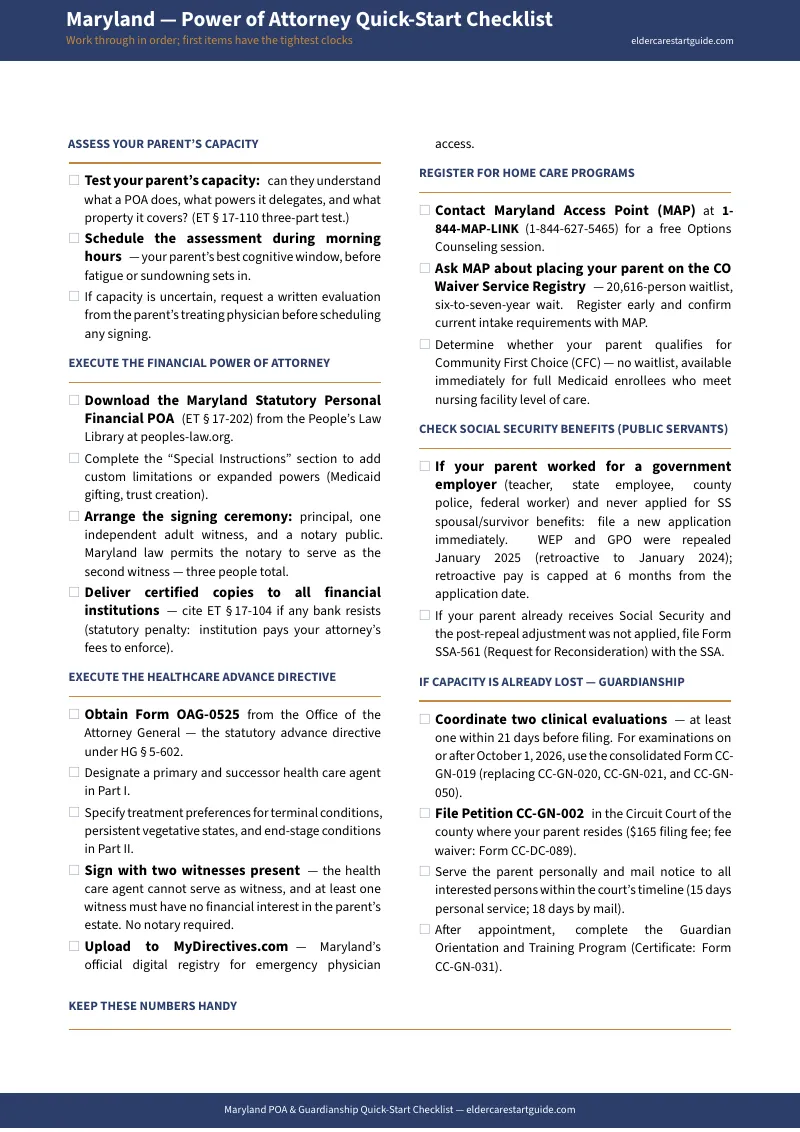
Maryland presumes every written POA is durable by default (ET § 17-101) — your authority survives your parent's incapacity without any special language. The kit walks through the statutory form (ET § 17-202), execution requirements under ET § 17-110, the limited POA option (ET § 17-203), and the Special Instructions section where you customize authority for your family's situation. Plus the critical efficiency most families miss: Maryland allows the notary to serve as one of the two required witnesses, so you need only three people in the room.
Healthcare Advance Directive — because Maryland doesn't use a "medical POA"
Maryland combines healthcare agent appointment and treatment preferences into a single Advance Directive under Health-General § 5-602. The kit covers the powers granted to your healthcare agent — consent, refusal, facility selection, medical records access, end-of-life decisions — and the witness restrictions that can invalidate the document if you get them wrong. Your designated agent cannot witness, and at least one witness must have no financial interest in your parent's estate.
Bank enforcement strategy — ET § 17-104 makes refusal expensive
Banks routinely push their own proprietary forms and reject validly executed statutory POAs. Under ET § 17-104, an institution that unreasonably refuses is liable for all attorney's fees incurred to obtain a court order compelling acceptance. The kit gives you the three-step escalation sequence that resolves most refusals at the compliance stage — before you ever file a motion.
Capacity assessment framework — because a dementia diagnosis is not a legal determination
A dementia diagnosis does not automatically strip your parent of legal capacity. Under Maryland law, capacity is a functional assessment at the moment of signing — can they understand the document, the powers being granted, and the property involved? The kit provides a structured capacity evaluation protocol, lucid interval documentation guidance, and a signing ceremony procedure that creates the evidentiary record you need if the POA is ever challenged.
Medicaid authorized representative pathway — the shortcut that avoids guardianship
If your parent lacks capacity and has no active POA or guardian, Maryland's COMAR 10.01.04.12 lets a family member in good faith use Form OES 015 to act as authorized representative in the Medicaid application process — no court, no attorney, no months of waiting. The kit explains when to use Form OES 015 versus the standard OES 2004 (LTC), how to navigate Maryland Access Point, and how to coordinate with Community First Choice and the Community Options Waiver.
Circuit court guardianship — when the voluntary path is closed
If capacity is already gone and no POA exists, the kit covers the full guardianship process: two medical evaluations, the CC-GN-002 petition, the Show Cause Order, service on interested persons, the court-appointed attorney, emergency guardianship under Maryland Rules Title 10, the surety bond, the 60-day inventory report, annual fiduciary accounts, and the October 2026 form consolidation that eliminates the psychologist's certificate. Including the current $165 filing fee and realistic cost ranges for every stage — because "consult a lawyer" is not a plan when the discharge planner needs an answer by Friday.
Sibling safeguards and record-keeping duties
Under ET § 17-102, every POA agent has mandatory record-keeping duties. Under ET § 17-103, siblings and other interested persons can petition the court to review an agent's conduct. The kit provides structured financial ledgers, co-agent provisions that prevent disputes before they start, and the legal framework for challenging — or defending — an agent's decisions.
Seven printable worksheets
Capacity assessment worksheet. POA signing ceremony protocol. Medical certification tracker for guardianship evaluations. Guardianship filing checklist with every form number and deadline. Medicaid benefit preparation sheet. Sibling transparency ledger. Agency communication log for MAP, CFC, and CO Waiver contacts.
Who This Is For
- Adult children who need to manage an aging parent's finances, medical care, or government benefits in Maryland
- Families watching a parent's cognitive capacity decline who want to execute legal documents before the voluntary window closes
- Caregivers applying for Community First Choice or the Community Options Waiver who need signing authority for the Medicaid application
- Siblings dealing with disputes over a parent's finances who need the statutory accountability and court-review framework
- Families already in the guardianship process who need the filing sequence, form numbers, and cost breakdown in one place
Why Free Forms Are Not Enough
Maryland's statutory POA form (ET § 17-202) is a 17-page legal template. The healthcare advance directive lives on the Attorney General's website. Guardianship forms are on the Maryland Judiciary portal. Medicaid authorized representative forms are buried in the Department of Health's COMAR regulations. None of these systems reference each other. None of them explain the execution sequence, the witness rules, the bank enforcement provisions, or the timing that determines whether your parent needs a $165 POA or a $10,000 guardianship.
Commercial DIY platforms charge more per document and generate national templates that ignore Maryland's specific systems — MAP, Community First Choice, the CO Waiver, the Form OES 015 pathway. They draft a document. This kit gives you the process that makes the document work.
Our Promise
If the kit does not give you a clear path forward for your family's situation, email [email protected] for a full refund — no time limit, no questions.
Get the Maryland Legal Authority Kit —
Or download the free Maryland POA Quick-Start Checklist to see the framework before you commit.