Your Parent Needs Help. Maine Says You Need Paperwork First.
Your father fell last week. The hospital is ready to discharge him, but he cannot live alone anymore. You need to move money from his savings to pay a facility deposit. You need to tell the surgeon what to do about his hip. You need to start the MaineCare application before the 10-business-day assessment window closes.
And every institution you call gives you the same answer: "Are you the authorized agent?"
Without the right legal documents, you are a bystander in your own parent's care. Banks will not let you touch the accounts. Hospitals will not let you make medical decisions. MaineCare will not process an application you sign. The State of Maine draws a hard, bright line between wanting to help your parent and being legally allowed to help them — and crossing that line requires specific instruments executed in specific ways under specific statutes.
The Legal Authority Roadmap — Everything in One Sequence
The Maine Power of Attorney & Guardianship Kit is not a stack of blank forms. It is a complete operational roadmap built specifically around Maine law — Title 18-C of the Maine Revised Statutes, the Maine Uniform Power of Attorney Act, the Uniform Health Care Decisions Act, and the probate court rules that govern your county. It takes every instrument you might need, puts them in the right order, and tells you exactly how to execute each one so it actually works when you present it to a bank, a hospital, or a state agency.
This is the difference between having a form and having a plan. A form from LegalZoom does not tell you that Maine financial powers of attorney are durable by default under § 5-904 — or that certain "hot powers" (gifts, trust changes, beneficiary designations) must be enumerated individually or the bank can legally refuse them under § 5-931. A free advance directive from the Maine Hospital Association does not explain how to coordinate it with a separate DHHS Authorized Representative form so your MaineCare application does not stall. And no generic template tells you what to do when the window for signing has already closed and your only path is the probate court.
What's Inside the Kit
- Durable Financial Power of Attorney — the notary protocol that banks actually accept. Maine only requires a notary acknowledgment (no witnesses) for financial POAs, but the document must specifically enumerate every "hot power" your parent's situation requires. The guide walks you through the § 5-931 hot powers checklist, the notary signing session, the § 5-920 bank acceptance procedure (including the 7-day statutory deadline and the Agent's Certification form at § 5-951), and how to record the document in the county Registry of Deeds if real estate transactions are involved.
- Advance Health Care Directive — medical authority and end-of-life decisions in one document. Maine combines the healthcare proxy and the living will into a single instrument. The guide covers the two-witness execution requirement (the named agent cannot be a witness), the POLST protocol for translating preferences into bedside orders, and how to register the directive with the Maine Health Information Exchange so every hospital in the state can pull it up.
- Fluctuating Capacity Framework — because a dementia diagnosis is not a legal disqualification. Under Maine common law, a parent can sign during a "lucid interval" — a window of clarity where they understand the document and the appointment. The guide includes a clinical-to-legal translation checklist for documenting those moments so the signing holds up against a future challenge.
- Probate Court Guardianship & Conservatorship Sequence — when the voluntary window has closed. If your parent has already lost capacity without executing documents, the guide walks you through the full court pathway: the correct petition forms (PP-201, PP-401, or the joined PP-205), the Guardianship and Conservatorship Plans (PP-502, PP-503), the mandatory physician evaluation (PP-505), the court-appointed visitor process, county-specific filing fees, and the surety bond requirement for estates over $25,000. It also covers emergency appointments under § 5-312 — when a delay in hospital discharge qualifies as "substantial harm" and the court can act within days.
- SSA Representative Payee Application — because the federal government ignores your state POA. Social Security does not recognize any state power of attorney. To manage your parent's Social Security or SSI benefits, you must apply directly to the SSA for a separate Representative Payee designation. The guide covers the application, the dedicated bank account requirement, and the annual accounting obligation.
- MaineCare Section 19 Eligibility Roadmap — clinical assessments, financial thresholds, and the spend-down pathway. The Section 19 waiver pays for personal care services in your parent's home. Qualifying requires passing a Medical Eligibility Determination (MED) assessment run by Acentra Health and meeting strict financial limits — a $10,000 countable asset cap (Maine's $2,000 base plus the $8,000 savings disregard) and a $2,982 monthly income limit. If income exceeds the cap, Maine's medically needy spend-down program offers a second pathway. The guide walks you through the Acentra Health referral process, the 24-hour hospital discharge turnaround and the 10-business-day community timeline, and the complete financial eligibility calculation including spousal impoverishment protections.
- DHHS Authorized Representative Designation — so your MaineCare application does not stall. A financial POA alone does not authorize you to act on your parent's behalf in MaineCare transactions. You need a separate DHHS form. The guide explains how these two instruments work together and how to avoid the administrative delays that catch most families off guard.
Who This Kit Is For
- Adult children who still have time. Your parent is showing early signs of decline — unpaid bills, missed medications, difficulty managing household tasks — but still has the cognitive capacity to sign documents. You want to get everything in place now, before a crisis forces you into the court system.
- Families in the middle of a medical crisis. Your parent was just hospitalized, capacity is fluctuating, and the discharge planner is asking questions you cannot answer. You need to know what documents you can still execute and what timeline you are working against.
- Caregivers whose parent never signed anything. Capacity is gone. The bank will not talk to you. The nursing home wants a deposit you cannot authorize. Your only path forward is probate court, and you need to know exactly what that process looks like in your county — forms, fees, timelines, and alternatives.
Why Free Forms Are Not Enough
You can download blank advance directive forms from the Maine Hospital Association. You can pull probate petition templates from your county court website. You can find generic power of attorney PDFs from half a dozen national legal sites.
None of those resources tell you what to do with the forms. They do not explain how to present a durable POA to a bank manager who does not want to accept it — or that § 5-920 gives you a statutory enforcement mechanism with a 7-day compliance deadline. They do not tell you that your parent's financial POA becomes useless the moment you try to redirect a Social Security deposit, because the SSA operates outside state law entirely. They do not walk you through the Acentra Health assessment process, or explain that Maine's $8,000 savings disregard means your parent can keep $10,000 in countable assets — not the $2,000 that applies in most states.
A blank form is a starting point. This kit is the operating manual.
The Guarantee
If the kit does not give you a clear, actionable path forward for your parent's legal authority situation, email us and we will refund your purchase — no questions, no time limit. You are making a decision for your family during one of the hardest stretches of your life. The last thing you need is to worry about whether a download was worth it.
Get the Maine Legal Authority Kit →
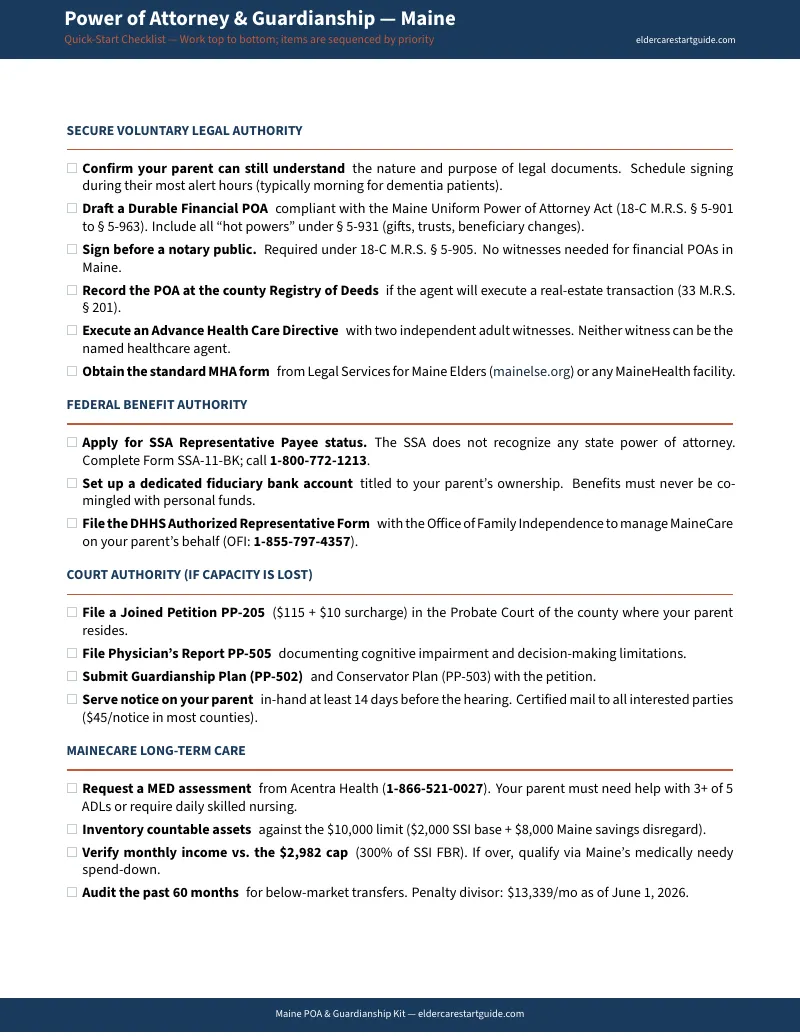
The free checklist gives you a one-page overview of the key steps and instruments. The full kit gives you the complete process — every statute, every form, every agency contact, every financial threshold, in the exact sequence you need them.