
Your Parent Needs Help at Home. Illinois Made the Paperwork Harder Than the Caregiving.
Your parent is struggling with daily tasks — bathing, cooking, managing medications — and you know they need help. But when you search for "home care in Illinois," you find lead-generation sites selling referrals to $35-per-hour private agencies, state portals buried in administrative code, and elder law firms offering $350-per-hour consultations. Nobody gives you the actual steps.
The state split the instructions across the Department on Aging, the Department of Healthcare and Family Services, thirteen Area Agencies on Aging, and a network of Care Coordination Units that most families have never heard of. Each agency has its own eligibility rules, its own phone numbers, and its own intake process. Miss one step and your parent waits weeks longer for services that should start within days.
The Illinois Home Care Navigator System
This guide replaces thirty hours of scattered research with a single, chronological action plan. It maps every pathway to subsidized home care in Illinois — the Community Care Program for state-funded services, the Medicaid Elderly Waiver for federal coverage, and the family caregiver payment framework that lets you earn income while caring for your parent — with the exact eligibility thresholds, application steps, and agency contacts for 2026.
What's Inside
- Community Care Program walkthrough — the state's entitlement program has no waitlist and no income limit, but most families never learn this because the Department on Aging's website buries the fact under seven layers of brochures. The guide takes you from your first call to the Senior HelpLine through the in-home assessment, the 29-point DON score threshold, and the cost-sharing scale.
- Medicaid Elderly Waiver application sequence — the 1915(c) "Persons who are Elderly" waiver delivers the same services through Medicaid, with the $1,330 monthly income limit and the $17,500 asset ceiling. If your parent exceeds the income limit, the Spenddown program works like a medical deductible — the guide shows exactly how to log expenses and submit them to DHS.
- DON assessment preparation guide — the Determination of Need assessment scores your parent across fifteen activities of daily living and measures unmet care needs. The guide explains what the case manager will ask, how to accurately represent functional limitations, and the minimum scoring thresholds that determine how many weekly care hours the state will authorize.
- Family caregiver payment roadmap — adult children, relatives, and since April 2026, spouses can be hired as W-2 caregivers through state-approved agencies. Wages range from $13 to $25 per hour. The guide covers the background check, the mandatory training hours, the agency application process, and the IRS Notice 2014-7 tax exclusion that can make live-in caregiver income federally tax-free.
- Asset protection and spend-down strategy — the $17,500 non-exempt asset limit, the $752,000 home equity exemption, pre-paid burial trusts, the 60-month look-back period, and the spousal impoverishment protections that let the at-home spouse keep up to $143,172 in countable assets and $4,066.50 per month in income.
- Hospital discharge crisis protocol — when a discharge planner says your parent cannot return home safely, the mandatory "Choices for Care" screening under Public Act 89-21 creates a 72-hour window to redirect from nursing home placement to home-based services. The guide walks through the exact sequence.
- Home modifications and free assistive technology — room-by-room safety modifications, the Home Services Program for extensive adaptations, and the Illinois Care Connections program that loans tablets, smart home systems, and mobility aids to qualifying seniors at no cost.
- Power of Attorney action pack — step-by-step completion guides for the Illinois Statutory Short Form Power of Attorney for Healthcare and Power of Attorney for Property, with witnessing requirements that ensure legal validity without attorney fees.
- Six printable planning tools — a CCU document dossier builder, DON assessment preparation worksheet, Medicaid spenddown bill tracker, agency communication log, POA execution checklist, and weekly care logbook. Print what you need, fill it in, and bring it to the appointment.
Who It's For
- Adult children in Illinois helping a parent stay safely at home — whether you are managing care from across town or across the country
- Family caregivers who have reduced their hours or left a job to provide care and want to get paid through the Community Care Program instead of continuing unpaid
- Families facing a hospital discharge deadline who need to evaluate home care options before a parent is placed in a nursing facility averaging $110,595 per year in Illinois
- Middle-class families who assume they earn too much for state help but do not realize the Community Care Program has no income limit
- Families protecting a parent's home from Medicaid estate recovery who need the specific Illinois exemptions before committing to any application
Why Not Just Use the State's Website?
The Illinois Department on Aging publishes brochures. The Department of Healthcare and Family Services publishes eligibility tables. Neither publishes a step-by-step action plan. To figure out what your parent qualifies for, you need to cross-reference rules across three state agencies, locate the correct Care Coordination Unit among thirteen regional offices, and interpret administrative code sections that reference each other in circles.
Lead-generation sites like A Place for Mom and Caring.com will happily give you a "free assessment" — but their business model relies on steering families toward private-pay facilities that pay referral commissions. State-subsidized programs like the Community Care Program generate zero commissions, so these sites barely mention them.
Elder law attorneys provide expert guidance, but at $310 to $350 per hour on average, a comprehensive Medicaid planning session can easily exceed $5,000. If your parent has a complex multi-million-dollar estate, you should hire an attorney. If your parent has a modest home and limited savings, you do not need a retainer to navigate the assessment and enrollment process — you need a roadmap.
Full Refund, No Time Limit
If the guide does not give you a clear path forward, email [email protected] for a full refund. No time limit, no conditions.
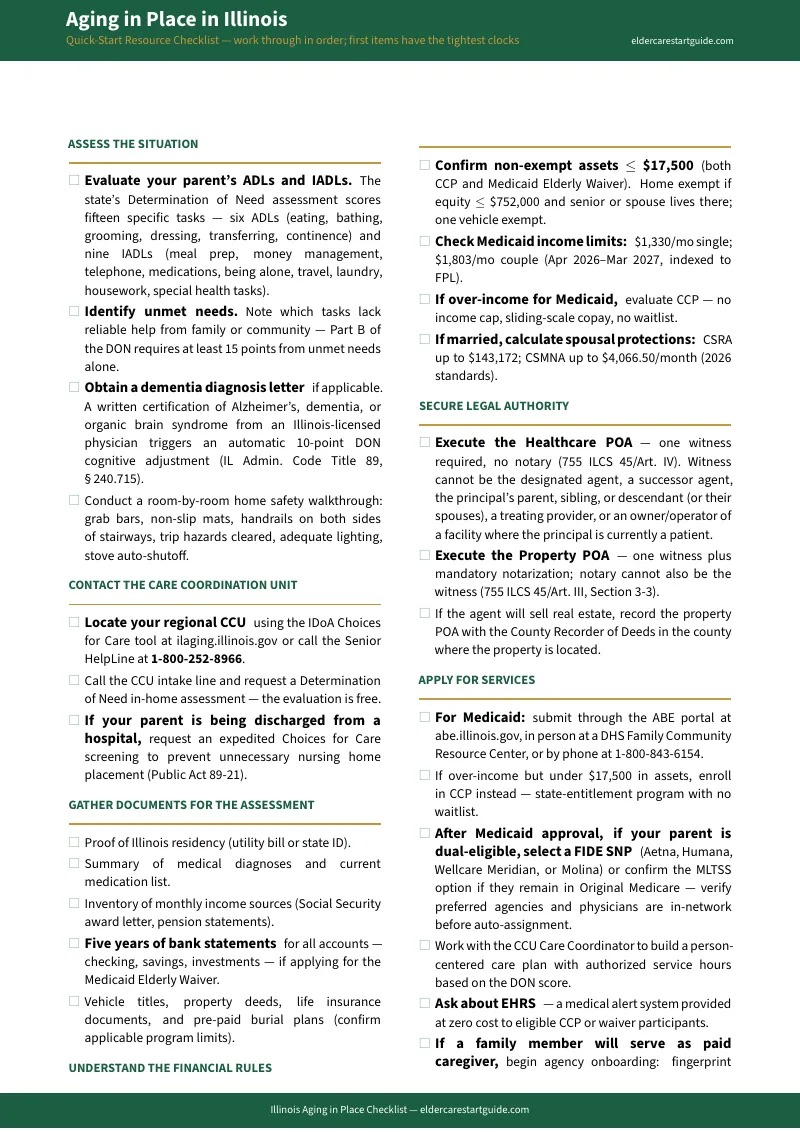
The free checklist shows you what to do. The full guide shows you exactly how — with every phone number, every eligibility threshold, and every form your family needs to keep your parent safely at home in Illinois.