
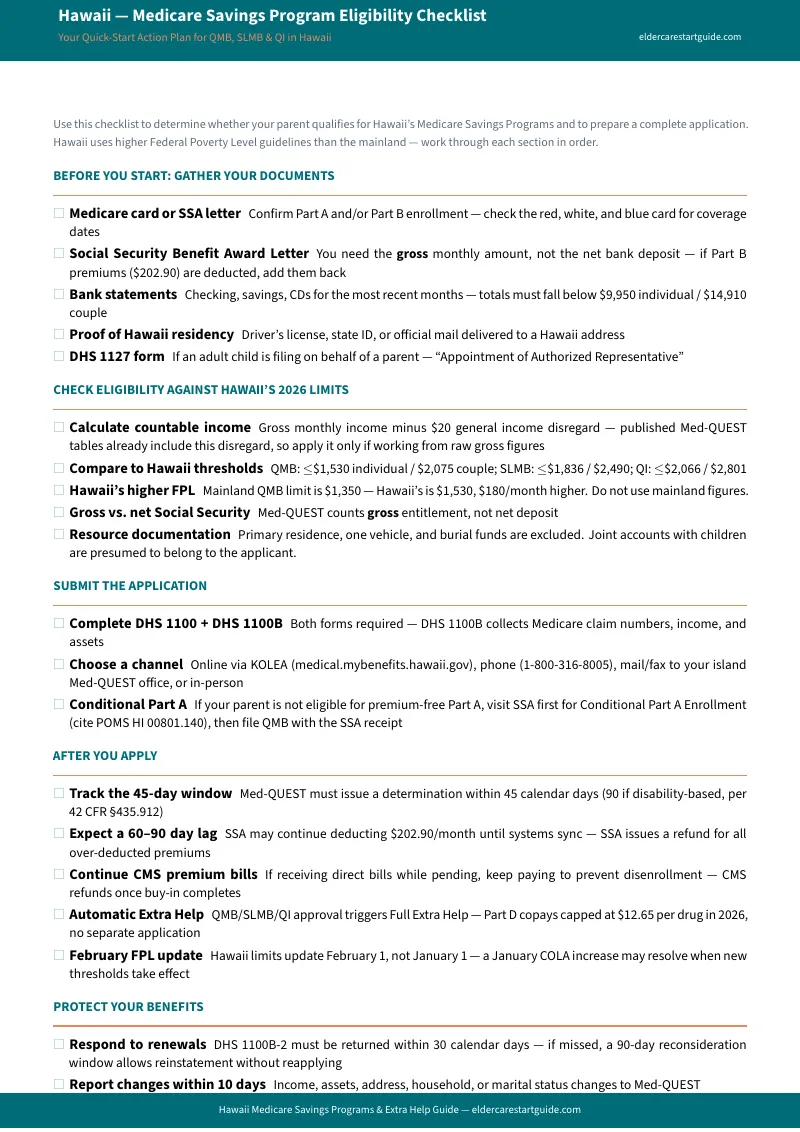
Your parent's Social Security check is $202.90 lighter every month. Hawaii can stop that deduction — but the path through Med-QUEST is anything but clear.
Every month, Medicare takes $202.90 from your parent's Social Security check before they see a cent. On a fixed income of $1,400 or $1,500 a month, that deduction is the difference between paying for groceries and falling behind on everything else.
Hawaii's Medicare Savings Programs can eliminate that deduction entirely — and in the most comprehensive tier, cover deductibles, copayments, and prescription drug costs as well. The state pays Medicare directly through the Med-QUEST Division, and your parent keeps more of their check.
The problem is figuring out how it actually works. The KOLEA portal gives you a login screen and a 16-page form that mixes Medicaid expansion questions with the completely different rules for seniors. The Med-QUEST customer service line routes you through hold queues that eat an afternoon. National Medicare guides publish income limits for the lower 48 states — not the higher limits Hawaii applies. And if you are managing this from the mainland, every step involves a time zone gap, a fax number you are not sure works, and a form your parent cannot fill out alone.
The Hawaii Medicare Cost Recovery System
This guide replaces scattered phone calls, conflicting web results, and guesswork with a single structured process — built for how Hawaii's Med-QUEST Division actually runs these programs, not the generic federal version you find on Medicare.gov.
It covers the full path from checking whether your parent qualifies under Hawaii's higher income thresholds through submitting a complete application, tracking the inter-agency handoff that stops the premium deduction, handling billing disputes with providers, and renewing coverage year after year — including what to do when the state sends a confusing notice or an incorrect denial.
What's inside
- The four-tier eligibility breakdown — QMB, SLMB, QI, and QDWI explained in plain English, with the exact 2026 income and asset limits Hawaii applies. Hawaii's Federal Poverty Level sits roughly 15% above the contiguous states, so a senior earning $1,500/month qualifies for QMB here when they would not on the mainland. Two worked dollar examples show how Med-QUEST caseworkers calculate countable income, including the $20 general disregard that can tip an "over-income" parent below the line.
- KOLEA portal walkthrough and island office route — step-by-step instructions for submitting a complete application through the state's online system (medical.mybenefits.hawaii.gov) or a local Med-QUEST eligibility office. Covers Oahu processing centers, neighbor island section offices in Hilo, Kona, Wailuku, and Lihue, and the phone, fax, and mail channels for when the portal stalls or you are applying from the mainland.
- Document assembly checklist — every proof Med-QUEST caseworkers look for (Social Security award letter, Medicare card, bank statements, pension records, insurance policies), organized in the order the DHS 1100 application asks for them, so nothing comes back marked "verification missing."
- The three-agency timeline — after Med-QUEST approves coverage, your parent's file moves from the state to CMS to the Social Security Administration before the premium deduction actually stops. The guide maps each handoff, the expected wait (60 to 90 days), and exactly who to call when the timeline stalls.
- QMB balance billing shield — federal law prohibits Medicare providers from billing QMB enrollees for deductibles, coinsurance, and copayments. The guide explains how this protection works in practice and what to do when a doctor's office, hospital, or collection agency sends a bill anyway — including the legal citation and the Med-QUEST compliance complaint process.
- Automatic Extra Help enrollment — every MSP approval triggers eligibility for the Low-Income Subsidy, capping Part D drug copays. No separate application is needed. The guide explains what changes at the pharmacy and how your parent's Part D plan updates.
- Part A buy-in for QMB — if your parent does not have premium-free Part A because they lack 40 work credits, QMB can pay the Part A premium through a conditional enrollment process with SSA. The guide walks through how this works so your parent does not have to wait for a General Enrollment Period.
- Renewal, redetermination, and appeals — how to respond to the annual renewal notice (Form N-14 / DHS 1100B-2), what the 90-day reconsideration window means if coverage closes, what Aid Paid Pending does during an appeal, and how to request a fair hearing through the Med-QUEST process under Hawaii Administrative Rules.
- Authorized Representative setup — how to establish legal permission to apply on your parent's behalf and communicate with Med-QUEST caseworkers, including the state disclosure forms and what the designation allows.
- COFA citizens and immigrant eligibility — how Compact of Free Association migrants and legal permanent residents qualify for MSP coverage in Hawaii, and why these programs are explicitly excluded from public charge determinations.
Who this guide is for
- Adult children helping a parent in Hawaii navigate Medicare costs — especially if you are managing from the mainland across a two-to-six-hour time zone gap
- Seniors on a fixed income who want to understand whether QMB, SLMB, or QI can reduce what Medicare takes from their check each month
- Families on the neighbor islands (Hawaii Island, Maui, Kauai, Molokai, Lanai) dealing with limited access to Med-QUEST offices and long mail processing times
- Families who received a confusing notice from Med-QUEST — a denial, a renewal packet, or a request for verifications that does not explain what is actually needed
- Anyone who has been told their parent "doesn't qualify" based on income but has not had Hawaii's higher FPL limits and income disregards properly applied
Why free resources leave the hard parts unsolved
Hawaii SHIP provides free, unbiased Medicare counseling, and their counselors are excellent at eligibility screening. But SHIP does not assemble your document packet, walk you through the KOLEA portal upload process, track the inter-agency handoff between Med-QUEST and Social Security, or help you decode a redetermination notice that arrives without clear instructions. That is not a failing of SHIP — it is outside their scope.
Medicare.gov and BenefitsCheckUp run federal eligibility calculators that publish the lower-48 income limits — not Hawaii's higher thresholds. National Medicare books on Amazon explain the federal program without mentioning KOLEA, the DHS 1100 form, or how Med-QUEST processes verifications on each island. If your parent earns $1,500/month and you check a mainland calculator, you see "over income" when they actually qualify.
An elder law attorney can handle complex Medicaid planning, but retainers in Hawaii start at $1,500 — sensible for nursing home asset protection, not for getting a $202.90/month premium covered.
This guide fills the space between the free screening and the expensive legal consultation: a structured, Hawaii-specific process you can follow on your own.
Satisfaction guarantee
Full refund, no time limit. If the guide does not help, email [email protected] and we will refund it.
Independent educational guide. Not affiliated with CMS, the Social Security Administration, or the Hawaii Department of Human Services. All eligibility thresholds reflect official 2026 federal and state standards.
Frequently Asked Questions
What if the rules change after I buy?
We update the guide when the rules change. Email us any time, even years later, and we'll send you the current edition free.