Your Parent Has Dementia. Hawaii's Care System Has Rules Nobody Assembled in One Place.
Your parent was just diagnosed with Alzheimer's or another form of dementia. The neurologist gave you a pamphlet. The internet returned a thousand pages of contradictory advice. And somewhere between "memory care in Hawaii runs over $11,000 a month" and "Med-QUEST has a $2,000 asset limit," you realized nobody is telling you what to actually do — in what order, under Hawaii's specific rules.
You searched for memory care licensing and discovered Hawaii doesn't issue one — the "memory care unit" your parent tours is legally just a marketing label inside an ALF or ARCH, with no separate state standards for dementia staffing, secure units, or training hours. You called the ADRC and learned the Kupuna Caregivers Program everyone recommends was defunded. You looked at the Med-QUEST application and found seven different forms across two portals, with no guidance on which to submit first or what happens if you list the house wrong.
Meanwhile, the family home sits exposed. The 60-month look-back clock is running. And every week you wait to execute a durable POA is a week closer to the day a Family Court judge decides your parent lacks capacity and you need a full guardianship proceeding instead.
The Hawaii Dementia Care Navigation System
This is not a directory of phone numbers you can find on elderlyaffairs.com. It is the process around the system — the part that elder law attorneys explain for $300 to $500 an hour and that state agency websites never cover.
The guide walks you through every stage of the dementia caregiving journey in Hawaii: from the first 48 hours after diagnosis through Silver Alert registration, legal authority, Kupuna Care enrollment, Med-QUEST financial eligibility, facility vetting, care transitions, and estate recovery protection. Every chapter follows the order these decisions actually arrive — because nobody facing a hospital discharge deadline has time to read chapters out of sequence.
What's Inside
- Immediate Safety — Silver Alert Registration and Wandering Prevention — The exact steps to register your parent with Hawaii's Silver Alert SaferWatch Portal under HRS § 353C-15, install door and window alarms, and set up GPS tracking — because sixty percent of dementia patients wander, and the Silver Alert only works if law enforcement already has your parent's profile on file before the first episode.
- Legal Authority Before Capacity Is Lost — How to execute a Durable POA under HRS Chapter 551E (notarized, effective after incapacity by default) and an Advance Health Care Directive under HRS Chapter 327E. The guide covers the signing requirements — notarization or two qualified witnesses who cannot be healthcare providers, employees, or the designated agent — and explains why waiting even three months can mean the difference between a single notarized document and a $5,000+ Family Court guardianship proceeding.
- Non-Medicaid State and County Support — The Kupuna Care program (age 60+, Hawaii resident, 2+ ADL impairments, not Medicaid-eligible), the county ADRC system with direct phone numbers for each island (Oahu, Big Island, Maui, Kauai), and the critical warning that the Kupuna Caregivers Program (KCGP) — still listed on national directories as providing $210/week — has been permanently defunded. The guide identifies the alternative programs that replaced it.
- Hawaii's Care Facility Types — ALFs, ARCHs, E-ARCHs, and CCFFHs — The licensed categories under HAR Chapters 11-90 and 11-101.1, their capacity limits, staffing requirements, and Medicaid acceptance policies. Special focus on Community Care Foster Family Homes (CCFFHs) — certified for up to three residents, staffed by a live-in licensed caregiver, and required to accept Med-QUEST — which many families on neighbor islands never learn about because placement agencies steer toward their commission-paying partners.
- Facility Vetting System — How to access OHCA inspection reports, what to look for in repeated deficiency citations, and the questions to ask during a tour that the facility's marketing team would prefer you didn't ask — overnight staffing ratios in the secured unit, annual dementia training hours per aide, restraint policies, and their specific discharge criteria when your parent's needs exceed what the license allows.
- Med-QUEST Eligibility — The Spend-Down Advantage — Hawaii is a Section 209(b) "medically needy" state. There is no hard income cap and no Miller Trust requirement. If your parent's income exceeds the $1,530 ABD limit, the excess above the $469 Medically Needy Income Limit becomes a monthly spend-down against medical costs. The guide covers the exact forms (DHS 1100, 1100B, 1167, 1169, 1169A, 8003, 8004), the online portal at medical.mybenefits.hawaii.gov, and the medical expenses that count toward the spend-down — prescriptions, home modifications, private care hours, insurance premiums.
- The 60-Month Look-Back and Asset Transfer Penalties — Any transfer below fair market value during the five years before a Med-QUEST application triggers a penalty period calculated by dividing the transferred amount by Hawaii's average monthly nursing home cost. The guide covers which transfers are exempt (paying off debts, funding irrevocable burial trusts, caregiver agreements at fair market value) and which look innocent but trigger devastating penalties.
- Protecting the Family Home from Estate Recovery — Hawaii's probate-only estate recovery definition means Med-QUEST can only recoup costs from assets that pass through formal probate court. Assets held in joint tenancy, revocable living trusts, or accounts with named beneficiaries generally bypass probate and are protected. The guide includes the specific titling strategies and trust structures that keep the family home out of the estate recovery pipeline — plus the federal exemptions for surviving spouses, caregiver children, and siblings with equity interests.
- Neighbor Island Challenges — Specialized dementia care providers are concentrated on Oahu. The guide covers telehealth strategies, inter-island medical transport coordination, and how neighbor island families can access the same assessment and placement resources without flying to Honolulu for every appointment.
Plus: 7 Printable Standalone Tools
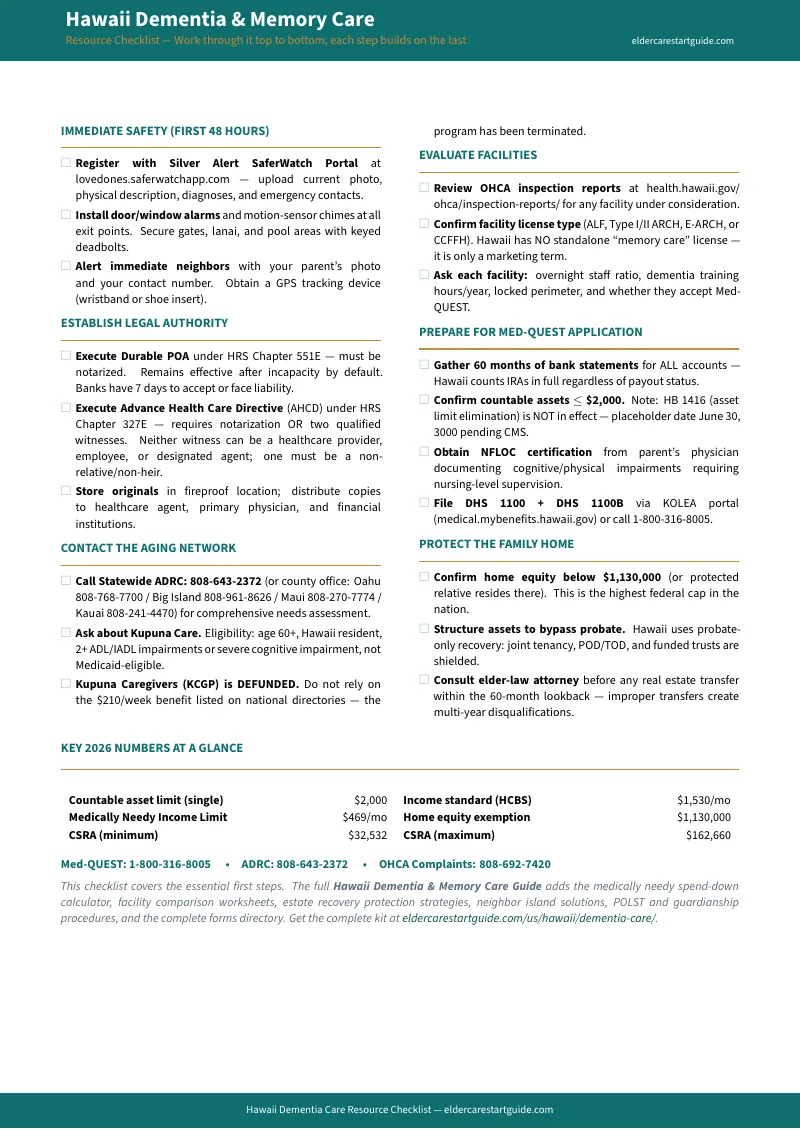
- Quick-Start Checklist (checklist.pdf) — One-page 20-item action list with every threshold, phone number, and deadline at a glance
- First 48 Hours Action Plan (first-48-hours.pdf) — Safety measures, Silver Alert registration, and the legal documents to execute immediately
- Med-QUEST Spend-Down Worksheet (spend-down-worksheet.pdf) — Asset inventory, income calculation, spend-down math, and the list of qualifying medical expenses
- Facility Vetting Checklist (facility-vetting-checklist.pdf) — Complete one per facility: physical environment, staffing ratios, dementia training, Med-QUEST acceptance, and discharge criteria
- Estate Recovery Protection Reference (estate-recovery-reference.pdf) — Probate-only definition, exempt asset structures, federal exemptions, and hardship waiver criteria
- Care Cost Comparison Sheet (care-cost-comparison.pdf) — Median costs by care setting (ALF, ARCH, CCFFH, skilled nursing) and a worksheet for your family's side-by-side comparison
- Resource Directory (resource-directory.pdf) — Every phone number, website, and contact for Hawaii dementia care agencies, courts, ADRC offices, and facility regulators
Who This Is For
- Adult children whose parent was just diagnosed with Alzheimer's or another form of dementia and need to know what to do first — in Hawaii, not generically
- Families on neighbor islands facing the additional burden of limited local specialists and inter-island medical travel
- Caregivers who have been providing hands-on home care and are reaching the point where 24-hour supervision is no longer sustainable alone
- Families trying to protect the family home and savings from Med-QUEST's $2,000 asset limit and post-death estate recovery
- Anyone navigating Hawaii's medically needy spend-down pathway because their parent's income exceeds the $1,530 ABD standard and national guides keep telling them they need a Miller Trust (they don't)
- Families who need to establish legal authority for a parent whose cognitive capacity is declining but still sufficient to sign a durable POA — and understand the consequences of waiting
Why Not Free Government Resources?
The county ADRCs provide intake assessments. The Office of Health Care Assurance publishes inspection reports. The Med-QUEST portal lists eligibility limits.
Here is what none of them provide:
- A step-by-step sequence that tells you what to do first, second, and third — not a directory of agencies to call in no particular order
- The plain-language explanation that Hawaii has no standalone memory care license, so you cannot rely on state regulation to guarantee dementia-specific care standards at any facility
- The asset protection strategies that are legal under Hawaii law, with the specific exemptions and timing rules that distinguish a Med-QUEST-approved spend-down from a penalized transfer
- The probate-only estate recovery definition explained with the specific titling structures that protect the family home — information that elder law attorneys charge $300 to $500 an hour to explain
- The warning that the Kupuna Caregivers Program is defunded, with the exact alternative programs that remain funded through the county aging offices
State agencies administer programs. Elder law attorneys explain them at $300 to $500 per hour. This guide bridges the gap — translating hundreds of pages of Hawaii statutes, administrative rules, and agency procedures into a sequence you can work through in an evening.
Satisfaction Guarantee
If the guide doesn't give you a clearer path forward for your parent's care, email [email protected] and we'll make it right.
— Less Than One Hour of an Elder Law Attorney's Time
An initial consultation with a Hawaii elder law attorney runs $300 to $500. A full Medicaid planning engagement can exceed $5,000. A Family Court guardianship proceeding adds thousands more in filing fees, court-appointed attorney costs, and ongoing reporting obligations.
This guide won't replace an attorney for complex trust litigation or multi-property estate planning. But for the Med-QUEST enrollment, asset mapping, facility vetting, and care transition planning that most Hawaii families need, it covers the process at a fraction of the cost — and if you do need an attorney, you'll walk in with organized records and the right questions instead of starting from scratch.
Start with the free checklist to see if the approach fits your situation. The full guide goes deeper — every threshold, every strategy, every form, every phone number.