
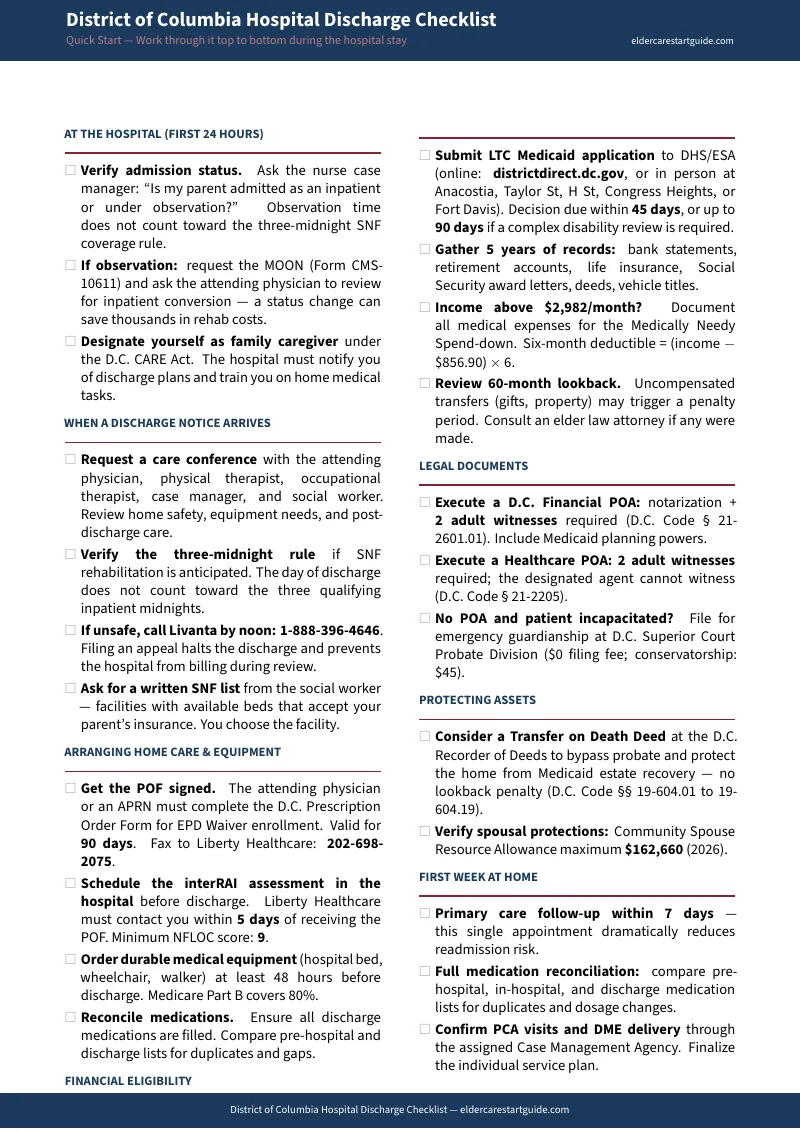
Your parent is in a D.C. hospital bed. The discharge planner just said "tomorrow." You don't know what to do — but you know it's not safe.
There's a specific phone call you can make right now that legally stops the discharge. There's a specific form the hospital is required to hand you that triggers your appeal rights. There's a specific clinical assessment that determines whether your parent qualifies for a home health aide at no cost. And there's a specific deed — a Transfer on Death Deed — that protects the family home from Medicaid estate recovery without triggering any penalty period.
The problem isn't that these protections don't exist. The problem is that they're scattered across DACL, DHCF, Livanta, Liberty Healthcare, the D.C. Recorder of Deeds, and CMS — six different agencies, each with their own portals, PDFs, eligibility rules, and phone trees. Nobody hands you a single roadmap. You're expected to figure it out while your parent is being wheeled toward the hospital exit.
The D.C. Hospital-to-Home Transition Toolkit is the roadmap. It puts every discharge deadline, appeal process, Medicaid eligibility pathway, waiver enrollment step, and asset protection mechanism into one manual — sequenced in the order you'll actually encounter them, from the first conversation with the discharge planner through the final deed recording at the Recorder of Deeds office on Capitol Hill.
What's Inside the Toolkit
The D.C. Discharge Rights System — because knowing you can appeal is useless without knowing the exact deadline and who to call. The toolkit maps the Livanta QIO appeal timeline hour by hour: when to call, what to say, what happens to billing while the independent medical review is active, and how the process differs between Original Medicare and Medicare Advantage. It covers the D.C. CARE Act — the hospital's legal obligation to identify you as the designated caregiver, notify you of discharge plans, and train you on medical tasks before your parent leaves. And it includes the observation status challenge protocol: how to identify if your parent has been classified as outpatient, why that voids the three-midnight rule for SNF coverage, and how to advocate for inpatient reclassification before it's too late.
The EPD Waiver Navigation Roadmap — because the Elderly and Persons with Physical Disabilities Waiver is D.C.'s most powerful home care program, and also its most confusing. The toolkit walks you through the full enrollment pathway: reaching DACL's Information, Referral, and Assistance line, obtaining the Prescription Order Form from a D.C. Medicaid provider, preparing for the Liberty Healthcare interRAI level-of-need assessment, and navigating the ward-based Lead Agency system (Terrific, Inc. for Wards 1/2/4, Iona for Ward 3, Seabury for Wards 5/6, East River for Wards 7/8). It explains the $2,982/month income limit and $4,000 asset limit, the Medically Needy Spenddown pathway for families above the income threshold, and how to calculate your parent's exact monthly spend-down obligation.
The Estate Protection Playbook — because D.C. is a probate-only estate recovery jurisdiction, and most families don't know what that means until an attorney charges them $3,000 to explain it. D.C. Medicaid can only recover from assets that pass through probate. A Transfer on Death Deed recorded with the D.C. Recorder of Deeds bypasses probate entirely — shielding the family home from estate recovery without triggering the five-year transfer penalty. The toolkit covers the exact filing requirements (square, suffix, and lot number), the post-death transfer using Real Property Recordation Form FP-7, and the deferral exemptions for surviving spouses and disabled children. It also explains why panicked asset transfers made without understanding the look-back rules routinely make things worse.
The SNF and Rehab Decision Framework — because choosing the wrong facility or signing the wrong admission contract can cost the family tens of thousands of dollars. The toolkit covers the Medicare SNF benefit period structure (days 1–20 at $0 coinsurance, days 21–100 at $209.50/day, zero coverage after day 100), how to evaluate D.C. facilities using CMS Care Compare data, which admission contract clauses to review — including the "responsible party" language that federal law prohibits facilities from requiring as a condition of admission — and the bed-hold rules that protect your parent's Medicaid-funded bed during temporary hospitalizations.
The Legal Authority Kit — because the hospital will ask who has decision-making authority, and "I'm the daughter" isn't a legal answer. The toolkit covers D.C.'s specific POA requirements: financial Powers of Attorney must be notarized under D.C. Code § 21–2601.05, and Durable Powers of Attorney for Health Care require two adult witnesses — at least one unrelated and not entitled to any portion of the estate. It explains the statutory surrogate hierarchy that applies when no POA exists, and how to establish legal authority before a crisis removes the option.
10 Standalone Fillable Worksheets — print-and-use planning tools for every stage: Discharge Safety Checklist, Medication Reconciliation Worksheet, Observation Status Verification Log, EPD Waiver Eligibility Calculator, Medicaid Application Document Tracker, Medically Needy Spenddown Tracker, SNF Admission Contract Audit, Agency Communication Log, Liberty Healthcare Assessment Prep Worksheet, and Home Safety Modification Planner.
Who This Is For
- The adult child who just got the discharge call — your parent is at MedStar or GW Hospital, the discharge planner says they're leaving tomorrow, and you have no plan. You need the Livanta appeal number, the deadline, and the exact words to say.
- The family navigating observation status for the first time — your parent spent three nights in a hospital bed, but the hospital says it was "observation." Now Medicare won't cover rehab. You need the reclassification protocol and the appeal pathway before the private-pay bills start.
- The caregiver trying to get their parent onto the EPD Waiver — you've called DACL and your ward's Lead Agency, and now you're being told about Prescription Order Forms, Liberty Healthcare assessments, and interRAI scores. You need the enrollment pathway mapped start to finish.
- The family worried about losing the house — your parent may need long-term Medicaid, and you've heard the District will take the home. You need to understand that D.C. only recovers from probate assets, and that a Transfer on Death Deed can protect the property without any penalty.
Why Not Just Google It?
You can find pieces of this information online. The problem is what "pieces" actually means when your parent is being discharged in 36 hours.
DACL's website still lists outdated financial eligibility figures in some sections. DHCF publishes the EPD Waiver rules in dense regulatory PDFs that don't explain the Liberty Healthcare assessment or the Lead Agency intake process. Livanta's website explains the appeal process but doesn't tell you how the timeline interacts with a simultaneous NOMNC appeal at a skilled nursing facility. The D.C. Recorder of Deeds has the Transfer on Death Deed form — but not the step-by-step instructions for calculating the square, suffix, and lot number, or an explanation of how the deed interacts with Medicaid estate recovery.
You could spend 20 hours collecting, cross-referencing, and sequencing all of this yourself. But you don't have 20 hours. You have until noon tomorrow, when the discharge planner comes back.
This toolkit is the 20 hours of research, organized in the order you need it, verified against 2026 D.C. regulations. It's less than a single hour of an elder-law attorney's time — and it covers more ground than that first meeting would.
Satisfaction Guarantee
If the toolkit doesn't help you navigate your parent's transition, email [email protected] for a full refund. No forms, no justification.
Every day without a plan is another day the discharge planner controls the timeline, the observation status goes unchallenged, and the EPD Waiver intake hasn't started.
Get the D.C. Hospital-to-Home Transition Toolkit →
Instant PDF download. Start tonight — the discharge planner isn't waiting.
Already downloaded the free checklist? Upgrade to the full toolkit →