Your parent needs long-term care in Wyoming. The system has answers — buried in 14 different agencies.
Your parent's nursing home bill is $10,114 a month. Their Social Security and pension put them over the $2,982 Medicaid income cap. Wyoming's Division of Healthcare Financing says they're ineligible — unless they set up something called a Qualified Income Trust. Meanwhile, you're trying to figure out what a "LT101 assessment" is, whether the Community Choices Waiver has any open slots, and whether the family ranch is going to be clawed back by estate recovery after your parent passes.
An elder law attorney in Cheyenne or Casper will walk you through all of this — for $300 to $500 an hour. A full Medicaid planning engagement runs $3,000 to $7,000. The state's official website publishes the rules, but not the strategy: it won't tell you how to structure a spend-down, protect the community spouse, or use the caregiver child exemption to shield the family home from Wyoming's expanded estate recovery definition.
The Long-Term Care Navigation System — every rule, every form, every strategy in one manual
The Wyoming Medicaid Long-Term Care & Asset Protection Guide is a 51-page manual that puts every eligibility threshold, every application step, and every asset protection strategy into one document — organized in the order you'll actually encounter them. It replaces the hours spent calling the Division of Healthcare Financing, the County Public Health Office, and the Area Agency on Aging to piece together information they each hold but never connect for you.
This is not a summary of what Medicaid is. It's a sequential action system: what to do first, what to file next, which traps to avoid, and exactly how each dollar of your parent's assets and income will be treated under Wyoming law.
What's inside the guide
- Miller Trust setup kit — Wyoming is an income-cap state. If your parent's income exceeds $2,982 by even one dollar, they're disqualified unless they establish an Irrevocable Income Trust. The guide walks through the trust document, the dedicated bank account, the monthly deposit-and-disbursement cycle, and naming Wyoming as remainder beneficiary — including the exact language Chapter 35 of the Wyoming Medicaid rules requires.
- Spousal asset protection calculator — Wyoming uses the maximum Community Spouse Resource Allowance: the at-home spouse keeps 100% of joint assets up to $162,660. The guide includes the CSRA and MMMNA formulas, the inter-spousal transfer process, and the income allocation rules that let the institutionalized spouse redirect income to bring the community spouse up to $4,066.50 per month.
- Five-year lookback audit guide — Every bank statement, property deed, and financial transaction from the past 60 months will be reviewed. The guide explains the $10,114 monthly penalty divisor, how Wyoming calculates ineligibility periods for past transfers, the critical timing rule that delays penalties until after application, and the exempt transfers (spousal, disabled child, caregiver child) that don't trigger penalties at all.
- LT101 assessment preparation — The County Public Health Nurse evaluates whether your parent needs nursing-home-level care. The guide details which activities of daily living are assessed, how to document your parent's worst-functioning days so the evaluation captures their true clinical need, and which county office to contact for scheduling.
- Community Choices Waiver roadmap — Wyoming's CCW funds home care services for people who qualify for nursing home level of care but want to stay home. The guide covers eligibility, the Participant Direction option (hiring a family member as a paid caregiver), which services are covered versus not (room and board at assisted living is never covered), and how to coordinate with the Fiscal Management Services agency.
- Wyoming Home Services bridge plan — WyHS is a state-funded, non-Medicaid program with county-level budgets and sliding-scale fees. The guide maps each county's provider, shows who qualifies, and explains how to use WyHS homemaking and personal care services to keep your parent safe at home while the Medicaid application processes or a CCW slot opens.
- Expanded estate recovery defense — Wyoming recovers Medicaid costs from joint tenancies, retained life estates, living trusts, and payable-on-death accounts — not just probate assets. The guide details which ownership structures are vulnerable, the mandatory deferrals, the caregiver child and sibling exemptions, and the undue hardship waiver process.
- Complete spend-down strategies — The legal, penalty-free ways to reduce countable assets below $2,000: paying off debt, home safety modifications, prepaid irrevocable burial trusts, medically necessary equipment, vehicle replacement, and home care at fair market value with a written personal care agreement.
- Application process timeline — The dual-track process: financial eligibility through the Long-Term Care Processing Unit (1-855-203-2936), clinical eligibility through your County Public Health Office's LT101 assessment. Every required document, every deadline, every contact number in one timeline.
- Appeals and denial response — Wyoming's strict 20-business-day Fair Hearing deadline, how to file before the effective date to maintain current services during appeal, and the filing address at the Division of Healthcare Financing.
Plus: 10 printable worksheets and planning tools
The guide comes with a complete toolkit of standalone, fillable PDFs — print them, fill them in with a pen, and keep them in the binder alongside your parent's financial records:
- Eligibility calculator — check income and assets against Wyoming's 2026 thresholds
- Miller Trust setup guide — trust document, bank account, monthly ledger, and disbursement order
- Spousal protection calculator — CSRA and MMMNA worksheets with 2026 figures
- Asset inventory worksheet — map every asset before filing
- Five-year lookback audit — document transfers, flag exemptions, calculate penalties
- Spend-down planner — penalty-free strategies with running totals
- Application document checklist — every required document, organized by category
- Estate recovery worksheet — identify exposed assets and applicable deferrals
- Agency communication log — track every call and letter with Wyoming agencies
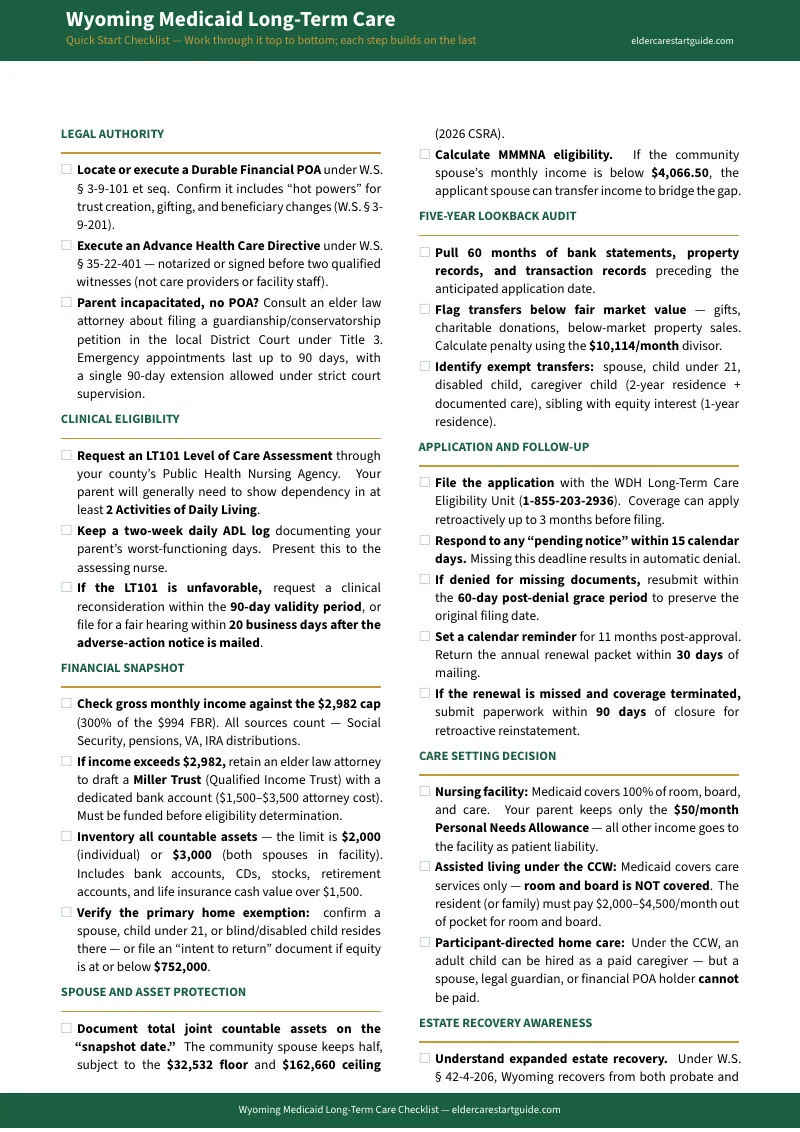
- Eligibility checklist — one-page reference with every critical action item and phone number
Who this is for
- The adult child whose parent just got a nursing home bill. Medicare's skilled nursing days are ending. You need to know who's paying $10,114 a month starting next week. The guide walks you through the crisis-admission sequence.
- The family protecting a home or ranch. Your parent's property has been in the family for decades. Wyoming's expanded estate recovery can reach it after death — but the caregiver child exemption, sibling exemption, and spousal deferrals can shield it if documented correctly.
- The adult child managing the Miller Trust. Your parent's income exceeds $2,982 per month. The guide covers the trust document, the bank account setup, the monthly ledger, and the disbursement order — so the first deposit doesn't trigger a compliance issue.
- The spouse worried about losing everything. Your husband or wife is entering a facility. Wyoming's 100% CSRA rule means you keep up to $162,660 — but you need to know the inter-spousal transfer process and income allocation formula to actually receive the protection.
- The sibling coordinating from out of state. You live in Denver or Salt Lake City. Your parent lives in Sheridan or Rock Springs. You need the phone number for the right County Public Health Office, the right Area Agency on Aging, and the right division at the Department of Health — without driving to Wyoming to find them.
Why the free tools aren't enough
The Wyoming Department of Health publishes the rules. Websites like A Place for Mom and Paying for Senior Care publish overviews. But none of them do what this guide does:
- State portals give you the thresholds — not the strategy. You'll learn that the asset limit is $2,000, but not how to spend down to it legally. You'll see that Wyoming does estate recovery, but not which ownership structures are vulnerable or which exemptions apply to your situation.
- Lead-gen sites capture your phone number, not your problem. National directories like A Place for Mom rank for high-volume searches, but their content is generic, often outdated on Wyoming-specific limits, and designed to route you to a sales call — not to explain the LT101 assessment process or the Miller Trust disbursement order.
- Elder law firm websites explain what they do — not what you can do yourself. Local attorneys publish authoritative content, but it's structured to funnel you toward a paid consultation. The guide covers the same ground for a fraction of the cost — and if you do hire an attorney, you'll arrive organized, which saves billable hours.
100% satisfaction guarantee
If the guide doesn't help you navigate Wyoming's Medicaid long-term care system, email [email protected] for a full refund. No forms, no waiting period.
Get started now
Download the free Wyoming Medicaid Long-Term Care Eligibility Checklist to see the format — then get the full guide for the complete strategy, every template, and every contact you need.
The guide costs less than 15 minutes of an elder law attorney's time. Your parent's care plan shouldn't wait until you can afford a $5,000 engagement.