The Hospital Says Your Parent Is Ready to Leave. You Know They're Not.
Your parent went into Wyoming Medical Center, Cheyenne Regional, Ivinson Memorial, or St. John's Health after a fall, a stroke, or a sudden decline. Now a discharge planner is telling you the acute stay is ending — often within 24 to 48 hours. And you're the one who has to figure out what happens next.
Where do they go? Will Medicare cover rehab? Why does the nurse keep saying "observation"? Can the hospital really send a frail parent home to a house in Riverton or Sheridan that doesn't have a grab bar in the bathroom? What if they need a nursing home — and how would you pay for it without losing the family property?
Hospital social workers mean well, but they work under intense pressure to clear the bed, and they're legally barred from managing your family's financial planning. Wyoming's state portals hand you regulatory definitions, not action plans. Elder law attorneys charge $300–$500 an hour and book out weeks in advance. And the national "senior living advisor" sites are lead-generation funnels that route your phone number to sales advisors earning facility commissions.
The Wyoming Discharge Defense System
This toolkit replaces the panic with a step-by-step system built specifically for Wyoming families — not a national Medicare overview with "Wyoming" pasted in. Wyoming appeal contacts, Wyoming Medicaid thresholds, the Community Choices Waiver process, and Wyoming's specific estate recovery statute, organized in the order a crisis actually unfolds.
It's built for the adult child who became the family's care coordinator overnight — whether you're in Casper, on a ranch outside Lander, or managing everything from out of state while your parent sits in a hospital bed hundreds of miles from home.
What's Inside
Discharge Rights and Appeal Scripts
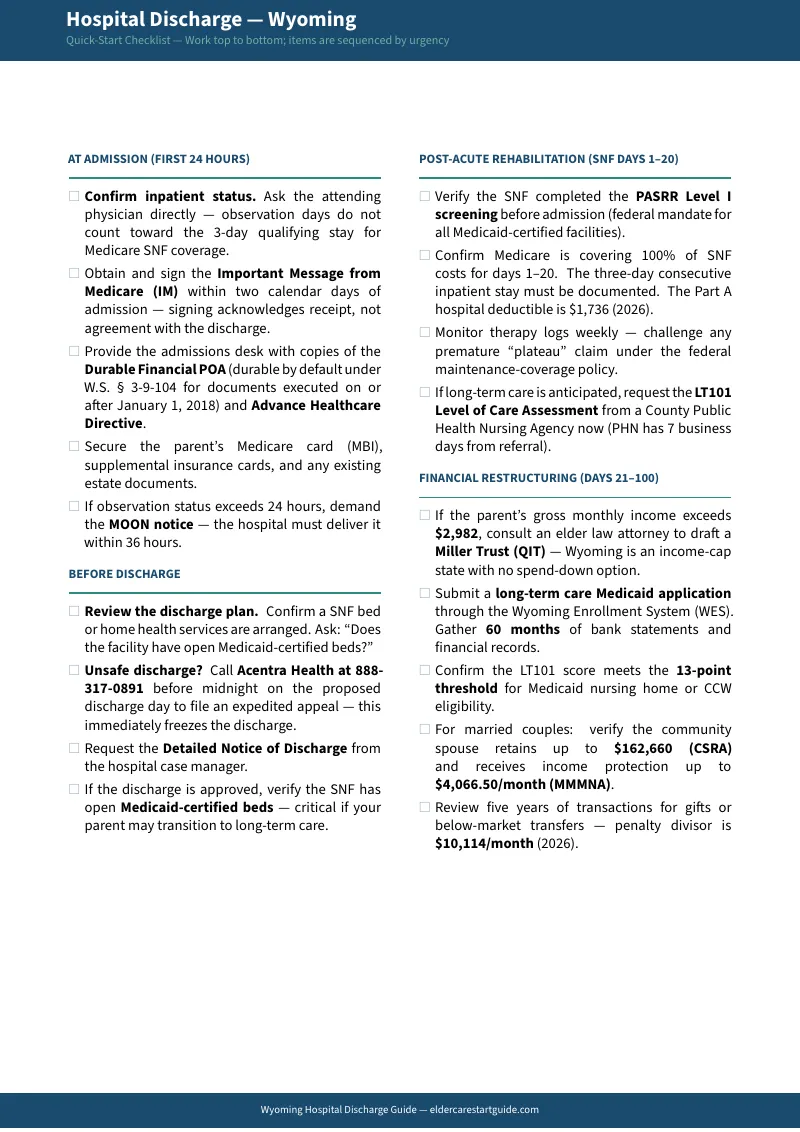
The exact process to challenge an unsafe discharge through Acentra Health, Wyoming's federally contracted BFCC-QIO, including the direct appeal line (888-317-0891), the midnight filing deadline, and the automatic stay that pauses the discharge — and stops the billing clock — while a QIO physician reviews the case. Plus word-for-word scripts for requesting a care-team meeting and a written discharge plan. You cannot be forced to accept a discharge you believe is unsafe.
The Observation Status Trap — and How to Escape It
If your parent spent three nights in a hospital bed but was classified as "observation" instead of "inpatient," Medicare Part A won't cover a single day of skilled nursing rehab — because observation days don't satisfy the three-midnight rule. The MOON notice you were handed is the warning sign. This section explains how to verify status, the script for asking the attending physician to write an inpatient order, and how to appeal the billing designation before a recovery turns into a five-figure out-of-pocket bill.
The "Responsible Party" Strikeout Template
Skilled nursing admissions coordinators routinely push adult children to sign as the "Responsible Party" or "guarantor." Here's what they don't tell you: Wyoming has no filial responsibility statute, and federal law (42 USC § 1396r) bans any Medicaid-certified facility from requiring a third-party payment guarantee as a condition of admission. This section gives you the exact wording to write in the contract margin so you sign solely as agent under Power of Attorney — with zero personal liability.
The Community Choices Waiver Eligibility Workbook
Wyoming's Community Choices Waiver (CCW) funds in-home care, personal care, and home modifications so your parent can avoid a nursing home — but it's capped at approximately 3,500 slots with a waitlist, and eligibility requires a nursing-facility level of care verified by a public health nurse through the LT101 assessment. This workbook walks you through the 2026 Medicaid limits ($2,982/month income cap, $2,000 individual asset limit), what counts and what doesn't, and the participant-directed option that lets you hire a family member as the paid caregiver.
Miller Trust (Qualified Income Trust) Setup Checklist
Wyoming is one of roughly a dozen strict income-cap states — there is no medically needy spend-down for long-term care Medicaid. If your parent's gross monthly income exceeds $2,982, they are categorically ineligible unless you set up a Miller Trust. This checklist covers the bank account requirements, trustee duties, the mandatory state-reimbursement clause, and the requirement to name Wyoming as the trust's remainder beneficiary upon the beneficiary's death.
Spousal Impoverishment Calculator and Protections
When one spouse enters a nursing facility, federal spousal impoverishment rules protect the at-home spouse. The Community Spouse Resource Allowance (CSRA) preserves up to $162,660 in countable assets. The Minimum Monthly Maintenance Needs Allowance (MMMNA) ensures the at-home spouse receives between $2,705.00 and $4,066.50 per month. The workbook guides you through calculating both allowances so the healthy spouse isn't impoverished by the other's care costs.
Estate Recovery Defense Guide
Under Wyo. Stat. § 42-4-206, Wyoming operates an expanded Medicaid estate recovery program that reaches beyond probate to joint tenancies, survivorship deeds, life estates, living trusts, and payable-on-death accounts. This guide explains the sibling exception (documented equity interest plus one year of continuous pre-admission residence), the caregiver child exception (two years of in-home caregiving that delayed institutionalization, with penalty-free transfer under 42 USC 1396p(c)(2)(A)(iv)), and Wyoming's narrow working-farm hardship waiver — with the exact documentation each exception requires.
60-Month Look-Back Audit Log
Every asset transfer your parent made in the five years before a Medicaid application is scrutinized. Gifts, below-market sales, and informal transfers can trigger penalty periods of ineligibility. This structured tracking tool helps you audit five years of bank statements, identify problem transactions, and document fair-market-value sales before they're flagged — because the penalty is calculated after approval, not before, and a surprise disqualification period can leave your parent with no coverage in a facility.
Wyoming Resource Directory
Every contact you'll need on one printable page: the Wyoming Aging Division, ADRC Wyoming (888-425-7138), county Senior Centers, the Long-Term Care Ombudsman, regional Wyoming Home Services (WyHS) providers, and the public health nurses who conduct LT101 assessments — so you can arrange care coordination, home-delivered meals, and in-home support close to where your parent actually lives.
Planning Timeline and Communication Log
Two printable tracking tools that keep the entire process organized. The planning timeline consolidates every deadline — appeal windows, LT101 validity, Miller Trust execution, Medicare benefit period milestones, and court-ordered report schedules — into one master calendar. The agency communication log records every call, email, and meeting with hospitals, state agencies, and facilities, so if a dispute arises about what was said or promised, your documentation is your evidence.
Who This Is For
- Adult children in Wyoming managing a parent's hospital discharge — first time or fifth time, the pressure is the same
- Out-of-state family members coordinating remotely for a parent at Wyoming Medical Center, Cheyenne Regional, Ivinson Memorial, St. John's Health, or a regional facility
- Families facing the observation-status surprise who just learned Medicare won't pay for rehab
- Families approaching Medicaid who need to understand Wyoming's $2,982 income cap, $2,000 asset limit, and the Miller Trust before savings run out
- Families worried about estate recovery — especially ranch and property owners concerned about Wyo. Stat. § 42-4-206's expanded reach
Why Free Tools Don't Cover This
National sites like A Place for Mom and Caring.com maintain big facility directories — but their business model depends on routing your phone number to sales advisors who earn commissions from placements. They won't tell you how to file a Medicare appeal, prepare for the LT101 assessment, or refuse a guarantor signature.
Medicare.gov and AARP explain federal discharge rights accurately — but in abstract language that never connects to Acentra Health's Wyoming phone number, your county's WyHS provider, or the specific Medicaid thresholds that apply here.
Wyoming's own Department of Health and ADRC pages contain the real rules — scattered across dozens of dense administrative pages that are nearly impossible to parse when you're standing in a hospital hallway deciding where your parent will sleep tomorrow.
This toolkit connects those fragmented pieces into a single action plan with the Wyoming-specific details already filled in.
Satisfaction Guarantee
If the toolkit doesn't give you the clarity and confidence to manage your parent's transition, email us for a full refund. No forms, no hoops, no time limit.
— Less Than a Single Hour of Professional Help
A Wyoming elder law attorney charges $300–$500 per hour. A geriatric care manager runs $150–$250 per hour. A Medicaid planner charges $2,000–$5,000 for an engagement. This toolkit handles the procedural and administrative work you can do yourself, and tells you exactly when it's time to bring in a professional.
Download the free Wyoming Hospital Discharge Checklist to start, or get the complete toolkit with the full guide, worksheets, scripts, and Wyoming resource directory.