
Your parent is losing $202.90 every month — and Wisconsin has three programs plus its own drug plan to stop it
That $202.90 Part B premium hits your parent's Social Security check every month before a single dollar reaches the bank. On a gross income of $1,600 or less, it takes more than twelve percent of their cash before rent, groceries, or prescriptions enter the picture. And that is only the premium. Original Medicare's deductibles and coinsurance stack on thousands more each year.
You've heard there's help. But Wisconsin runs its benefit programs through ten regional Income Maintenance consortia — not a single state office. The DHS website lists rules in regulatory language. The ACCESS portal times out. The ADRC counselor has a three-week wait. And every search for "help paying Medicare Part B Wisconsin" lands on a site that wants your parent's contact information for an Advantage plan sales call.
Meanwhile, your parent keeps paying the full premium — possibly for months or years longer than they need to.
The Wisconsin Medicare Cost-Relief System
This is a step-by-step system for cutting your parent's Medicare costs through the programs Wisconsin already funds — without waiting for a counseling appointment, without deciphering CARES notices alone, and without handing personal information to a broker disguised as a benefits checker.
It covers four stacking layers of cost relief that most families handle one at a time (or miss entirely): the Medicare Savings Programs that eliminate the Part B premium and — under QMB — all deductibles and coinsurance; Extra Help that slashes Part D prescription copays; SeniorCare, Wisconsin's own pharmacy assistance program for residents 65 and older that extends drug coverage to incomes well above the MSP ceiling; and the QMB billing protections that federal law guarantees but providers routinely ignore.
What's Inside
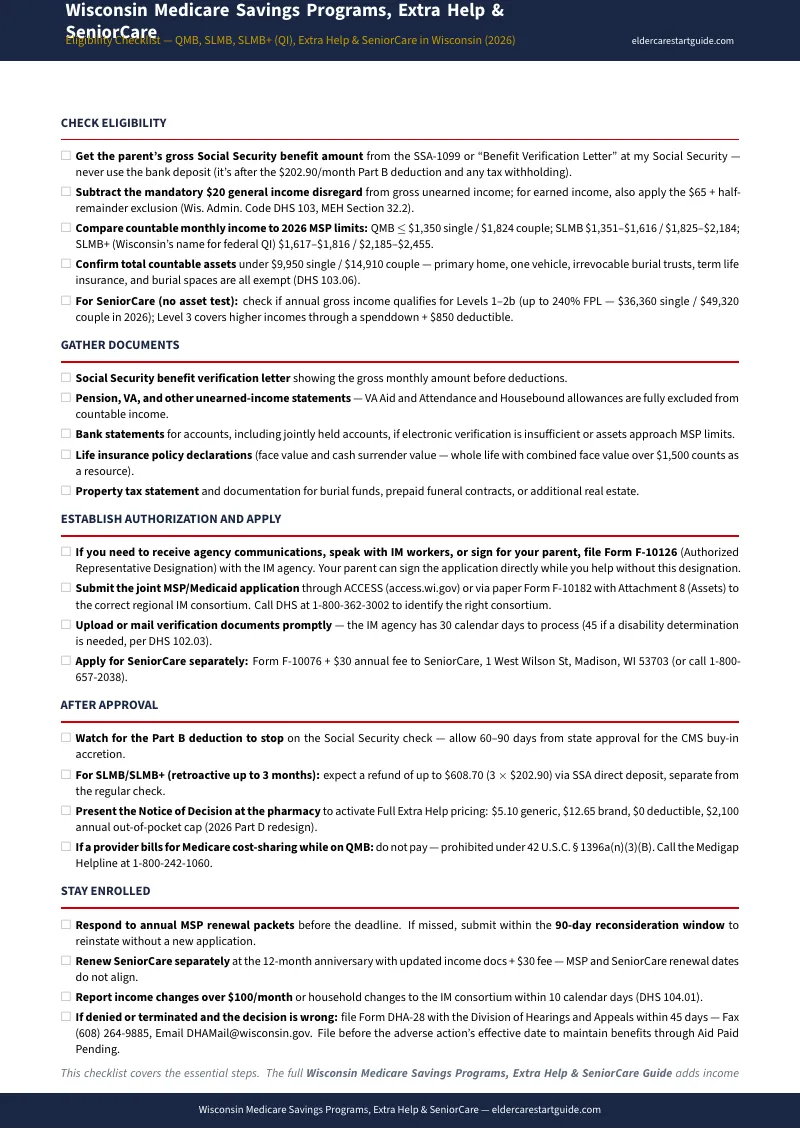
- The 2026 Wisconsin eligibility breakdown — Current income and asset limits for QMB ($1,350/month single), SLMB ($1,616/month), and SLMB+ ($1,816/month) — Wisconsin's name for the federal QI program. Worked income calculations showing exactly how the $20 disregard and earned-income exclusions change who qualifies.
- The ACCESS application walkthrough — Step-by-step filing through Wisconsin's online ACCESS portal and the paper alternative, which documents to gather before you start, and how to avoid verification stalls that delay processing by weeks.
- Income Maintenance consortia directory — Wisconsin processes MSP applications through 10 regional consortia, not one central office. The guide maps every consortium to its counties, its direct call center number, and its fax processing line — so you call the right office the first time instead of spending three days bouncing between DHS, SSA, and your parent's county.
- Authorized representative setup — How to complete Form F-10126 and register as your parent's authorized representative in the CARES system, so the consortium will actually discuss the case with you. Without this form on file, privacy regulations block every phone call and every letter.
- The 60-to-90-day refund tracker — After the consortium approves your parent, Social Security keeps deducting $202.90 for weeks while the state transmits records to CMS and CMS updates SSA. The guide maps this timeline and tells you when to expect the retroactive refund — and what to do if it stalls.
- QMB billing protections — Federal law prohibits Medicare-enrolled providers from billing QMB beneficiaries for deductibles, coinsurance, or copayments. Automated billing systems send those bills anyway. The guide includes the steps to challenge an illegal bill, citing the federal regulation that protects your parent.
- Part A buy-in for seniors without 40 work quarters — Wisconsin is a buy-in state. If your parent lacks premium-free Part A, QMB approval can trigger Part A enrollment at any time of year, outside the normal enrollment windows. The guide walks through this process.
- SeniorCare — Wisconsin's own drug plan — How SeniorCare works across its four participation levels (Level 1 through Level 3), the $30 annual fee, the income thresholds and deductible math at each level, how SeniorCare membership grants a Special Enrollment Period to add or switch Part D plans outside the annual window, and how SeniorCare coordinates with Extra Help and Part D for maximum coverage.
- Extra Help and Part D coordination — How MSP approval automatically triggers full Extra Help, what the 2026 copay caps are ($5.10 generic, $12.65 brand-name), how the $2,100 annual out-of-pocket cap works, and how SeniorCare wraps around Part D for additional protection.
- Renewal system — MSP renewals run through ACCESS on the consortium's annual review schedule. SeniorCare renewals run on a separate annual cycle tied to sign-up month with a $30 fee. Extra Help runs its own redetermination. The guide gives you the dates and documents for each one so nothing lapses because you missed a deadline you didn't know existed.
- Denial and appeal roadmap — How to request a fair hearing through the Division of Hearings and Appeals, the strict 45-day filing deadline, how to request continuation of benefits while the appeal is pending, and what evidence to prepare.
- Estate recovery — what is and isn't at risk — MSP benefits carry zero estate recovery under Wisconsin MEH Section 22.1.8 and federal law. The guide explains exactly which Wisconsin programs can trigger a claim against a home after death and which cannot, so the fear of losing the house doesn't stop your parent from applying for premium relief they're entitled to.
The Complete Toolkit
- 42-page guide — 12 chapters covering every program, every step, and every edge case a Wisconsin family faces
- Eligibility checklist — Confirm qualification for QMB, SLMB, SLMB+, Extra Help, and SeniorCare in minutes
- Eligibility worksheet — Fillable income and asset calculation against the 2026 Wisconsin thresholds
- Application document checklist — Everything to gather before filing through ACCESS or by paper, with separate sections for MSP and SeniorCare
- Agency communication log — Record every call and office visit with IM consortia, SeniorCare, SSA, and providers
- QMB billing dispute letter — Fill-in template citing the federal billing prohibition for challenging illegal balance bills
- SeniorCare spenddown tracker — Track prescription spending against your Level 3 spenddown and deductible
- Premium refund tracker — Monitor the 60-to-90-day SSA reimbursement timeline after approval
- Dual renewal calendar — MSP and SeniorCare renewal dates side by side so neither program lapses
- Hearing preparation checklist — Organize evidence for a State Fair Hearing through the Division of Hearings and Appeals
Who This Is For
- Adult children managing a parent's Medicare costs in Wisconsin — whether you live in the same county or across the country
- Seniors on fixed incomes who are paying the full Part B premium and suspect they shouldn't be
- Families confused by the difference between SLMB+ and QI — and who aren't sure which program Wisconsin actually calls it
- Caregivers who received a confusing CARES notice — a verification request, a termination letter, or a renewal they didn't expect — and need to know what it means and what to do next
- Families helping a parent who earns too much for MSPs but could benefit from SeniorCare's drug coverage at higher income levels
- Anyone helping a parent who lacks 40 work quarters navigate Part A enrollment through QMB
Why Not Just Use the Free Resources?
The free resources are real and they're valuable. Elder Benefit Specialists at ADRCs are excellent. DHS publishes the application forms. The ACCESS portal accepts online applications. Medicare.gov lists the federal rules.
But here's what the free path looks like in practice:
- ADRC counselors carry heavy caseloads — appointment wait times stretch to weeks during Medicare Open Enrollment and after the annual poverty-guideline update, exactly when most families need them
- The ACCESS portal serves MSPs, BadgerCare, FoodShare, and every other state benefit through one shared interface — there is no Medicare-specific workflow, no guidance on which supporting documents to upload, and no explanation of what happens after you click submit
- Wisconsin DHS pages list income limits and regulations but do not tell you which consortium handles your parent's county, what the consortium's direct phone number is, or what to do when a verification request stalls the application
- National explainers use the federal name "QI" for the program Wisconsin calls "SLMB+" — families searching for QI in Wisconsin find nothing on state sites and conclude the program doesn't exist here
- Every search for "help paying Medicare premiums" surfaces insurance lead-gen sites that capture your parent's contact information and route it to an Advantage plan sales call
This guide doesn't replace ADRC counseling — it gets your parent's paperwork organized before the appointment so the counselor's time goes to plan evaluation, not document collection. And when the ADRC isn't available for weeks, the guide lets you file the application yourself without waiting.
Your Purchase Is Protected
Full refund, no time limit. If this guide doesn't help your family's situation, email [email protected] and you get your money back. No forms, no justification.
The guide costs less than a single month's Part B deduction. A successful MSP application saves your parent $2,434 a year in Part B premiums alone — before Extra Help, SeniorCare, and QMB cost-sharing savings are counted.
Get Started
Download the free eligibility checklist to see if your parent qualifies. Ready for the full system? Get the complete Wisconsin Medicare Cost-Relief System — — and start the application this week.
Frequently Asked Questions
What if the rules change after I buy?
We update the guide when the rules change. Email us any time, even years later, and we'll send you the current edition free.