
Your Parent Needs Help at Home. Wisconsin Has Programs That Pay for It — If You Can Get Through the System.
Your parent fell last Tuesday. Or maybe it was the stove left on for the third time, or the unopened medication bottles lining the kitchen counter. Either way, you're the one who noticed. And now you're the one searching at midnight for answers that seem to live across forty different government websites, none of which agree with each other.
You found out Wisconsin has something called an ADRC. You found a phone number. You called and got a voicemail. You heard terms like "LTCFS" and "Income Maintenance consortium" and "functional screen" — and nobody explained how any of them connect or what order to do them in. Meanwhile, private home care runs $30–$34 per hour. Full-time weekday help costs $5,500–$5,700 per month. Round-the-clock care pushes past $15,000. Your parent's savings won't last a year at those rates.
The Wisconsin Home Care Navigation System
This is not a reprint of the DHS website. It is the process around the regulations — the part that $400/hour elder law attorneys walk clients through in billable consultations and that ADRC options counselors, who are required to remain neutral, cannot customize into a family action plan.
The guide covers every step from the first crisis through stable home-based care: establishing legal authority before cognitive decline closes the window, navigating the ADRC functional screen and the separate Income Maintenance financial application, choosing between Family Care managed care and IRIS self-directed care, qualifying for Medicaid under Wisconsin's $2,000 asset limit and $2,982 income standard, getting paid as a family caregiver through IRIS, funding home modifications, and protecting the family home from the Wisconsin Medicaid Estate Recovery Program.
Wisconsin has a structural advantage most families never learn about: Family Care and IRIS are entitlement programs with no waiting list. If your parent meets both the functional and financial eligibility criteria, enrollment is guaranteed. No lottery, no multi-year queue. But qualifying requires documenting functional limitations precisely enough to pass a subjective assessment, navigating a two-track application system that trips up families who assume the functional screen and the financial application are the same thing, and understanding a 60-month look-back period that can disqualify your parent over a gift they made four years ago.
What's Inside
- 10-Day Crisis Stabilization Protocol — Your parent is being discharged and someone mentioned "home care." This section tells you exactly who to call (your county ADRC, find yours at dhs.wisconsin.gov/adrc), what legal documents to execute before your parent's capacity declines, and how to prevent an unsafe hospital discharge while you get the Medicaid process started. Includes every form number: F-00036 for Financial POA, F-00085 for Healthcare POA, F-00060 for the Living Will.
- ADRC and Functional Screen Walkthrough — The Long-Term Care Functional Screen (LTCFS) determines whether your parent qualifies for waiver services. The guide explains how the screener evaluates Activities of Daily Living, what to document before the interview, how to present cognitive impairment that a parent masks during brief assessments, and what happens after the screen. Because here's the part nobody tells you: passing the functional screen does not mean your parent is enrolled. The financial application is a completely separate process through a different agency.
- Family Care vs. IRIS — The Real Comparison — Not the brochure version. Family Care gives you an MCO (My Choice Wisconsin, Community Care, or iCare) that manages everything. IRIS gives you a budget and lets you hire anyone — including yourself. The guide maps the actual tradeoffs: who controls the budget, who picks the workers, what happens if your parent needs residential care later (IRIS doesn't cover licensed CBRFs), and how each program handles the transition if care needs escalate.
- Medicaid Financial Eligibility — Without the Legalese — Wisconsin's $2,000 individual asset limit, the $2,982 monthly income standard, the medically needy spend-down process that eliminates the need for a Miller Trust, and the spousal impoverishment protections that shield $50,000–$162,660 in Community Spouse Resource Allowance. Every exempt asset category, every legitimate spend-down strategy, and the documentation the Income Maintenance consortium actually requests — organized in the order you'll need it.
- Getting Paid as a Family Caregiver — Under IRIS Self-Directed Personal Care, your parent can hire you as a paid caregiver. The guide covers the IRIS Representative rule (the paid caregiver cannot also serve as the representative), the Fiscal Employer Agent payroll process, background check requirements, and how to structure the arrangement so it survives audit. Family Care also permits family-provided care in some configurations — the guide explains when and how.
- Home Safety and Modification Funding — A room-by-room safety assessment followed by the funding map: USDA Section 504 grants (up to $10,000 for seniors 62+ in rural areas), NFCSP funding through the ADRC, Medicaid waiver budget allocations through IRIS or Family Care, and Wisconsin's "Stepping On" falls prevention program (proven to reduce falls by 31%).
- Estate Recovery Shield — Wisconsin's Medicaid Estate Recovery Program reaches further than most families expect. Joint tenancies, life estates, TOD deeds, and revocable trusts are all within WERP's reach under Wis. Stat. s. 49.849. The guide details the Caregiver-Child Transfer Exception, the Sibling Equity Exception, the spousal protections, and the Undue Hardship Waiver — so you understand what's protected before you enroll, not after the state sends a recovery notice.
- Residential Care Transition Map — When home care is no longer safe, the guide compares Community-Based Residential Facilities (CBRFs) under DHS 83 with Residential Care Apartment Complexes (RCACs) under DHS 89. The critical difference: RCACs cap supportive care at 28 hours per week, while CBRFs provide 24/7 supervision. And if your parent is on IRIS, they must transition to Family Care for licensed facility placement.
- Community Resources Directory — Home-delivered meals through the ADRC, Section 85.21 Specialized Transportation assistance, the National Family Caregiver Support Program, the Alzheimer's Family Caregiver Support Program, Benefit Specialist services, and adult day care — with phone numbers, eligibility criteria, and what to request from each program.
Plus: Printable Standalone Worksheets and References
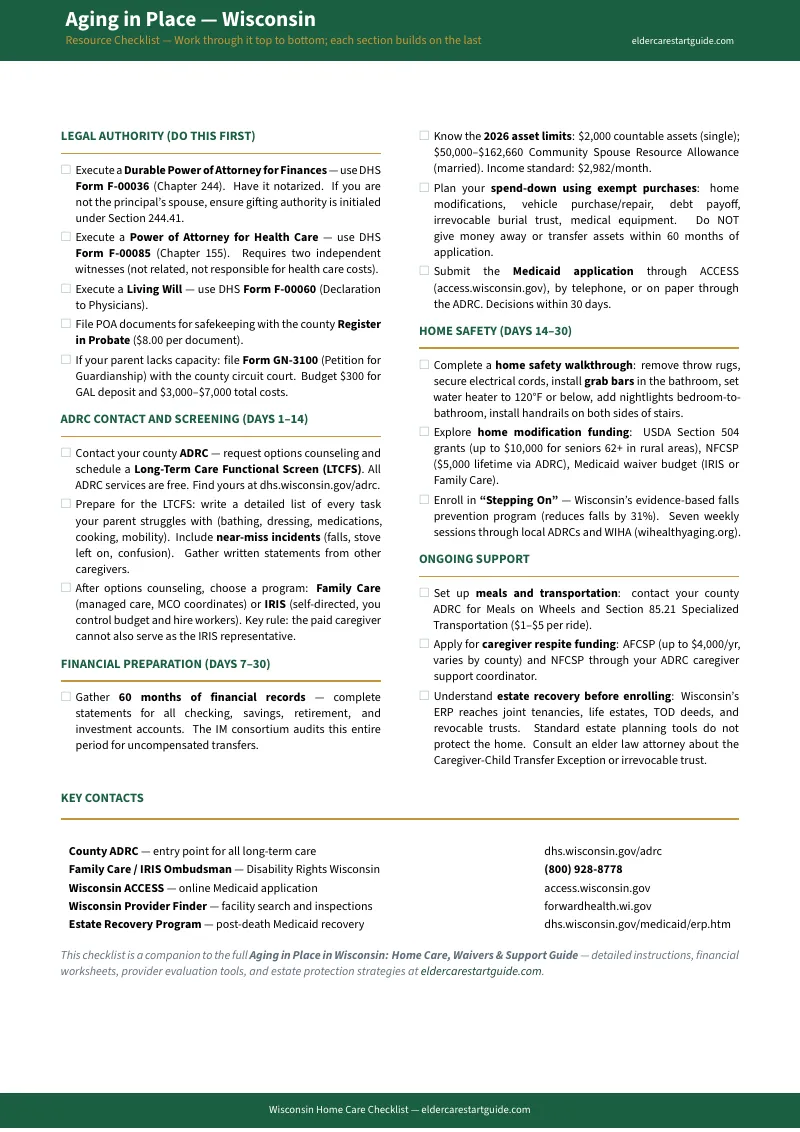
- Wisconsin Aging in Place Resource Checklist — An 18-item action list organized by priority: legal authority documents (Days 1–3), ADRC contact and LTCFS preparation, financial documentation assembly, home safety walkthrough, and ongoing support enrollment.
- Medicaid Asset and Income Worksheet — Tally every countable asset against Wisconsin's 2026 limits, calculate the spend-down amount, and track exempt purchases.
- ADRC Screening Preparation Sheet — Document your parent's functional limitations, near-miss incidents, and cognitive impairment patterns before the LTCFS interview.
- Family Care vs. IRIS Comparison Chart — Side-by-side comparison with decision criteria, service limits, and program transition rules.
- Home Safety Assessment — Room-by-room checklist with modification cost ranges and Wisconsin funding sources.
- Estate Recovery Protection Worksheet — Which asset structures are within WERP's reach and which qualify for exemptions.
- Emergency Care Binder Template — Five-section organizer for medical records, legal documents, financial accounts, benefits information, and daily care logs.
- Spousal Impoverishment Calculator — CSRA and MMMNA calculations, asset allocation tracker, and post-eligibility renewal timeline.
- Caregiver Employment Guide — IRIS provider enrollment steps, FEA payroll setup, background check requirements, and Family Care authorization process.
- Key Contacts Reference — State agency phone numbers, ADRC lookup instructions, and a fill-in directory for your parent's local service providers.
- Official Forms Directory — Every DHS, DOA, and court form number referenced in the guide, with its purpose and where to get it.
Who This Is For
- Adult children whose parent was just hospitalized and someone said "you need to arrange home care" — but private care costs $5,500+ per month and nobody explained how to access the state-funded programs
- Families who need to qualify a parent for Family Care or IRIS but are confused by the two-track system — the ADRC functional screen and the Income Maintenance financial application are separate processes through separate agencies
- Caregivers already providing daily unpaid care who want to get paid through IRIS but don't understand the representative rule, the FEA payroll process, or the background check requirements
- Families planning ahead after an early dementia diagnosis who need to understand the 60-month look-back period, the spousal impoverishment rules, and what WERP can actually recover after death
- Out-of-state siblings coordinating Wisconsin home care remotely with no idea which of the 72 county ADRCs to contact or how to manage the process from a distance
Why Not Free Government Resources?
The DHS publishes eligibility guidelines. Your county ADRC provides free options counseling. The Income Maintenance consortium has an application portal.
Here is what none of them provide:
- A step-by-step LTCFS preparation strategy showing you how to document your parent's functional limitations so the screener sees the full picture — not just the version your parent performs during a 45-minute interview
- A financial eligibility walkthrough that explains which assets are countable, which are exempt, how to spend down legally, and how the spousal protections actually work — not the three-sentence summary on the ACCESS portal
- A Family Care vs. IRIS comparison based on what happens when care needs change, not the enrollment brochure's feature list
- An estate recovery analysis explaining which ownership structures WERP can reach after death and which qualify for statutory exemptions — not a "consult an attorney" footnote
- A caregiver employment framework covering the IRIS representative rule, FEA payroll, background checks, and audit compliance — because getting paid to care for your parent has rules that nobody spells out in one place
Government sites publish regulations. This guide compiles fragmented county, state, and federal rules into a single, sequential process you can follow from crisis to stable home care — without paying an elder law attorney to explain things you can learn yourself.
Your Parent's Safety Net
Every week you spend figuring out the system is a week your parent goes without the funded care they may already be entitled to. Wisconsin is an entitlement state — there is no waiting list. But only if you apply.
Get the guide. Contact the ADRC. Start the clock.
Get the Wisconsin Home Care Guide →
The free checklist gives you the 18-item action list to start immediately. The full guide gives you every chapter, every form reference, every spend-down strategy, and the complete LTCFS preparation framework.