
Washington Has Five Agencies Running Dementia Care — And None of Them Explain How Their Programs Connect
Your parent has been diagnosed with dementia, or the signs are unmistakable — and now you're trying to figure out what Washington State actually offers. You find DSHS, ALTSA, HCS, DDA, and the Health Care Authority, each running separate programs with separate eligibility rules. Community First Choice covers personal care hours but not adult day care. COPES covers adult day care but requires a waiver slot. The Specialized Dementia Care Program pays for memory care inside certain assisted living facilities — but only those with an EARC-SDC contract. The Tailored Supports for Older Adults program serves families who earn too much for Medicaid but can't afford private-pay memory care at $8,229 a month.
None of these programs explain each other. DSHS publishes WAC chapters and PDF manuals written for caseworkers, not for an adult child trying to figure out which application to file first. Free senior placement services will happily match you with private-pay memory care facilities in their network — because they earn a commission on the first month's rent — but they won't mention the Medicaid-funded options, the SDCP contracted beds, or the small Adult Family Homes that charge thousands less per month.
The Washington Dementia Care Navigation System
This guide maps every Washington-specific program, eligibility rule, and application pathway into a single chronological sequence — from establishing durable power of attorney under RCW 11.125 through the CARE assessment, CFC and COPES enrollment, facility vetting, Medicaid financial qualification, and estate recovery protection. Every agency name, asset limit, and legal citation is specific to Washington's 2026 rules.
What makes this different from DSHS portals and national caregiving sites: it connects the systems Washington treats as separate bureaucracies. Your parent's CARE assessment score determines their CFC personal care hours. Their CFC enrollment is a prerequisite for COPES wraparound services. Their COPES eligibility determines whether they can access SDCP memory care beds. Their Medicaid financial qualification requires understanding Washington's medically needy spend-down — not a Miller Trust, which Washington doesn't use. And their estate recovery exposure depends on how the family home is titled. These are not independent processes. The guide shows how each decision flows into the next so you can sequence the applications correctly and avoid the gaps that cost families months of coverage.
What's Inside — 9 PDFs
- The Complete Guide (15 chapters) — covers Washington's dementia care system from initial legal authority through CARE assessment preparation, CFC and COPES program enrollment, memory care facility options and the new E2SSB 5337 certification, SDCP access, Apple Health financial eligibility, the five-year lookback, estate recovery protections, safety planning, abuse reporting, and a step-by-step crisis workflow
- CARE Assessment Prep Worksheet — how the CARE tool scores your parent's ADL and cognitive dependencies, the critical scoring rule, a 14-day ADL care log template to prevent "showtiming," and what the joint historian must cover during the three-hour evaluation
- Medicaid Financial Worksheet — the 2026 Apple Health income cap ($2,982/month), asset limit ($2,000), Washington's medically needy spend-down to $994 (no Miller Trust needed), spousal impoverishment protections including the CSRA and MMMNA, and a fillable asset inventory and income calculation
- Five-Year Lookback Audit — Washington's daily penalty divisor ($462/day), a fillable transfer log with penalty calculator, exempt transfer checklist, and steps to take if penalties apply
- Estate Recovery Worksheet — Washington's probate-only recovery rule, a fillable asset inventory showing what passes through probate, probate bypass methods (joint tenancy, TOD deeds, beneficiary designations), deferral conditions, and DSHS lifetime lien protections
- Facility Tour Scorecard — printable comparison worksheet for three facilities, E2SSB 5337 certification verification questions, staffing ratios, Medicaid acceptance, SDCP contracted beds, discharge criteria, and red flags to watch for
- Safety Planning Fridge Sheet — Silver Alert activation steps, wandering prevention checklist, CFC-funded assistive technology (PERS, GPS, fall detectors), home safety audit, and driving evaluation under RCW 46.20.041
- Crisis Contacts Fridge Sheet — all Washington emergency and support numbers on one printable page: DSHS HCS, Adult Protective Services, Complaint Resolution Unit, Alzheimer's Association 24/7 line, Long-Term Care Ombudsman, and WSP Missing Persons
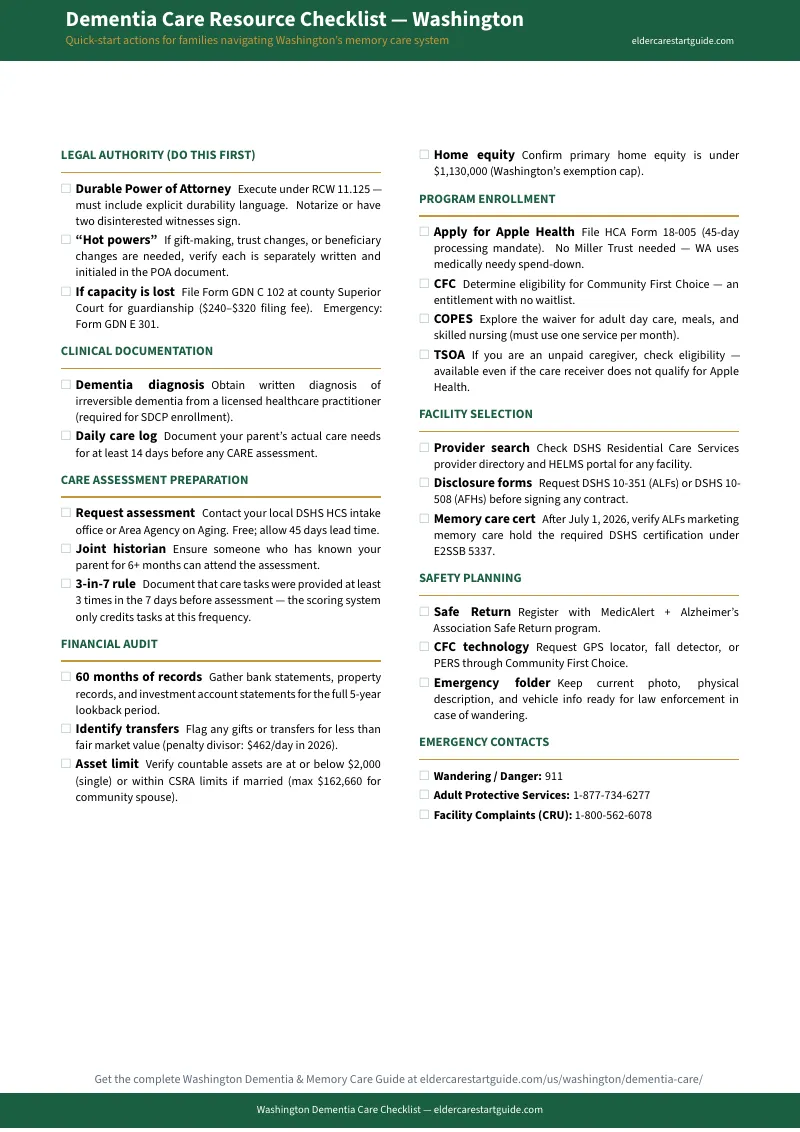
- 20-Item Dementia Care Checklist (free lead magnet) — the essential actions from legal authority through program enrollment, facility vetting, and safety planning in a single printable page
Who This Is For
- Adult children managing a parent's dementia in Washington who need to understand which state programs exist and how to apply for them in the right order
- Families facing a hospital discharge crisis where the parent can't return home safely and a care placement decision must happen within days
- Caregivers whose parent is burning through savings at $8,000+ per month on private-pay memory care and needs to transition to Medicaid-funded options before the money runs out
- Anyone preparing for a CARE assessment who needs to document their parent's real daily deficits and prevent the "showtiming" that causes denials of service
- Families trying to protect the family home and other assets from Medicaid estate recovery after a parent passes
- Out-of-state adult children coordinating care from a distance who need Washington-specific agency contacts, program names, and application pathways — not generic national advice
Why Free Resources Leave You Stuck
DSHS publishes the WAC chapters, program descriptions, and application forms. But these documents are written by compliance officers to protect the state's budget, not to help families secure benefits. You can find the CARE assessment description on the ALTSA website, but you won't find an explanation of which scoring thresholds qualify your parent for CFC versus COPES, what the critical cognitive-impairment-only rule means for nursing-level care determination, or how to document deficits so a "good day" during the assessment doesn't erase months of documented decline.
Free placement services like A Place for Mom and Caring.com will connect you with memory care facilities — the ones that pay them referral commissions. They don't show SDCP contracted beds in smaller facilities, they don't explain that Adult Family Homes often provide more personalized dementia care at lower cost than large ALFs, and they have no incentive to help you navigate the Medicaid application that would eliminate their commission.
Elder law attorneys and certified Medicaid planners provide expert, personalized guidance — at $300 to $600 per hour. For complex asset protection strategies, professional counsel is essential. But you shouldn't be paying attorney rates to learn the basic difference between CFC and COPES, understand what a CARE assessment evaluates, or figure out that Washington doesn't require a Miller Trust. Using this guide to organize your documentation and understand the system before your first consultation can save thousands in billable hours.
Satisfaction Guarantee
If the guide doesn't help you identify at least one program, eligibility pathway, or protection strategy you weren't already aware of, email us for a full refund. No forms, no waiting period.
Navigate Washington Dementia Care with Confidence
Download the free checklist to get the essential action items — or get the full toolkit for and have all 9 PDFs: the 15-chapter guide, CARE assessment prep worksheet, Medicaid financial worksheet, five-year lookback audit, estate recovery worksheet, facility tour scorecard, safety planning fridge sheet, crisis contacts fridge sheet, and the printable checklist.