
Your parent's care costs $8,500 a month. Your savings won't last. The state website won't help you protect what's left.
You just found out that Medicare's 100 days of skilled nursing coverage are ending — or maybe your parent's assisted living savings are draining toward zero. Either way, you're staring at the same problem: how do you pay for long-term care in Utah without losing the family home, the savings your healthy parent needs to survive, or your own sanity navigating two separate state agencies that don't talk to each other?
The Utah DWS website will tell you the asset limit is $2,000. It will not tell you how to get there without making a transfer that triggers a five-year penalty. The DHHS clinical team will assess your parent's care needs. They will not tell you how to coordinate that assessment with the financial application sitting in a different agency's queue. And neither of them will help you protect the community spouse from impoverishment — that's explicitly outside their mandate.
The Utah Care Funding Navigator: a step-by-step system for families who need to act, not just understand the rules
This isn't a summary of Medicaid eligibility requirements you could find on a government website. The Utah Care Funding Navigator is a structured action system that walks you through the exact sequence of decisions, documents, and deadlines that determine whether your family preserves its resources or loses them to administrative mistakes.
It bridges the gap between knowing the rules and executing them — the gap that elder law attorneys charge $300 to $500 an hour to fill for families with straightforward estates that don't need complex legal strategies.
What's inside
- The Dual-Track Application Workflow — Utah splits Medicaid into two agencies: DWS handles finances, DHHS handles clinical assessment. Most families don't realize these tracks run in parallel until one stalls because the other's paperwork is incomplete. The guide maps both tracks side by side with the exact submission points and handoff triggers.
- 60-Month Lookback Audit Prep System — DWS reviews five years of bank statements, property transfers, and asset sales. The guide gives you an organization framework that produces the exact documentation package caseworkers expect, cutting the collection process from weeks of confusion to a structured sequence you can work through in focused sessions.
- Spousal Protection Calculator — Formulas for the Community Spouse Resource Allowance (protecting up to $162,660 in joint assets) and the Minimum Monthly Maintenance Needs Allowance income diversion, with the exact figures DWS uses in 2026. Tells you what the healthy spouse keeps, what gets spent down, and how to document the split.
- Legal Spend-Down Playbook — A menu of state-approved methods to convert countable assets into exempt resources: irrevocable burial trusts, mortgage payoffs, home modifications, medical equipment, debt elimination. Each method includes the documentation DWS requires to confirm fair market value was received.
- Waiver Transition Matrix — Side-by-side comparison of the Aging Waiver and New Choices Waiver: who qualifies, the residency prerequisites (90 days for nursing homes, 365 days for assisted living), the three annual application windows, waitlist realities, and what each waiver actually pays for versus what remains the family's responsibility.
- Estate Recovery Defense Guide — Utah uses an expanded estate definition that reaches beyond probate. The guide explains exactly when the Office of Recovery Services can pursue the home, when recovery is legally barred, and the caregiver child exception that allows a penalty-free home transfer.
- Medicaid Pending Protections Worksheet — During the 45- to 90-day application review, your parent cannot be evicted. The guide includes the formula to calculate the estimated patient liability so you pay the correct amount — not the full private-pay rate that facilities sometimes pressure families into during this window.
- Medically Needy Spend-Down Ledger — Utah doesn't use Miller Trusts for over-income applicants. Instead, the Medically Needy program lets families apply excess income toward care costs. The ledger template shows you how to track, document, and submit monthly medical expenses to DWS using the required process.
Who this guide is built for
You're the adult child — probably the one who lives closest, or the one everyone else assumed would handle this. Your parent is facing a care transition, and you've been handed a stack of acronyms (DWS, DHHS, NFLOC, NCW, CSRA, MMMNA) and told to figure it out.
This guide is for families where the estate is straightforward — a primary home, one vehicle, savings accounts, maybe a small retirement fund. If your parent owns commercial real estate, has business entities across state lines, or needs a Medicaid Asset Protection Trust, the guide tells you exactly when to bring in an elder law attorney (and what to have organized before that meeting so you're not paying legal rates for document collection).
Why free tools fall short
The state of Utah can tell you what the limits are. Government websites publish the income ceilings, the asset thresholds, the waiver eligibility criteria. What they cannot do — and what DWS caseworkers are explicitly barred from doing — is show you how to meet those limits.
They won't advise you on which spend-down methods avoid triggering a lookback penalty. They won't help you coordinate the DWS myCase financial submission with the DHHS clinical assessment timeline. They won't calculate whether your community spouse's income diversion should be $2,705 or $4,067. And national Medicaid planning sites give you templates built for income-cap states with Miller Trusts — tools that don't apply in Utah and represent a waste of time and money if you follow them.
The Navigator was built specifically for Utah's system — the DWS/DHHS split, the Medically Needy program instead of QITs, the NCW application windows, the ORS expanded estate recovery rules. Every worksheet, formula, and checklist references the agencies and processes your family will actually use.
Satisfaction guarantee
If the guide doesn't give you a clearer path forward within the first week, email us and we'll refund your purchase. No forms, no questions beyond "what didn't work?"
Your parent's care transition doesn't wait for you to figure out the system
Every week you spend piecing together scattered advice from forum posts and outdated articles is another week of private-pay charges, another week closer to a waiver application window closing, another week where a misstep in the lookback period becomes harder to fix.
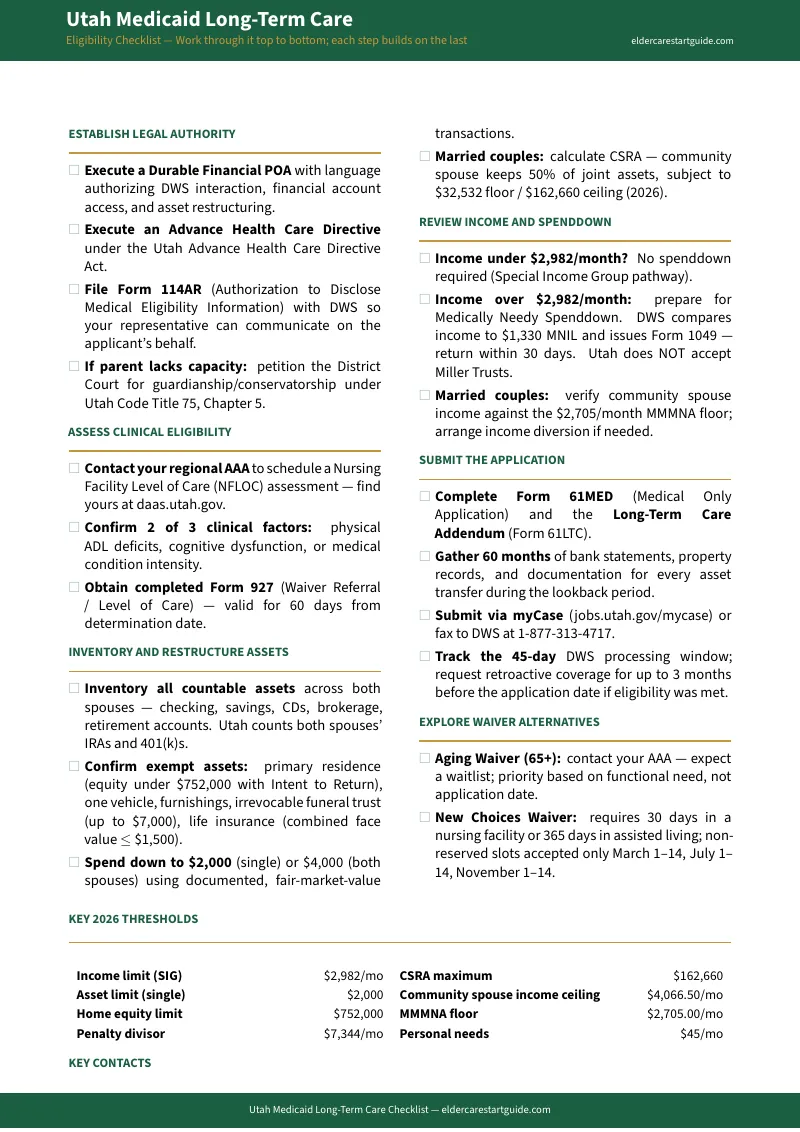
The free checklist gives you the eligibility overview and document list to get started tonight. The full Utah Care Funding Navigator gives you the complete action system — spend-down strategies, spousal protection calculations, waiver applications, estate recovery defenses, and the dual-agency workflow that ties it all together.
Get the Utah Care Funding Navigator →
Or start with the free checklist — it's on this page, no credit card needed.