
Your Parent Is Probably Paying Medicare Costs That Texas Will Cover
Every month, $202.90 comes out of your parent's Social Security check for the Part B premium. On a fixed income in Texas, that deduction can mean choosing between prescriptions and groceries — and when you search online for help, most of what comes up are insurance broker pages designed to sell Medicare Advantage plans, not to help your family file a state application.
Here is what most families never hear: Texas's Medicare Savings Programs can eliminate that premium entirely, and the QMB tier goes further — covering the Part A hospital deductible ($1,736 per benefit period), the Part B annual deductible ($283), and every Medicare coinsurance and copay. A QMB enrollee owes nothing to any Medicare provider beyond what Medicare and Medicaid pay. And approval for any MSP tier automatically triggers the federal Extra Help benefit, slashing Part D prescription drug costs with no separate application.
The problem is not that help does not exist. The problem is that nobody puts Texas's system together in one place. The HHSC website publishes raw income tables without explaining the $20 disregard that could pull your parent under the limit. YourTexasBenefits.com routes every applicant through a generic intake that overwhelms MSP-only families with demands for documentation they do not need. Most applicants download the 19-page Form H1200 — the full Medicaid application designed for nursing home care — when the streamlined Form H1200-EZ is all an MSP application requires. And families who do get approved watch three more months of premiums get deducted while they wait for SSA and CMS to process the buy-in file, with no one explaining why.
The Texas Medicare Cost-Help Navigator
This guide consolidates every layer of Texas's Medicare cost-assistance system — the four MSP tiers (QMB, SLMB, QI, QDWI), Extra Help, and how Texas handles Part D prescriptions without a general state pharmacy program — into a single process you can follow from eligibility check through application, approval, and annual renewal. It is built for the way Texas HHSC actually administers these programs through its MEPD eligibility units, not the way the federal government describes them on Medicare.gov.
If you are an adult child coordinating this from Dallas, Denver, or anywhere across the country for a parent in Texas, or a senior handling it yourself, this is the reference that replaces scattered state websites, outdated web articles, and confusing HHSC notices with one organized workflow.
What the Guide Covers
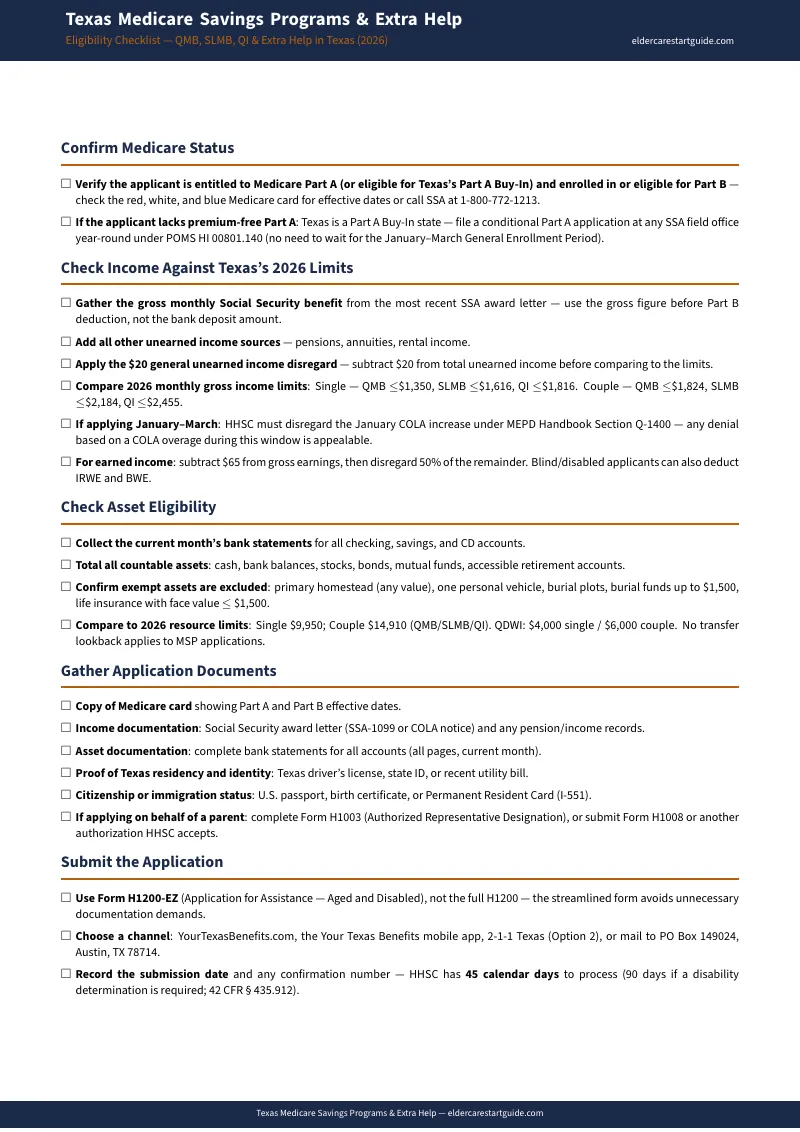
- 2026 Texas income limits with the disregards most families miss — the actual monthly thresholds for QMB ($1,350 gross single), SLMB ($1,616), QI ($1,816), and QDWI ($2,660), with the $20 general unearned income disregard and earned income exclusions worked through in concrete examples that show how a parent who looks over the limit on gross figures can qualify
- 2026 asset limits and exempt property — $9,950 for an individual, $14,910 for a couple, with the primary residence, one vehicle, household goods, and pre-need burial funds up to $1,500 fully exempt. No lookback period and no transfer penalties for MSP applications
- Form H1200-EZ versus the 19-page H1200 — how to use the streamlined MSP application instead of the full Medicaid form that demands nursing-home-level documentation, plus every submission channel: YourTexasBenefits.com, paper mail to the HHSC processing center, fax, and 2-1-1 intake
- Part A buy-in for parents without work credits — Texas is a Part A buy-in state, so a parent without 40 work quarters can enroll in Part A through QMB at any time of year, with no conditional enrollment filing at SSA and no General Enrollment Period wait
- Processing timelines and premium refund tracking — the 45-day HHSC processing clock, how effective dates differ by program, the 60-to-90-day wait for Social Security to stop deducting the Part B premium after approval, and what to do when the refund is stuck
- QMB billing protections with a dispute letter — the federal law that prohibits providers from billing QMB beneficiaries for deductibles, coinsurance, and copays, how the cross-over payment system works, and a ready-to-customize dispute letter for when a Texas medical provider sends a bill anyway
- Extra Help auto-enrollment and Texas drug coverage — how MSP approval triggers deemed eligibility for the federal Part D Low-Income Subsidy with no separate application, and why Texas has no general senior pharmacy assistance program (SPAP) — with the narrow exception of the Kidney Health Care program for end-stage renal disease
- The COLA disregard — January through March protection — how HHSC protects current beneficiaries from losing coverage when Social Security increases benefit payments before poverty guidelines update, and why a denial during this window may be wrong
- Renewals, denials, and fair hearings — the annual redetermination cycle, what must be reported and when, how to read Form H1009 denial notices, the 13-day continued-benefits deadline, and how to request and prepare for a fair hearing
- Estate recovery exemption — why MSP-only benefits are 100% exempt from the Texas Medicaid Estate Recovery Program (MERP) under federal law, and where the exemption ends if a beneficiary later receives long-term care Medicaid
Who This Guide Is For
- Adult children helping a parent in Texas apply for Medicare cost assistance — whether you live in the same city or are coordinating everything remotely from across the state or the country
- Seniors in Texas handling the application on their own and looking for clear instructions instead of dense HHSC handbook chapters and confusing agency notices
- Families who were told their parent earns too much or has too many assets — and want to check whether that assessment used gross figures or the net income after the $20 disregard, and the actual 2026 resource thresholds rather than outdated numbers
- Anyone helping a parent without 40 work quarters who needs to understand Texas's Part A buy-in status and what to say when an SSA representative asks for conditional enrollment that is not required in a buy-in state
- Families dealing with an HHSC denial or discontinuance notice who need to understand the fair hearing process, the 13-day continued-benefits deadline, and where to find free legal help
- Caregivers looking to stack every layer of help — MSP premium coverage, Extra Help for prescriptions, and QMB cost-sharing protections
Why Free Resources Are Not Enough
Texas does have free help available. HICAP counselors provide unbiased Medicare advice through the State Health Insurance Assistance Program (reachable at 1-800-252-9240). HHSC eligibility offices answer general questions. Legal aid organizations handle benefit denials and appeals.
But HICAP counselors cannot fill out Form H1200-EZ line-by-line for your family, organize personal financial records, draft provider billing dispute letters, or track Social Security premium reimbursement checks over multi-month processing periods. Appointment availability at local Area Agencies on Aging can involve significant wait times during peak enrollment windows. National websites publish federal figures without explaining how Texas's income disregards and the COLA protection period change the math. And the first page of every Bing search for "help paying Medicare Part B Texas" is dominated by insurance lead-generation pages designed to capture phone numbers and sell Dual Eligible Special Needs Plans — those brokers earn commissions on plan enrollments, not on helping you file an HHSC application.
This guide is not an insurance company. It does not sell plans, collect health data, or earn carrier commissions. It is an independent, self-paced reference that prepares your family to file a complete application through the right channel, avoid the processing traps that cause months of delay, and manage the ongoing paperwork so the help does not lapse.
What You Get
The download includes the full guide, the eligibility checklist, and 4 standalone printable tools — 6 PDFs total:
- The full guide — 48 pages covering eligibility under Texas's 2026 income and asset limits, the Form H1200-EZ application process, every submission channel, Part A buy-in, processing timelines and premium refund tracking, QMB billing protections with a dispute letter template, Extra Help auto-enrollment, the COLA disregard, renewals, denials, fair hearings, estate recovery, and key contacts including HICAP, legal aid, and HHSC resources
- The eligibility checklist — a printable 2-page action list you can work through in one sitting to determine eligibility, gather documents, and submit the application
- Application document checklist — every document Form H1200-EZ requires, organized by category with checkboxes
- Application submission tracker — logs the filing date, channel, confirmation number, key deadlines (45-day processing clock, Form H1020 response window), and post-approval milestones
- QMB billing dispute letter — a ready-to-customize letter citing federal law to stop improper balance bills from medical providers
- Agency communication log — a dated log for recording every call and visit with HHSC, SSA, HICAP, and billing departments
Satisfaction Guarantee
If the guide does not help your family navigate Texas's Medicare cost-assistance system, email [email protected] for a full refund — no time limit, no questions.
Get Started
Download the free eligibility checklist to see if your parent qualifies. If you are ready for the full process — the Form H1200-EZ walkthrough, Part A buy-in navigation, billing protections, renewal management, and appeal strategy — get the complete guide for less than what one month's Part B premium deduction costs your parent.
Frequently Asked Questions
What if the rules change after I buy?
We update the guide when the rules change. Email us any time, even years later, and we'll send you the current edition free.