
Your parent's bank rejected the power of attorney — and Social Security won't accept it either
The bank compliance officer said no. The Social Security agent said a power of attorney does not appoint you as representative payee. Your parent has dementia, or had a stroke, or is declining in ways that make managing the monthly check impossible — and the legal document you paid an attorney to prepare does not give you the SSA authority needed to receive and manage that benefit.
Federal law requires a separate appointment. You must apply with Form SSA-11-BK and complete an interview with SSA — usually face-to-face at a field office. When a criminal background check applies, SSA asks the applicant for permission and runs the check through eRPS. The agency evaluates candidates under its preference hierarchy. If you show up without the right medical evidence, stumble on the criminal-history screening questions, or set up the bank account wrong afterwards, the whole process stalls — and your parent's bills keep piling up.
The Payee Appointment System: Every Step from "They Need a Payee" Through the First Year of Managing the Benefit
The Representative Payee Guide is built around the full arc — from recognising that a power of attorney won't work, through the application and interview, to the spending rules and record-keeping that govern your first year as payee. This is not a summary article or a list of phone numbers. It is a 13-chapter process guide with printable worksheets, banking scripts, and tracking templates that turn a confusing federal process into a clear sequence of steps.
What You Get
- Capability Evidence Guidance — how SSA evaluates whether your parent needs a payee, including the medical evidence standard (Form SSA-787), lay evidence from family members, and what happens when a court has already declared incapacity; with practical advice on approaching a busy physician's office for a timely capability statement
- The Form SSA-11-BK Interview, Step by Step — what the field office technician asks, the identity documents to bring, the criminal background check through eRPS when required and with permission, the criminal-history screening under the Strengthening Protections for Social Security Beneficiaries Act of 2018, and the creditor and income questions SSA asks
- SSA's Preference Hierarchy — the regulatory order that determines who gets appointed (a spouse, parent, or adult child with custody or strong concern shares the top preference category), how to position your application when a sibling also wants to serve, and what happens when no family member qualifies
- Disqualification Bars and Background Checks — SSA's disqualification bars include Social Security Act §§ 208/811/1632(a) convictions, listed fugitive-felon warrants, payee-related fraud, and Section 202 felonies under the Strengthening Protections for Social Security Beneficiaries Act of 2018 such as robbery, government-assistance fraud, forgery, and identity theft; the Section 202 bars have exceptions for specified custodial relatives and guardians, certain previous parent payees, and people granted presidential or gubernatorial pardons for the conviction; what the eRPS screening looks for; and how to address a historical record before the interview
- Bank Account Titling That Actually Complies — the POMS-compliant account title ("Beneficiary Name by Payee Name, Representative Payee"), why a standard joint account fails, the narrow checking-account exception for some co-residing parent or spouse payees, and a script to hand the bank teller when they insist on setting up a POA account
- Spending Rules from Day One — what counts as current maintenance (food, shelter, clothing, medical, personal needs), how to handle saved benefits, the Personal Needs Allowance when a parent enters a facility, and a first-30-day administrative calendar so the transition doesn't start with missed payments
- Reporting Obligations and the Cost of Missing Them — what changes you must report to SSA, the timeline for reporting, and the consequences of failing to report — including potential personal liability for misused benefits
- Annual Accounting Primer — who must file, who qualifies for an exemption, what records to keep, and the monthly ledger template that makes the annual filing straightforward when it arrives at the end of your first year
- Advance Designation — how a beneficiary can name up to three preferred payee candidates through SSA while they still have capacity, so the family isn't scrambling if the need arises suddenly
- Authority Boundary Comparison — a side-by-side map of power of attorney, representative payee, VA fiduciary, OPM annuitant payee, Railroad Retirement Board substitution, and court guardianship — so you know exactly which instrument controls which income source
- Printable Worksheets — SSA-11 Interview Preparation Checklist, Medical Evidence Request Cover Letter, Bank Account Setup Script, First 30 Days Setup Calendar, Monthly Benefit Allocation Ledger, Agency Communication Log, Lay Evidence Incident Log, Change Reporting Tracker, and Capability-and-Authority Decision Map
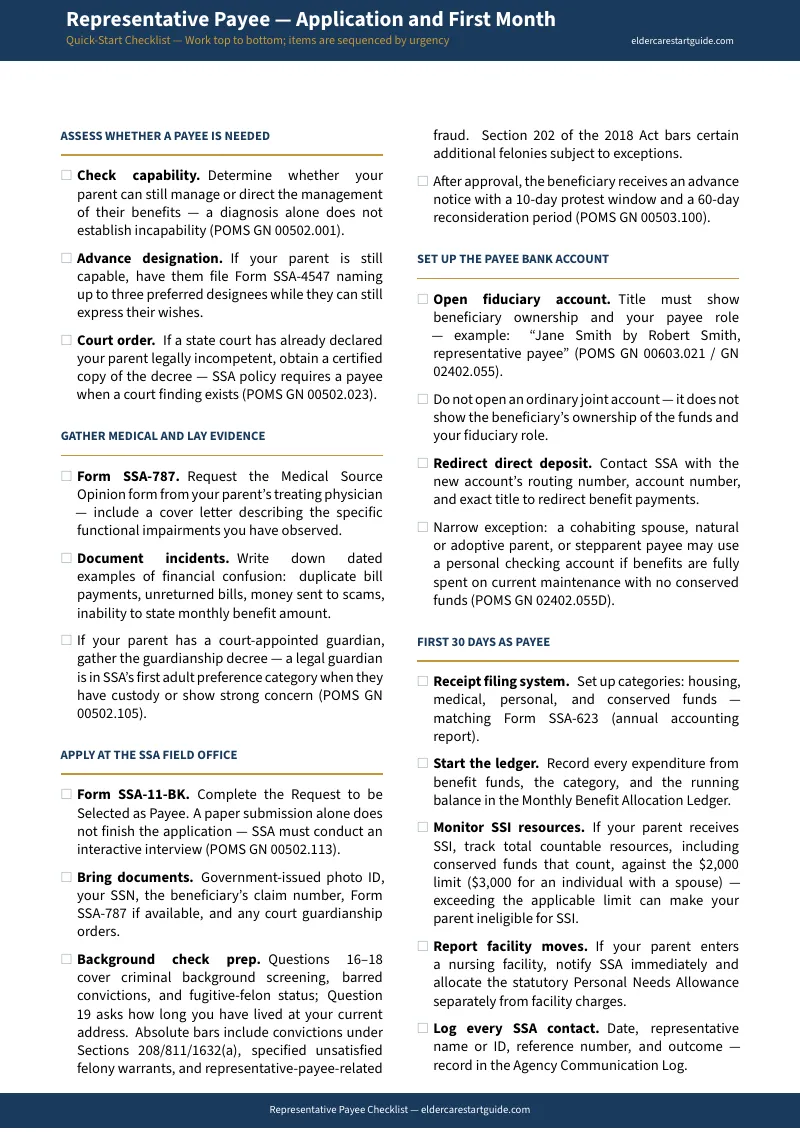
Plus: a printable 24-item application and first-month checklist — download it free, no purchase required.
Who This Guide Is For
- Adult children whose parent can no longer manage the monthly benefit — whether the trigger was a dementia diagnosis, a stroke, a hospital stay, or a slow decline that finally reached the point where bills are going unpaid
- Families preparing for the field office interview who don't want to show up without the right documents and face a return visit that delays the appointment by weeks
- Caregivers setting up the payee bank account who keep getting conflicting instructions from their local branch about how to title it
- Siblings figuring out who should apply — especially when more than one person wants to serve and nobody knows how SSA's preference hierarchy works
- Out-of-state adult children coordinating a parent's finances remotely, who need a tracking system for spending, receipts, and reporting from day one
- Families whose parent is entering a nursing facility and needs help separating the facility payments from the Personal Needs Allowance
Why Not Just Read SSA's Website or Call the Office?
Every SSA form is free, and this guide says so plainly. SSA's Guide for Representative Payees (Publication EN-05-10076) covers the rules. Legal aid organisations publish excellent toolkits for overpayment disputes. The guide cites all of these and tells you where to find them.
But the official materials state the rules without walking you through execution. They don't include a pre-interview document checklist, a banking compliance script you can hand to a teller, a first-30-day calendar, or a monthly ledger template that matches the annual accounting categories. Legal aid toolkits focus on crisis debt defence after an overpayment — not on the initial application. And field office staff answer policy questions but cannot coach you through physician cover letters or sibling disagreements about who should serve.
This guide fills the gap between "here are the regulations" and "here is what to do, in what order, with the worksheets to prove it was done right." It is the organised system that keeps the application moving and the first year's records clean.
Satisfaction Guarantee
If the guide does not deliver what you expected, email [email protected] for a full refund, no time limit. Every purchase also includes the free Application and First-Month Checklist — download it now to get the key steps immediately, even before you decide on the full guide.
Get the Representative Payee Guide →
Or download the free Application and First-Month Checklist to start with the essential steps — no purchase needed.
Frequently Asked Questions
What if the rules change after I buy?
We update the guide when the rules change. Email us any time, even years later, and we'll send you the current edition free.